Seeing the Qualities of Energy of the Grahas through the Shapes of Their Special Aspects
Every graha looks across the chart at the house opposite it. Three of them — Maṅgala, Guru and Śani — are given a second and a third look that belongs to no one else. Put those looks on a circle and join the points, and you get three triangles. One of them is perfect. One of them leans forward. One of them does not contain the centre of the wheel at all.
रविजामरेज्यरुधिराः परे च ये क्रमशो भवन्ति किल वीक्षणे अधिकाः ॥
ravijāmarejya-rudhirāḥ pare ca ye kramaśo bhavanti kila vīkṣaṇe adhikāḥ ||
First published 17 April 2020 · redrawn and expanded 8 September 2026
What Was on the Page
In April of 2020 I drew a page in a notebook, photographed it, and put it on this site under a single sentence. The sentence said that visual examples of the special aspects, taken as the end points of triangles, pictorially show the language we use about Guru, Maṅgala and Śani, and it promised my derivation of the angle values. Then it stopped. The derivation was never written down. The page has sat here for six years with three circles on it, some numbers in ballpoint, and nothing to say why any of it mattered.
This is the derivation. It is also everything else the drawing turned out to be holding, which is a good deal more than I knew at the time — including one finding that corrects the words I wrote on the notebook page itself.
Start with what a look is. A graha in a chart does two things: it sits somewhere, and it looks somewhere. The looking is dṛṣṭi दृष्टि, from the root √dṛś, to see. The vocabulary is worth pausing over, because the tradition could have said shine, or strike, or reach, and it does not: the verb in Varāhamihira’s verse is avalokayanti, “they look down upon,” and the noun for the strength of the look is vīkṣaṇa, a gazing. The verb is one of seeing rather than of sending, and whether anything actually travels is not something the vocabulary settles. What it does settle is the posture: a graha attends to the house it aspects, and what it attends to, it involves in its own business.
Every graha looks fully at the seventh house from itself — the one directly across the wheel, half a circle away. That much is common property and there is nothing to draw: a diameter is a diameter. What is worth drawing is the rest of the doctrine, which almost everyone learns as a list and almost no-one learns as a shape.
A Quarter, a Half, Three Quarters, All
Varāhamihira’s verse, quoted above, is the oldest clean statement of the rule I have found, and it does two jobs in a single breath. First it says that every graha looks at four pairs of places with rising intensity — caraṇābhivṛddhitaḥ, “by the increase of a quarter”:
| Place | Sanskrit | Strength | Angle from the graha |
|---|---|---|---|
| 3rd and 10th | tridaśa त्रिदश | a quarter | 60° · 270° |
| 5th and 9th | trikoṇa त्रिकोण | a half | 120° · 240° |
| 4th and 8th | caturasra चतुरस्र | three quarters | 90° · 210° |
| 7th | saptama सप्तम | full | 180° |
Look at the middle column before the others. Trikoṇa is “three-cornered.” Caturasra is “four-cornered.” These are not house numbers dressed up; they are the names of figures. Only tridaśa is a plain numeral compound — “three-ten” — and even that word does double duty in Sanskrit as a name for the gods. The tradition’s own vocabulary is at least pointing at shapes. Drawing them is not an innovation so much as a reading of the names.
The fit is not perfect, and it would be dishonest to pretend otherwise. Trikoṇa really does draw a triangle — the fifth and the ninth with the graha are an equilateral one, as we shall see. But caturasra names a four-cornered figure, and the fourth and the eighth, joined to the graha, make a three-cornered one. That name is probably looking back at the quadrant — the fourth house’s ninety degrees, the square corner — rather than forward at the figure this essay draws. Mine So take the names as encouragement to draw, not as a licence to say the drawing was already there.
The same graded scale is repeated by Parāśara[2] and by Mantreśvara[3] in almost the same words — Mantreśvara says aṅghri-vṛddhyā, “by the increase of a foot,” which is the same quarter under another name. Parāśara adds a remark that matters for anyone who wants to know where this came from: having given the rule, he says iti sāmānyataḥ pūrvair ācāryaiḥ pratipāditā — “thus it was set out in general by the earlier teachers.”[2] Nobody in the surviving literature claims to have invented it.
Three Grahas Given Looks No One Else Has
Then the verse’s second job, in its second line: over and above that ordinary graded looking, three grahas are adhika, greater — Śani in the third and tenth, Guru in the trine, Maṅgala in the four-cornered pair, kramaśaḥ, each in his own turn. Parāśara puts it as flatly as it can be put:
पूर्णं च सप्तमं सर्वे शनिजीवकुजाः पुनः ।
विशेषतश्च त्रिदशत्रिकोणचतुरष्टमान् ॥ “All look fully at the seventh; but Śani, Jīva and Kuja” — Śani, Guru and Maṅgala — “in addition and particularly, at the third-and-tenth, the trine, and the fourth-and-eighth.” — Bṛhat Parāśara Horā Śāstra 26.4[2]
Set out as a table, the exception has a shape of its own that is easy to miss:
| Graha | Houses | Named | Ordinary strength | Its strength | Promotion |
|---|---|---|---|---|---|
| ♂ Maṅgala | 4th and 8th | caturasra चतुरस्र | ¾ | full | +¼ |
| ♃ Guru | 5th and 9th | trikoṇa त्रिकोण | ½ | full | +½ |
| ♄ Śani | 3rd and 10th | tridaśa त्रिदश | ¼ | full | +¾ |
The graha with the weakest baseline gets the largest promotion. Śani’s third and tenth are the faintest places on anyone’s list, a bare quarter; his exception carries them all the way up, a leap of three quarters. Maṅgala’s fourth and eighth were already three-quarters strong; his exception adds only the last quarter. Guru sits in the middle of both scales, as Guru tends to. Whatever else the doctrine is doing, it is not simply making strong grahas stronger.
One more thing about this list of three, which has nothing to do with doctrine and everything to do with the sky. Of the five tārā-grahas, the star-planets — Budha, Śukra, Maṅgala, Guru, Śani — exactly three have orbits lying outside the earth’s, and they are these three. In consequence they are the only three of the five that can ever stand in the seventh house from the Sun: Budha never strays more than about 28° from it and Śukra never more than about 47°, so neither can reach opposition, ever.[10] (The luminaries are a different case and I am not counting them — the Sun is the reference itself, and the Moon stands opposite it at every full moon.) So among the five star-planets, the three granted a full look of their own are exactly the three that can look the Sun in the face. I do not know that this is why. I know that it is true.
From the Square Diagram to the Circle
The North Indian chart is a beautiful instrument and a bad protractor. It keeps the order of the houses and their adjacencies perfectly, and it throws away their angles: the first house is a diamond an eighth of the square, the second a triangle half that size, and the eye reads a distance across the diagram that the sky knows nothing about. If you want to see what the special aspects are, you have to put the twelve houses back where they belong — evenly spaced around a circle, thirty degrees apiece.
A note on what is being idealised. I am counting aspects by whole houses, which is how the doctrine of special aspects is stated and how it is used: Śani in the sixth aspects the eighth, whatever degree he happens to occupy. Parāśara goes on, two verses after the one quoted above, to give a degree-exact formula for a sphuṭa dṛṣṭi, a look measured in fractions from the actual longitudes.[2] That is a different and finer instrument, and the figures below are not it. Nor are they the sign-to-sign rāśi dṛṣṭi of the Jaimini tradition, which Parāśara also carries, in a chapter of its own, and which he is careful to distinguish from the planet-based aspect at the head of chapter 26.[5] These figures are the doctrine drawn at the resolution the doctrine is written in: twelve equal points on a ring.
Two consequences follow at once, and both are worth naming before we look at anything. Because every vertex sits on the circle, the angle at each corner is half the arc facing it — the theorem is Euclid’s, Elements III.20, and it is the single fact that makes this whole exercise possible.[9] And because every arc between house cusps is a multiple of thirty degrees, every angle in every one of these figures is a multiple of fifteen — so all three triangles are measured out in a single angular unit. Their sides are another matter: two of Maṅgala’s come to √2 and √3 times the radius, and those two lengths have no common measure at all. That the three figures should be built from the same coarse thirty-degree grid and still come out completely different in character is the interesting part.
Three Triangles, One at a Time
मङ्गल · Maṅgala · Mars
Maṅgala stands in the first house and takes the fourth and the eighth. Walk the circle forward from him and the three arcs come out 90°, 120°, 150° — an arithmetic progression, each stride thirty degrees longer than the one before, closing the circle exactly. That alone is a small elegance; I have never seen it remarked on.
The angles follow from the arcs by the theorem: each corner is half the arc it faces. The corner at Maṅgala faces the 120° arc, so it is 60°. The corner at the fourth house faces the 150° arc: 75°. The corner at the eighth faces the 90° arc: 45°. And those three — 45°, 60°, 75° — are themselves an arithmetic progression, stepping by fifteen. Every angle is acute; the largest is 75°; the centre of the wheel therefore lies comfortably inside the figure. It is a scalene triangle of no particular fame, and it is 91 % as large as the largest triangle the circle allows.
गुरु · Guru · Jupiter
Guru stands in the first house and takes the fifth and the ninth. The arcs are 120°, 120°, 120°. The angles are 60°, 60°, 60°. It is the equilateral triangle, and everything that can be said about it has already been said by saying that.
Nonetheless, some of what follows is worth spelling out, because in this context each piece means something. It is the unique triangle inscribable in a circle with maximum area — no other configuration of three points on a circle encloses more. It is the unique one with three-fold rotational symmetry, so it looks identical from each of its corners: there is no privileged vertex, and nothing in the figure distinguishes Guru from the houses he sees. Its balance point is the centre of the circle. Its angle spread is zero. And it is the only one of the three whose arcs are all equal, which is another way of saying that it is the only one that carries no information about direction at all.
शनि · Śani · Saturn
Śani stands in the first house and takes the third and the tenth. Two of the arcs are small — 60° from Śani forward to the third, 90° from the tenth back round to Śani — and the third arc, running the long way from the third house to the tenth, is 210°. That is a reflex arc: more than half the circle. It is the only one of the nine arcs in this essay that exceeds a semicircle, and everything peculiar about Śani’s figure comes from it.
Because the corner at Śani faces that 210° arc, the angle there is 105° — obtuse. The other two are 45° and 30°. An inscribed triangle contains the centre of its circle in its interior if and only if it is acute — a right-angled one has the centre sitting on its longest side — so Śani’s figure, alone among the three, leaves the centre of the wheel outside itself. Its area is 53 % of Guru’s, its angles are spread across 75°, and its stride, walked forward, has no pattern at all.
The Three Shapes Side by Side
Drawn at one scale, in identical circles, the three figures are not variations on a theme. They are three different animals.
| ♂ Maṅgala | ♃ Guru | ♄ Śani | |
|---|---|---|---|
| houses seen | 4 · 8 | 5 · 9 | 3 · 10 |
| arcs, walked forward | 90° · 120° · 150° | 120° · 120° · 120° | 60° · 210° · 90° |
| the stride | lengthens by 30° each step | does not change | short, enormous, middling |
| angles | 45° · 60° · 75° | 60° · 60° · 60° | 30° · 45° · 105° |
| spread of the angles | 30° | 0° | 75° |
| largest angle | 75° | 60° | 105° obtuse |
| area | 91.1% | 100.0% | 52.6% |
| perimeter | 97.7% | 100.0% | 83.6% |
| balance point | 75° ahead, 0.17 R | dead centre | 5° behind, 0.50 R |
| centre of the wheel | inside | inside | outside |
| rule reapplied | reaches all twelve | closes | reaches all twelve |
Textthe classical texts say it Geometryit follows from the drawing and can be checked Minemy reading, offered as a reading
Area and perimeter are given as percentages of the maximum, because the absolute numbers depend on how big you draw the circle and the ratios do not. Guru’s is the largest triangle that can be inscribed in a circle — larger figures are available, and one of them turns up in section eight — so every other inscribed triangle is smaller than his, and Maṅgala’s and Śani’s are smaller by very different amounts. How each row was computed is set out in the notes.[11] Geometry
Where the Weight of Each Figure Falls
Here is the measurement that made me want to rewrite the notebook page rather than simply publish it larger.
A triangle has a balance point — the centroid, the place where a cut-out of it would sit level on a pin. Where it falls is a fact about the triangle and nothing more; what I want to do with it is not. I read the balance point of a figure whose corners are a graha and the two houses it commands as saying where the mass of that graha’s attention sits on the wheel, and everything I draw from the numbers in this section rests on that reading rather than on the arithmetic. Mine Under Maṅgala on my notebook page I had written progressive movement, expansive. Under Śani, regressive movement, contractive — and I had begun to write progressive under Śani before crossing it out, which tells you I was going by feel. The balance points say something sharper than feel, and in one respect they say I was wrong.
- Guru’s balance point is the centre of the wheel, exactly. Not near it: on it — the figure has no lean in any direction. Geometry Its weight, then, is the observer’s own standpoint. Mine
- Maṅgala’s falls 75° ahead of him — exactly 75°, the middle of his own third house — at a little under a fifth of the radius. Geometry The figure leans forward, in the direction the zodiac runs; progressive movement was right. Mine
- Śani’s falls about 5° behind him, at half the radius — which is to say, it sits on Śani’s own side of the wheel, half-way between Śani and the centre, and just barely retrograde of him. Geometry The figure does not reach out; it huddles. Contractive was right, and regressive is right by five degrees, which is a good deal less than I meant when I wrote it. Mine
And here is the correction. My notebook wrote expansive under Maṅgala, and by area Maṅgala is not the expansive one — Guru is, and by definition, since no triangle in a circle can be larger than the equilateral. What distinguishes Maṅgala is not size but direction. His figure is nearly as large as Guru’s, 91 % of it, and unlike Guru’s it points somewhere. That is a better description of Maṅgala than expansive ever was: not the graha that takes up the most room, but the one whose attention is thrown out in front of itself. Mine
There is a second, cruder measure that says the same thing. Walk the three arcs forward from each graha, in the order the zodiac runs. Maṅgala’s go 90° · 120° · 150° — a stride that lengthens by exactly thirty degrees each time. Guru’s go 120° · 120° · 120° — a stride that does not change. Śani’s go 60° · 210° · 90°: a short step, then an enormous one, then a middling one, with no progression at all. A steady acceleration; a perfect stillness; a broken gait. Geometry
What Comes Back, and What Does Not
Guru’s triangle has a property that neither of the others has, and it is not merely that it is prettier. Ask the obvious question: if a graha in the first house looks at the fifth, what would a graha of the same kind, standing in that fifth house, look at?
For Guru the answer is the ninth and the first. He returns. The fifth from the fifth is the ninth; the ninth from the fifth is the first. Apply Guru’s own rule at every corner of Guru’s own triangle and you generate that same triangle, for ever. In the arithmetic of the twelve houses — where an aspect is just an addition modulo twelve — Guru’s two steps are four and eight, and {0, 4, 8} is closed under addition: it is a group. Maṅgala’s steps are three and seven, Śani’s two and nine, and neither set closes. Reapply their rule and it walks: a Maṅgala aspect on a Maṅgala aspect on a Maṅgala aspect eventually touches every house in the chart, and so does Śani’s, both of them in five rounds. Geometry
Of the fifty-five triangles you can make by joining a graha in the first house to two other houses, exactly one is equilateral, and it is Guru’s. That is not a coincidence that needed finding; it is what “trine” means. But it is worth saying in that form, because it makes the scale of the singularity visible. One figure in fifty-five is perfectly balanced, self-reproducing, maximal in area, and centred on the observer — and the tradition handed it to the graha it calls guru, the heavy one, the teacher, and jīva, the living principle. Text Geometry
What Happens When the Seventh Goes Back In
Everything above deliberately leaves out the seventh-house aspect, on the ground that it belongs to everyone and therefore distinguishes nobody. That is a defensible choice and it is also a choice, so here is what it costs.
Put the seventh back and each graha’s points make a quadrilateral instead of a triangle: the house he stands in, his two special houses, and the house opposite. Measure those, and the order changes hands. Not, strictly, a reversal — Guru stays ahead of Maṅgala — but Śani goes from last to first, and Maṅgala from second to last.
| ♂ Maṅgala | ♃ Guru | ♄ Śani | |
|---|---|---|---|
| triangle (special pair) | 91% | 100% | 53% |
| quadrilateral (with the 7th) | 75% | 87% | 93% |
Śani’s four points — the house he occupies, and the third, seventh and tenth from it — are the most evenly distributed set any of the three grahas gets. Evenness is exactly what maximises the area of a cyclic polygon, so Śani’s quadrilateral is the biggest, at 93 % of the square, and Maṅgala’s, which has the seventh and the eighth crowded next door to one another, is the smallest at 75 %. Geometry
I do not think this sinks the reading; I think it is a second reading, and one the tradition would recognise. Taken in his particular gift, Śani is the narrow and contracted one. Taken in the sum of everything he watches, Śani is the graha whose attention is spread the most evenly over the whole chart — which is a fair description of a graha whose business is time, and who is said to leave nothing out. Mine
What I would not want anyone to take from this essay is that the geometry proves the psychology. It does not, and it cannot. What the geometry does is something more modest and, to me, more interesting: it shows that the three descriptions the tradition gives these grahas are not three arbitrary labels hung on three arbitrary rules. Whatever the ancients were tracking when they singled out these three pairs of houses, the shapes that result are as different from one another as the grahas are — and different along the same axes. Mine
Rajas, Sattva, Tamas — and Whose Scheme That Is
Across the top of the notebook page I wrote three pairs of words, one under each graha: Rajas / Brahmā under Maṅgala, Sattva / Viṣṇu under Guru, Tamas / Śiva under Śani. Six years on I want to be exact about which half of that is quotation and which half is mine.
Maṅgala
Creation, motion, the forward throw. The figure leans 75° ahead of the graha and its stride lengthens by thirty degrees at every step.
Guru
Preservation, poise, holding. The figure is equilateral, maximal, balanced on the centre, and reproduces itself from any corner.
Śani
Dissolution, weight, the drawing-in. The figure is the smallest, the most lopsided, the only obtuse one, and the only one that does not contain the centre.
The second half of each pair is not mine at all. The identification of the three guṇas with the three functions and their gods is old and standard, and one line of the Bhāgavata Purāṇa carries it — by correspondence of order, in the way Sanskrit likes to set two lists side by side and let the reader pair them: sattva with Hari, rajas with Viriñci (Brahmā), tamas with Hara (Śiva). Text
सत्त्वं रजस्तम इति प्रकृतेर्गुणास्तैर्युक्तः परः पुरुष एक इहास्य धत्ते ।
स्थित्यादये हरिविरिञ्चिहरेति संज्ञाः … “Sattva, rajas, tamas — these are the qualities of prakṛti; joined with them the one supreme Puruṣa here assumes, for preservation and the rest, the names Hari, Viriñci and Hara.” — Bhāgavata Purāṇa 1.2.23[7]
The first half is mine, and it departs from the standard text. Parāśara does assign the guṇas to the grahas, in his third chapter; what he does not do is give these three a guṇa apiece. Text
What Parāśara actually says
जीवसूर्येन्दवः सत्त्वं बुधशुक्रौ रजस्तथा । सूर्यपुत्रधरापुत्रौ तमःप्रकृतिकौ द्विज ॥ — “Guru, Sūrya and Candra are sattva; Budha and Śukra are rajas; the son of the Sun and the son of the Earth” — Śani and Maṅgala — “are of the nature of tamas.” Bṛhat Parāśara Horā Śāstra 3.22.[6] Kalyāṇavarmā agrees, scattered through his descriptions of the planets.[4] So Guru is sāttvic in both schemes, but classically Maṅgala is tāmasic, in the same basket as Śani, and rajas belongs to Budha and Śukra. Nor do the classical lists of graha deities support a Brahmā–Viṣṇu–Śiva reading of these three: Parāśara gives Kārttikeya to Maṅgala, Indra to Guru and Brahmā to Śani,[8] and the Matsya Purāṇa gives Skanda, Brahmā and Yama.[8]
I am keeping my scheme, and labelling it. It is a functional reading rather than a textual one — Maṅgala as the rājasic principle because rajas is motion, and motion is what Maṅgala is for; Śani as tamas because tamas is weight and delay. It is the reading almost every modern practitioner works with, and it deserves to be said out loud that it is a modern synthesis and that Parāśara puts Maṅgala elsewhere. Mine
What I will say for the drawing is that it was made without any of this in view. I drew the circles first and wrote the words underneath. The figure that turned out to be maximal, balanced and self-reproducing is the one I had already labelled sattva; the figure that turned out to be smallest, most lopsided and centre-excluding is the one I had already labelled tamas. That is not proof of anything. It is, however, the reason this page has stayed on my desk for six years.
The Aspect Wheel
The figures above all put the graha in the first house, because a triangle has to start somewhere. Nothing depends on that. Move the graha and the figure turns with it, rigidly, without changing shape by a degree — which is itself the point: Śani’s gaze has the same broken geometry from the sixth house as from the first. What changes is only which of your houses it lands on.
So the wheel below does two things at once. It shows the figure, with its arcs and angles measured; and it shows, in the chart underneath, which houses are actually being looked at from that placement. If you want to know what Śani in your sixth house is attending to, step him round to six and read the chart: the eighth and the third. If you want to see the scaffolding the three exceptions were carved out of, switch on the quarter-aspects.
Keyboard: the arrow keys walk the graha round the houses, 1, 2 and 3 choose Maṅgala, Guru and Śani, 0 shows all three, and Home returns to the first house.
The Notebook Page
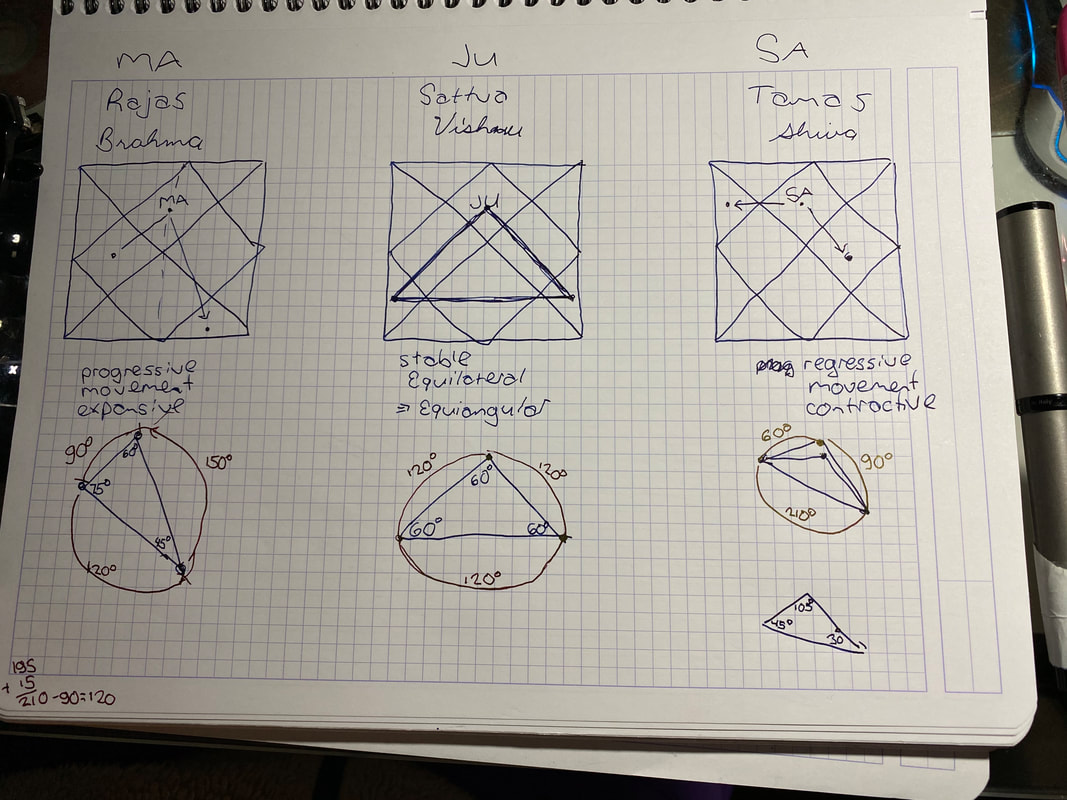
Top row — the three North Indian charts of Fig. 2, with arrows from the graha to the two houses it commands. Under Śani, the word progressive is begun and struck out in favour of regressive.
Middle row — the three circles of Figs. 4, 5 and 6, each number written outside the rim beside the arc it measures, and the interior angles inside. The values are the ones used throughout this essay: 90, 120 and 150 for Maṅgala; three 120s and three 60s for Guru; 60, 210 and 90 for Śani. On the page they are written where they fall round the rim, not in the order they are walked.
Lower right — Śani’s triangle drawn again on its own, away from the circle, so that the 105° at the top can be seen for what it is.
Bottom left corner — the arithmetic: 195 + 15 = 210, then 210 − 90 = 120. The second line is the derivation itself: the eighth house cusp stands at 210° from the graha, the fourth at 90°, and Maṅgala’s middle arc is the difference between them. The first line I can no longer reconstruct — 195 is not a house cusp, and whatever I was correcting by fifteen degrees has gone. Those two lines in the corner were the whole of the derivation the old page promised, which seemed, on rereading, like a promise worth keeping properly.
References
- Varāhamihira, Bṛhat Jātaka 2.13 — tridaśatrikoṇacaturasrasaptamānyavalokayanti caraṇābhivṛddhitaḥ… Sanskrit text with word-by-word analysis and translation by Michael D. Neely (2007), Wisdom Library. The English in the epigraph is my own rendering, following Neely’s glosses of tridaśa, trikoṇa, caturasra and caraṇa, and his reading of pare as setting the three apart from the ordinary aspectors. The long compound resolves as ravija (Saturn, “born of the Sun”) + amarejya (Jupiter, “he whom the immortals worship”) + rudhira (Mars, “the red one”); the sandhi of the first two is why it is printed here as ravijāmarejya-. The e-text sets वीक्षणे अधिकाः without sandhi where वीक्षणेऽधिकाः would be expected.
- Bṛhat Parāśara Horā Śāstra, adhyāya 26, graha-sphuṭa-dṛṣṭi-kathanādhyāya, verses 1–6. Sanskrit e-text at sanskritdocuments.org; English in R. Santhanam’s translation, ch. 26. Verse 3 gives the graded scale, verse 4 the three exceptions, verse 5 the acknowledgement to the earlier teachers, verse 6 the degree-exact sphuṭa dṛṣṭi formula. Verse 2 distinguishes the sign-based aspect from the planet-based one. (The available e-text reads शानि- for शनि- in verse 4 and पादवृद्धया for पादवृद्ध्या in verse 3; both are evident typographical slips.)
- Mantreśvara, Phaladīpikā 2.23 — the same four grades, called aṅghri-vṛddhyā, “by the increase of a foot,” with the same three exceptions. The verse’s first pāda is corrupt in the freely available e-text; its second half, which carries the aṅghri-vṛddhyā phrase, is clean, and that is the part relied on here.
- Kalyāṇavarmā, Sārāvalī 4.32–33 (tr. R. Santhanam). 4.33 gives the special aspects and agrees with the other three texts. The printed English of 4.32 transposes the half and three-quarter values relative to Bṛhat Jātaka 2.13, BPHS 26.3 and Phaladīpikā 2.23; I have not been able to check it against a Sanskrit edition and have not relied on it. The guṇa descriptions at 4.23–25 agree with BPHS 3.22.
- Jaimini, Upadeśa Sūtras 1.1.2–4 (numbering of B. Sūryanārāyaṇa Rao) — abhipaśyanti ṛkṣāṇi, pārśvabhe ca — the sign-to-sign aspect, a different system from the one drawn here. BPHS 8.2–3 gives the same rule in the same technical vocabulary, so Parāśara carries both systems and flags the difference himself at 26.2.
- Bṛhat Parāśara Horā Śāstra 3.22 (graha-guṇa-svarūpādhyāya) — Guru, Sūrya and Candra sattva; Budha and Śukra rajas; Śani and Maṅgala tamas.
- Bhāgavata Purāṇa 1.2.23 — sattva, rajas and tamas as the qualities of prakṛti, and the names Hari, Viriñci and Hara. The verse sits inside a Vaiṣṇava argument for Viṣṇu’s pre-eminence, which is worth knowing when quoting it for the correspondence alone. Text and translation.
- Graha deities: Bṛhat Parāśara Horā Śāstra 3.18 — Agni, Varuṇa, Kārttikeya, Viṣṇu, Indra, Śacī, Brahmā, for the seven in order; and Matsya Purāṇa 93.13–16, which gives Skanda to Maṅgala, Brahmā to Guru and Yama to Śani in its first tier, with Kṣiti (Earth), Indra and Prajāpati in its second. The Matsya verses are one of the few places these lists can actually be pinned to a text — the tables that circulate online generally cite nothing — and the text’s own tier-labels do not always match the ones those tables use, so it is safer to cite the verse numbers than the labels.
- Euclid, Elements III.20 — the angle at the centre is double the angle at the circumference standing on the same arc. Every angle in every figure here is a consequence of it. (The seventh-house aspect needs no theorem: two points half a circle apart are the ends of a diameter, and a diameter is a straight line by construction.)
- Greatest elongations: Budha (Mercury) reaches between about 18° and 28° from the Sun, Śukra (Venus) about 45° to 47°, so neither can be more than a house and a half or so away from it. Maṅgala, Guru and Śani, having orbits outside the earth’s, reach opposition once in each synodic period — 780 days, 399 days and 378 days respectively.
- The measurements in this essay were computed rather than drawn. The angles can be checked with a protractor on any of the figures; the areas, perimeters and balance points cannot, so the formulae are given here instead. Area is given as a fraction of 3√3⁄4 r², the area of the inscribed equilateral triangle; perimeter as a fraction of 3√3 r; the quadrilaterals of section eight are given as a fraction of 2r², the inscribed square. The balance point is the centroid of the three vertices. An inscribed triangle contains the centre in its interior exactly when it is acute.
A drawing made in a notebook in April 2020, redrawn in September 2026 with its angles measured, its sources traced, one of its own captions corrected, and a wheel attached so that the reader can turn it.
Three grahas · Nine arcs · One equilateral
← Back to Writings