The Circle of Varuṇa
Varāhamihira’s earthquake omens, the Moon’s nakṣatra, and 76,888 earthquakes — a sixth-century claim carried to the seismographs, and what came back.
मण्डलमेतद्वारुणमस्यापि भवन्ति रूपाणि ॥
maṇḍalam etad vāruṇam asyāpi bhavanti rūpāṇi ||
Published 18 September 2026
At the Feet of the Masters
This essay began without a subject. I sat, as I sometimes do before I know what I am going to write, with the presence of sitting at the feet of the ancient masters of Jyotiṣa — not any one of them, at first, just the sense of a row of teachers and of being the student in front of them. After a while one of them had a name. It was Varāhamihira, the astronomer of Ujjain in the sixth century, and the name carried me straight to the book of his that I love most and read least systematically, the Bṛhat Saṁhitā, the “Great Compendium,” a hundred and six chapters on everything the sky and the earth can be read for: the courses of the planets, the colours of clouds, the shapes of temples, the marks on a horse, the taste of well water, the meaning of a crow’s cry.[2]
I have had an interest in earthquakes for a long time. In 2017 I pulled thirty years of USGS records of the larger earthquakes and found that the phase of the Moon correlates with earthquake magnitude, and wrote it up here.[3] So when, leafing through the Saṁhitā, I reached chapter 32, bhūkampa-lakṣaṇa, “the signs of an earthquake,” I stopped — and when I reached the part of the chapter that sorts earthquakes by the nakṣatra the Moon is in when the ground moves, I was delighted, in the particular way one is delighted by a very old text that has, without meaning to, made a claim a computer can check.
The essay that follows is that check. It runs in the order shown below, and every box is a link.
What Varāhamihira Says About Earthquakes
Chapter 32 is twenty-nine verses long, and it opens the way a good scientist opens: with the competing theories. Some, he says, hold that the earth trembles because of the great creatures that live in the waters beneath it; others, that it shifts when the elephants of the directions, tired of the earth’s weight, move to rest; others, that wind struck by wind falls to the earth and makes it sound; and some teachers say it is caused by the unseen — adṛṣṭa, the karmic residue that has no visible cause.[1] He reports all four and commits to none. Then he tells a story. Long ago, when mountains still had wings and flew about and landed where they liked, the earth went to Brahmā in the assembly of the gods, ashamed, and said: you gave me the name Acalā, the Unmoving, and it is not true; I cannot bear this weariness. Brahmā looked at her face — her voice breaking, her lip trembling, her eyes full of tears — and told Indra to throw his thunderbolt and break the wings of the mountains. Indra did, and said to her, do not be afraid. But, the god added, four of us — Wind, Fire, Indra himself, and Varuṇa — will go on shaking you in the four quarters of the day and the night, to make good and bad results known to those who live on you.[1]
That is the frame. An earthquake is a message, and the sender is one of four gods. Which one is read in two ways. The first is the hour: the four gods take the four quarters of the day and of the night in turn, Vāyu the first, Agni the second, Indra the third, Varuṇa the fourth (32.7). The second, and the one the chapter dwells on, is the sky — as the commentators and translators read the verses, the nakṣatra the Moon occupies when the ground moves.[4] The twenty-eight asterisms (Varāhamihira counts Abhijit, so twenty-eight, not twenty-seven) are dealt out into four maṇḍalas, circles, of seven each:
Each circle has its rūpāṇi, its signs — the weather that precedes the quake — and its effects. A Vāyu quake is announced by a sky choked with dust and smoke, a wind that throws up the red earth and breaks trees, and a dim, weak sun; it destroys crops, water, forests and herbs, brings swelling, asthma, madness, fever and cough, and is hard on merchants, soldiers, physicians, women, poets, musicians and craftsmen, and on the countries of Saurāṣṭra, Kuru, Magadha, Daśārṇa and Matsya.[1] An Agni quake comes with falling meteors, a sky that seems to burn, and the glow at the horizon called digdāha; it dries up clouds and reservoirs, sets kings at odds, and brings skin diseases, fever, erysipelas and jaundice, striking the Aśmakas, Aṅgas and Bāhlīkas, the Taṅgaṇas, Kaliṅgas, Vaṅgas, Draviḍas and the many kinds of Śabaras. An Indra quake is preceded by clouds like moving mountains, deep-voiced, lit with lightning, the colour of buffalo, bees or serpents, letting down rain; it destroys those famed for learning and lineage, kings and their chiefs, and brings dysentery, throat and face disease and vomiting, striking Kāśi, Yugandhara, the Pauravas, the Kirātas, Kīras, Abhisāras, Halas and Madras, Arbuda, Surāṣṭra and Mālava — and yet it brings welcome rain.[1]
And then Varuṇa, lord of the waters. His signs are clouds the colour of blue lotus, of bees, of split collyrium, sweetly thundering, massed, their bodies lit by lightning, raining in streams like sprouting shoots. His quake, the text says in a verse I will come back to more than once,
गोनर्दचेदिकुकुरान् किरातवैदेहकान् हन्ति ॥
gonarda-cedi-kukurān kirāta-vaidehakān hanti ||
There is more, and it is worth having in one place, because the chapter is not only a classification but a set of quantitative claims. A quake ripens its fruit in six months, a thunderclap (nirghāta) in two (32.23). The two classifiers interact: a quake of Indra’s circle cancels one of Vāyu’s hour and the reverse, and likewise Varuṇa and Agni (32.24) — Utpala, quoting Garga, adds that when the two disagree the hour takes precedence.[4] Agni and Vāyu quakes bring the death of famous kings and afflict people with famine, plague and drought; Varuṇa and Indra quakes bring plenty, auspicious rain and good will, cows rich in milk, and kings turned from enmity (32.25–26). Wind bears its fruit in four fortnights, Fire in three, Indra in a week, and Varuṇa at once (32.27). And each shakes a stated range: Wind two hundred yojanas, Fire a hundred and ten, the Lord of Waters a hundred and eighty, the Wielder of the Thunderbolt a hundred and sixty (32.28).[1]
| Circle | Nakṣatras (32.8, 12, 16, 20) | Signs | Effects & peoples | Fruit · range |
|---|---|---|---|---|
| Vāyu | Uttaraphalgunī, Hasta, Citrā, Svātī, Punarvasu, Mṛgaśīrṣa, Aśvinī | dust and smoke, wind breaking trees, a dim sun | crops, water and herbs fail; swelling, asthma, fever, cough; merchants, soldiers, physicians, artists; Saurāṣṭra, Kuru, Magadha, Daśārṇa, Matsya | 4 fortnights · 200 yojanas |
| Agni | Puṣya, Kṛttikā, Viśākhā, Bharaṇī, Maghā, Pūrvabhādrapadā, Pūrvaphalgunī | meteors, a burning sky, digdāha | clouds and reservoirs dry; kings quarrel; skin disease, fever, jaundice; Aśmaka, Aṅga, Bāhlīka, Taṅgaṇa, Kaliṅga, Vaṅga, Draviḍa, Śabara | 3 fortnights · 110 yojanas |
| Indra | Abhijit, Śravaṇa, Dhaniṣṭhā, Rohiṇī, Jyeṣṭhā, Uttarāṣāḍhā, Anurādhā | mountainous, thundering, lightning-lit clouds that rain | the learned and well-born, kings and chiefs perish; dysentery, throat and face disease; Kāśi, Yugandhara, Paurava, Kirāta, Kīra, Abhisāra, Hala, Madra, Arbuda, Surāṣṭra, Mālava; welcome rain | 1 week · 160 yojanas |
| Varuṇa | Revatī, Pūrvāṣāḍhā, Ārdrā, Āśleṣā, Mūla, Uttarabhādrapadā, Śatabhiṣaj | blue-black, sweetly thundering clouds raining in streams | those who live by sea and river die; excessive rain; enmity ends; Gonarda, Cedi, Kukura, Kirāta, Videha | at once · 180 yojanas |
A note on names. Varāhamihira names the asterisms by their deities, as the tradition did: āryamṇa for Uttaraphalgunī, āditya for Punarvasu, āgneya for Kṛttikā, pitrya for Maghā, āja for Pūrvabhādrapadā (Aja Ekapāda), bhāgya for Pūrvaphalgunī, prājāpatya for Rohiṇī, aindra for Jyeṣṭhā, vaiśva for Uttarāṣāḍhā, maitra for Anurādhā, pauṣṇa for Revatī, āpya for Pūrvāṣāḍhā, ahirbudhnya for Uttarabhādrapadā, and varuṇa for Śatabhiṣaj.[5] The translations on this page are my own from the Sanskrit; N. Chidambaram Iyer’s 1884 English and V. Subrahmanya Sastri’s 1946 edition read the circles the same way, and Sastri glosses 32.8, after Utpala, “whenever an earthquake occurs in any one of these stars, it has to be construed that it is due to the Wind Circle.”[6] I test the star, not the hour: the hour of an earthquake in a modern catalogue is entangled with the hour of its detection — networks hear more at night, when the ground is quiet — and untangling that is another essay.
Why I Was Excited
Because this is testable. Most of the Saṁhitā’s omens are not — one cannot go back and check the colour of the clouds before an earthquake in the sixth century, and one cannot easily count the kings who quarrelled afterwards. But the classification at the heart of chapter 32 depends on exactly one quantity, the position of the Moon at the moment the earth moves, and that quantity is knowable to a fraction of a degree for any instant in the last two thousand years and the next. The United States Geological Survey publishes the origin time of every earthquake its network records, to the millisecond. Put the two together and every earthquake since the seismographs went global has a nakṣatra, a circle, and a god.
So the first question writes itself. If the text is only a classification — a way of naming quakes after the fact — then the Moon’s nakṣatra at the moment of an earthquake should be distributed exactly as the Moon’s nakṣatra is distributed at any moment: uniformly, give or take the small unevenness of her orbit. If the text is more than a classification — if the ground really does move more under some stars than others — the distribution will not be uniform, and the test will say so. And a second question follows from the verse above: in the country of Videha, at least, the text expects Varuṇa. Does it find him?
The instrument below is the whole essay in one figure. It shows the number of earthquakes under each nakṣatra, coloured by circle, against the number expected if the Moon did not matter. You can choose the world, any country with enough earthquakes to test, or the two ancient regions taken up later; and you can count with or without Abhijit. Every recorded shaking counts, for a reason I give in the next section.
- Earthquakes
- —
- χ² (df)
- —
- p-value, uniformity
- —
- Effect size w
- —
- Statistical power (w = 0.3)
- —
- Varuṇa circle
- —
The Catalogue and the Test
The data are the USGS Comprehensive Catalog (ComCat), queried month by month for every earthquake of magnitude 4.5 or greater from 1 January 1980 through 31 December 2025, and then cut at magnitude 5.0.[7] That gives 76,888 earthquakes. Five is the floor at which the global network has been essentially complete for the whole period, so that an earthquake in 1983 and one in 2023 had the same chance of being written down; the start in 1980 takes its cue from my 2017 article, where I argued that a uniform worldwide seismograph network was only in place from the mid-1970s, and begins a little later to be safe.[3] Even at five the catalogue is thicker in its later decades than its earlier ones; that matters for nothing the Moon does, since she circles the zodiac six hundred times in forty-six years, but it matters a great deal for the slow grahas, and I return to it when they come up.
For each event I computed the Moon’s geocentric sidereal longitude at the origin time with the Swiss Ephemeris (Moshier mode, which needs no data files and is good to about an arcsecond), using the Lahiri ayanāṁśa that the rest of this site uses.[8] I checked the machinery against Drik Panchang at two moments that matter to this essay: the Moon left Punarvasu for Puṣya on 25 April 2015 at 13:55 Nepal time by both, and left Śravaṇa for Dhaniṣṭhā on 27 August 2026 at 01:03 by both.[9] The nakṣatra is then the longitude divided into twenty-seven equal arcs of 13°20′ — or, in the twenty-eight-fold scheme Varāhamihira uses, into the same arcs with Abhijit carved out of the last quarter of Uttarāṣāḍhā and the first fifteenth of Śravaṇa, from 276°40′ to 280°53′20″, the convention the Sarvatobhadra and Koṭa Cakra tools on this site also follow.[10]
The null
“Uniform” needs care. The Moon moves faster near perigee, so she spends slightly less time in whichever arcs she crosses near perigee in a given year; over forty-six years the apsides go round five times and this nearly washes out, but not quite. Rather than assume equal expected counts, I sampled the Moon’s position every six hours across the whole window — 67,208 moments — and used the fraction of time spent in each nakṣatra as the expectation. The largest departure from 1/27 is 1.1 %. Every test of the Moon on this page is against that time-weighted null.
The test, and the statistical-power gate
The test is Pearson’s chi-square goodness of fit, with 26 degrees of freedom (27 when Abhijit is counted). Because a test that cannot detect anything is not a test, I set a gate: a country is shown on the map only if the number of its earthquakes gives the test a statistical power of at least 0.8 — an 80 % chance — to detect a medium-sized departure from uniformity — Cohen’s w = 0.3 — at the 5 % level.[11] For 27 bins that means at least 258 events; for 28, at least 262. Thirty-three countries clear it. The gate is not only for the map: nowhere on this page do I print a chi-square p-value from a sample below it — a test that would miss a medium departure most of the time has nothing to say either way — and the instrument above replaces the p-value with the statistical power whenever a region falls short. The one-sided binomial test of a circle’s share, which comes up later, has its own gate on the same principle: a statistical power of at least 0.8 to detect a medium excess in a proportion (Cohen’s h = 0.5, a share of 50 % against 26 %), which the exact test reaches at 28 events. I apply no correction for the number of tests; instead I say, each time, how many of them the 5 % level would colour by chance alone — 1.65 of 33 — and let the reader hold the count against that.
Countries
An earthquake belongs to the country whose territory contains its epicentre, using the Natural Earth 1:50 million boundaries; an offshore epicentre goes to the nearest country within two degrees of arc, about 220 km, which is what puts the great subduction-zone quakes off Honshu, Sumatra and the Chilean coast where any reader would expect them.[12] 15,380 events are on land; 44,376 more are near a coast; 17,132 are in open ocean and belong to no one. A country’s bubble sits at the median of its epicentres, which is why the United States appears in the Aleutians and France in the Lesser Antilles.
Every shaking counts
One decision has to be made before any counting, and I want to be open about it. Earthquakes cluster: a great earthquake is followed by dozens of shocks above magnitude five in the days and weeks after it, and a seismologist who wants independent events removes them with a rule — the Gardner–Knopoff windows are the classic one — before testing anything.[13] I have not done that here, and the reason is the text. Varāhamihira’s reader felt the ground move, looked up, and read the star; he had no way to know, and no reason to care, that the shaking under his feet was the twentieth in a train set off by one rupture a week before. To him, and to the chapter, each shaking was a sign in its own right, and a tally that drops the aftershocks is not a tally of what he would have counted. So every recorded earthquake of magnitude five and above is in the count below, once, with its own Moon. The cost is statistical and I state it plainly: the tests that follow treat the shakings as independent draws, and the ground does not oblige, so a great sequence can carry a whole country’s distribution on its back, and the reader should hold the p-values in that light. The catalogue I publish at the foot of the page carries a mainshock flag for anyone who wants to make the other choice.
The Map
Here is the world. Each bubble is a country whose test has statistical power of at least 0.8 — the others are simply not drawn; the larger and redder the bubble, the smaller the p-value of the test that its earthquakes fall uniformly across the Moon’s nakṣatras. Grey means the distribution is indistinguishable from uniform; gold is the conventional 5 % threshold; red is far beyond it. Hover a bubble for the numbers, use the buttons to switch between twenty-seven and twenty-eight asterisms, and the corner button to see it full-screen.
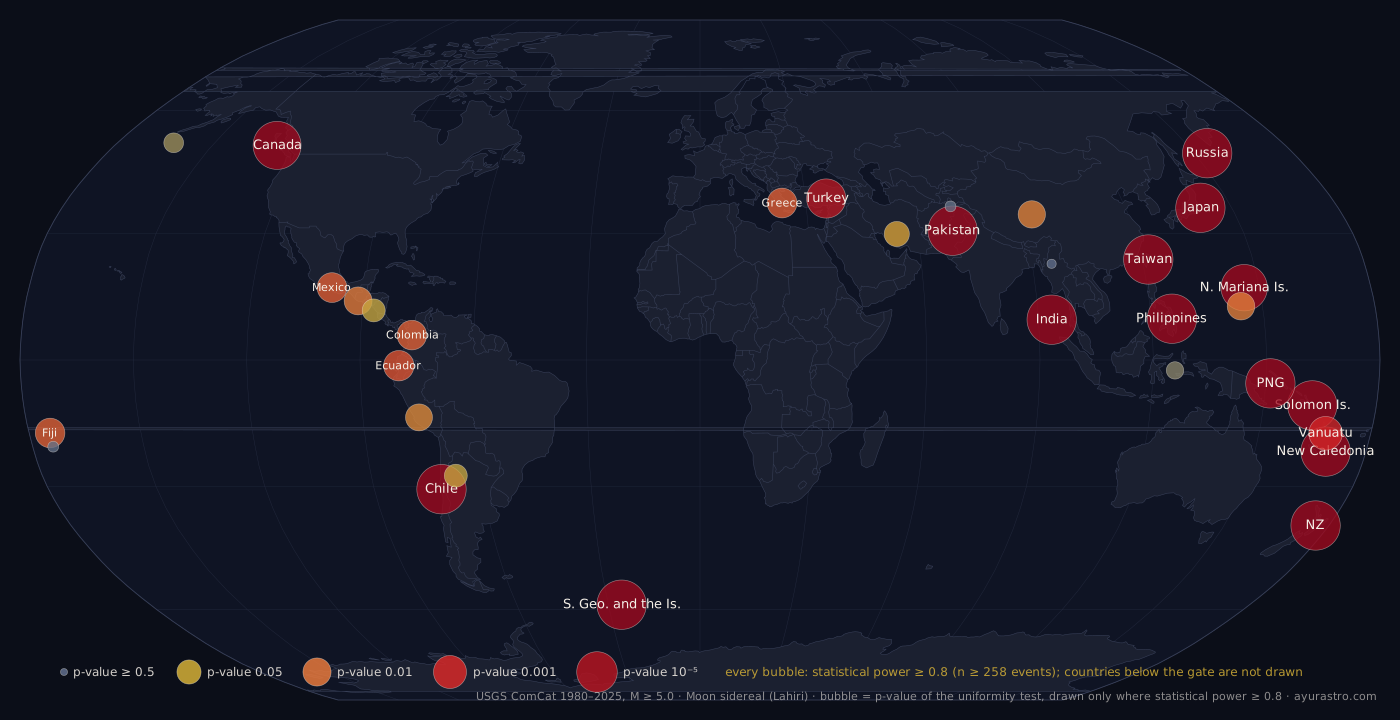
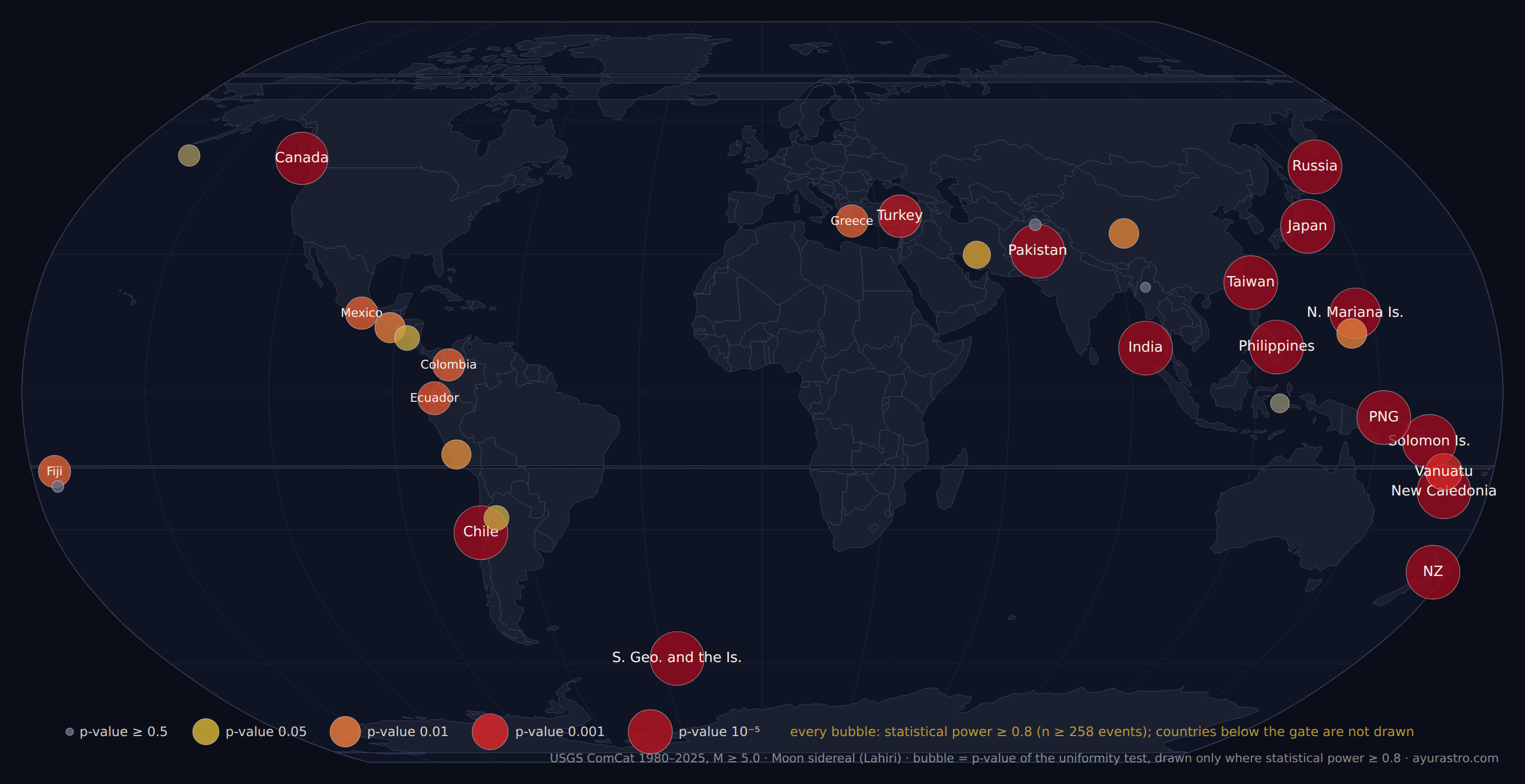
The world is red. Of the 33 countries that can be tested, 26 fail uniformity at the 5 % level, where chance would fail one or two. India’s 1,041 shakings give a p-value near 10−61; Russia’s 3,849 give 10−58; Japan’s 4,616 give 10−50. The whole world together — 76,888 shakings — fails at 10−22. Seven countries look uniform: Indonesia, with the most earthquakes of any, the United States, Tonga, Argentina, Nicaragua, Afghanistan and Myanmar.
Hover the reddest bubbles and the shape of the thing shows. India’s distribution is the Andaman–Nicobar arc after Boxing Day 2004: 383 of its 1,041 shakings came in the following year, 75 of them under Maghā and 66 under Ārdrā. Japan’s is the month after Tōhoku, 467 shakings, 156 of them under Kṛttikā. Russia’s is Kamchatka and the Kurils, and above all the great earthquake of July 2025, whose year alone supplies 507 of its 3,849. The Moon’s star at the world’s earthquakes is far from uniform, and what makes it so is that a great earthquake is not one event in the count but a train of them, all under the Moon of that week. I have chosen, for the reason given above, to count the train as the chapter would have counted it, and the map is the honest result of that choice: it is a map of where the great sequences happened and what the Moon was doing when they did. A reader who wants the other tally will find the catalogue at the foot of the page carries the flag to make it.
The Places He Named
But the text does not only make a claim about the world; it makes claims about places. Chapter 32 names some thirty peoples and countries across the four circles, and chapter 14 — the kūrma-vibhāga, the division of the land of Bhārata into nine parts laid on the body of a tortoise — names well over a hundred more, each tied to a group of three nakṣatras.[14] Most of these are peoples, not territories, and most can no longer be drawn on a map with any confidence; and most of the ones that can are in places where large earthquakes are rare. I went through the names looking for regions that could be located and that have had enough earthquakes since 1980 to say anything at all. Two came close.
Kāśmīra. Kashmir is named in the north-eastern ninth of the tortoise — aiśānyāṁ meruka-naṣṭarājya-paśupāla-kīra-kāśmīrāḥ, “in the north-east: Meruka, Naṣṭarājya, Paśupāla, Kīra, Kāśmīra…” (14.29) — under the nakṣatras Revatī, Aśvinī and Bharaṇī, but it is assigned to no earthquake circle in chapter 32.[14] The Indra circle does list the Kīras, Abhisāras and Madras, peoples of Kashmir’s southern and western fringes, but Kāśmīra itself is absent. I took the region to be the Kashmir Valley and its rim, 33–35.5° N and 73.5–76.5° E, which includes the 2005 Muzaffarabad earthquake.
Videha. The ancient kingdom of Mithilā, the land of Janaka and Sītā, is the Tarai of Nepal and the plain of north Bihar between the Ganga and the hills. It is named in the eastern ninth (14.6, as Mithilā) and — the case that matters — in the Varuṇa circle of chapter 32, as the vaidehakāḥ, alongside the kirātāḥ, the hill peoples of the Himalaya whose name Nepal still uses for its eastern hill communities.[15] I took Videha to be the territory of Nepal together with north Bihar (25.4–27.6° N, 83.5–88.3° E), and I also tested Nepal alone, since it holds nearly all the earthquakes.
| Region | n | Statistical power, uniformity test | Uniformity p-value | Varuṇa share | Varuṇa p-value |
|---|---|---|---|---|---|
| Kāśmīra | 38 | 0.12 | not reported | 10 / 38 = 1.02× | 0.54 |
| Videha (Nepal + north Bihar) | 101 | 0.32 | not reported | 37 / 101 = 1.41× | 0.011 |
| Nepal alone | 96 | 0.30 | not reported | 36 / 96 = 1.45× | 0.008 |
n: every recorded shaking of M ≥ 5.0, 1980–2025Statistical power: of the chi-square uniformity test to detect w = 0.3 at α = 0.05; below 0.8 the p-value is not reportedVaruṇa p-value: one-sided binomial, share of Varuṇa nakṣatras above the time-weighted expectation of 25.9 %; reported from 28 events (statistical power ≥ 0.8 for h = 0.5)
Read the table by the same rule as the map, and the broad question goes quiet. Kāśmīra, at magnitude five, has 38 shakings in forty-six years — a statistical power of 0.12 — and I keep it in the table only to show what an untestable region looks like (the October 2005 earthquake and its train supply eight of the 38, five of them under Jyeṣṭhā). Videha is not much better off for the broad test: 101 shakings give it a statistical power of 0.32, so by the rule I set for the map no chi-square p-value appears for either region — a test that would miss a medium departure two times in three has nothing to report, in either direction. The shape of the distribution is there to look at in the instrument: it is lumpy, and the lumps are 2015, when thirty-one of the region’s 101 shakings, all of them in Nepal, came in the five weeks after Gorkha. But looking is not testing, and the honest summary of the broad question for the places the text names is that the catalogue is too thin to ask it.
Except in the last two columns.
The Varuṇa Test
The chi-square test asks a broad question — is anything anywhere in the twenty-seven bins out of line? — and pays for its breadth with 26 degrees of freedom, which is why a hundred shakings cannot carry it. Varāhamihira asks a narrow one, and a narrow question needs far fewer events: the binomial test of a single circle’s share reaches a statistical power of 0.8 to detect a medium excess at 28 events. For Videha he names a circle, and the seven nakṣatras of that circle are known: Revatī, Pūrvāṣāḍhā, Ārdrā, Āśleṣā, Mūla, Uttarabhādrapadā, Śatabhiṣaj. Under the time-weighted null they hold the Moon 25.9 % of the time. The narrow question is whether Videha’s earthquakes fall in them more often than that, and the natural test is a one-sided binomial test of the Varuṇa share.[16]
They do. Of Videha’s 101 shakings of magnitude five and above since 1980, 37 fell in Varuṇa nakṣatras — 37 % against an expected 26 %, 1.41 times the expectation, one-sided p-value 0.011 (two-sided 0.017). For Nepal alone, 36 of 96, 1.45 times, p-value 0.008. And the circle the text does not name for Videha but names for the Kirātas, Indra’s, is the emptiest: 12 of 101, a little over half its share.
I tried to break it. The first worry is the one I raised in Section Three: 2015. The M 7.3 of 12 May and its eight followers all fell under Śatabhiṣaj, and Śatabhiṣaj alone carries 12 of the 37. So take the five weeks after Gorkha out altogether — every shaking from 25 April to the end of May — and the remaining 70 shakings still put 26 in Varuṇa’s stars, 1.45 times expectation, one-sided p-value 0.023; the excess does not live in the sequence. It is not one star, either: with the 2015 train in, Āśleṣā carries eight against about four expected, Mūla five, Ārdrā and Revatī four each, Pūrvāṣāḍhā three, Uttarabhādrapadā one — four of Varuṇa’s seven above their share — and the 37 are spread across twenty-two different years from 1980 to 2025. It holds on both sides of 2015: 1.40 times on the 47 shakings before, 1.43 on the 54 since. It does not weaken as the floor rises: at magnitude 4.5, where Nepal has 336 shakings, the ratio is 1.33 (p-value 0.0003); at 5.0 it is 1.45; at 5.3, on 35 shakings, 1.54. It is not a global tilt: across all 76,888 shakings the Varuṇa share is 0.99 times expectation, and of the 33 testable countries the highest ratio is Afghanistan’s 1.15, with Mexico at 1.13 and Turkey at 1.13 — nothing near 1.4. And it is not because Varuṇa happens to be the biggest circle: in the twenty-eight-fold scheme every circle has seven nakṣatras, and Varuṇa’s hold 25.9 % of the Moon’s time against Vāyu’s 26.0 % and Agni’s 26.0 % — Indra’s is 22.2 %, since Abhijit is a sliver.
Now the other side. A hundred and one shakings is not many, and they are not independent; the 95 % interval on Videha’s Varuṇa share runs from 28 % to 46 %, so the true excess could be anything from marginal to large. I did not pre-register the test — I read the verse first and then looked — though the verse is fifteen centuries old and the hypothesis is the text’s, not mine. I have applied no correction for having looked at four circles, or at Kāśmīra as well; a reader who insists on one can multiply the odds by four for the circles and still find them a little better than one in twenty, or by eight for the region too and find them at about one in fourteen, short of the conventional line. The result will not bear the weight of “Varāhamihira was right”; it will bear the weight of “the one specific, falsifiable prediction the chapter makes about a place we can locate and test is the one that points the right way after everything else has been cleaned out, at odds of about one in ninety against chance.” That is more than I expected when I sat down, and it is a claim with a clean test attached: at the present rate — two or three M ≥ 5 shakings a year in the region, more when the ground is restless — every twenty years of catalogue adds two-fifths again to the sample, and a sample of this size already has a better than 99 % chance of catching a medium excess if it is real. The ratio will drift toward 1.0 or it will not. I have put the scripts at the foot of the page so that anyone can rerun them in 2046.
The broad claim dissolves with the aftershocks.
The narrow one, the one the text actually makes, is still standing.
The Other Eight Grahas
Varāhamihira reads the circle from the Moon, and only from the Moon. But a reader who has come this far will want to know what the rest of the sky was doing over Videha at those hundred and one moments, if only to see whether the Moon’s result is special or whether any graha, asked the same question, would have answered as well. So here is the same analysis for all nine: for each graha, its sidereal nakṣatra at the origin time of every earthquake of magnitude five and above in Videha — Nepal with north Bihar — the distribution across the twenty-seven (twenty-eight with Abhijit), its departure from the null, and the share of its positions that fall in Varuṇa’s seven stars.
The null has to change. For the Moon, which laps the zodiac every twenty-seven days, the fraction of time spent in each nakṣatra is the right expectation. For Jupiter, which takes twelve years, Saturn, which takes twenty-nine, and the nodes, which take eighteen and a half, the time-weighted null is confounded with the growth of the catalogue and with the accident of which decades Nepal’s earthquakes happened to fall in: forty-six years is one and a half Saturn cycles, and a region whose big earthquakes came in 1980, 1988, 2015 and 2023 will show Saturn “preferring” whatever stars he stood in those years. So for the eight I use the world catalogue itself as the reference — the distribution of that graha’s nakṣatra over all 76,888 shakings on Earth in the same forty-six years, same magnitude floor — and ask whether the sky over Videha’s earthquakes differs from the sky over everyone’s. For the Moon the two nulls give expected counts that differ by a fraction of an event in every bin; the instrument in Section Two shows both. And the rule of Section Three holds here too: with 101 shakings no graha’s distribution gives the broad chi-square test the statistical power it needs, so none is given a p-value for uniformity — what each graha gets is its share of Varuṇa’s stars, for which 101 is ample.
| Graha | Varuṇa share | Ratio | Varuṇa p-value (one-sided) | Most-filled circle | Least-filled circle | Varuṇa ratio without the five weeks after Gorkha (70 shakings) |
|---|---|---|---|---|---|---|
| Sūrya · Sun | 13 / 101 | 0.49× | 1.00 | Vāyu 1.48× | Varuṇa 0.49× | 0.71× |
| Candra · Moon | 37 / 101 | 1.43× | 0.010 | Varuṇa 1.43× | Indra 0.55× | 1.45× (p-value 0.023) |
| Maṅgala · Mars | 9 / 101 | 0.37× | 1.00 | Agni 1.86× | Varuṇa 0.37× | — |
| Budha · Mercury | 19 / 101 | 0.72× | 0.97 | Agni 1.44× | Vāyu 0.66× | 1.04× |
| Guru · Jupiter | 46 / 101 | 1.83× | 5 × 10⁻⁶ | Varuṇa 1.83× | Indra 0.68× | 0.86× |
| Śukra · Venus | 27 / 101 | 0.98× | 0.58 | Indra 1.71× | Vāyu 0.62× | — |
| Śani · Saturn | 20 / 101 | 0.79× | 0.91 | Indra 2.10× | Agni 0.24× | — |
| Rāhu | 16 / 101 | 0.59× | 1.00 | Vāyu 2.21× | Indra 0.56× | — |
| Ketu | 53 / 101 | 2.23× | 3 × 10⁻¹⁰ | Varuṇa 2.23× | Indra 0.50× | 1.33× (p-value 0.08) |
101 Videha shakings, M ≥ 5.0, 1980–2025Varuṇa share = positions in Revatī, Pūrvāṣāḍhā, Ārdrā, Āśleṣā, Mūla, Uttarabhādrapadā, ŚatabhiṣajRatio and p-value against that graha’s world-catalogue shareNo uniformity p-values: the 27-bin test has statistical power 0.32 at n = 101
Three things stand out. First, three grahas, not one, have a Varuṇa share far above expectation — the Moon at 1.43, Jupiter at 1.83 and Ketu at 2.23, the last two at odds that look overwhelming. Second, two of the three are the same thing seen twice, and the thing is 2015. Jupiter stood in Āśleṣā and Ketu in Uttarabhādrapadā — both Varuṇa’s — for the whole of April and May 2015, so every one of the thirty-one shakings of the Gorkha sequence counts for them as a Varuṇa shaking: one message, thirty-one times over. Take those five weeks out, as the last column does, and Jupiter’s ratio falls to 0.86 and Ketu’s to 1.33 with a p-value of 0.08, while the Moon’s holds at 1.45 with a p-value of 0.023. That is the difference between a slow graha and a fast one: the Moon changes her star every day, so a five-week train of shakings is spread across five or six of her nakṣatras and three of the four circles, and no single sequence can hand her an excess; Jupiter and the nodes keep one star for months, so a single sequence hands them everything. The same accident is why Saturn’s most-filled circle is Indra’s at 2.10 and Rāhu’s is Vāyu’s at 2.21 — Saturn stood in Anurādhā and Rāhu in Hasta through that spring. Third, the fast grahas that could carry a real signal alongside the Moon — Sun, Mars, Mercury, Venus — do not: their Varuṇa shares are at or below expectation, and the one high bar among them, Venus in Indra’s circle at 1.71, is one of the thirty-two graha-and-circle bars in Fig. 8 for the other eight grahas, and is what chance produces in thirty-two bars.
So the answer to the question this section asks is: no, any graha would not have done as well. Asked the text’s question, only the graha the text names answers on its own account; the two that seem to answer louder are repeating one week.
The Trishuli, August 2026
Three weeks before I wrote this, the Varuṇa verse stopped being an abstraction. At 08:37 on the morning of Wednesday 26 August 2026, a piece of the glacier on the north face of Langtang Lirung — six hundred metres wide, a fifth of a square kilometre, somewhere between two hundred and five hundred million cubic metres of ice and rock — broke off at about 5,200 metres and fell more than a kilometre into the valley below. Seismometers around the world recorded it as a magnitude 5.2 event; the USGS later concluded that the seismic signal was not an earthquake that triggered the collapse but the collapse itself. Seven minutes later a surveillance camera at Gyirong Port, the border crossing between Tibet and Nepal’s Rasuwa district, recorded a wall of water and debris destroying it. The flood had covered twenty kilometres in seven minutes. It went down the Lhende Khola into the Bhotekoshi and the Trishuli, took out the Rasuwagadhi customs post and the Friendship Bridge and the bridge at Trishuli Bazar, damaged thirteen hydropower stations, and settlements along a seventy-kilometre reach, and carried bodies two hundred and forty kilometres into India. As I write, 1,403 people are confirmed dead in Nepal and 6,150 missing, with 43 dead and 519 missing on the Tibetan side.[17]
It was a disaster in stages. On 27 August the Chinese authorities warned that a barrier lake of two million cubic metres had formed upstream where the Chhochen Khola meets the Purepu Tsangpo. On 28 August it overflowed, and rescue work along the river was halted for three hours while everyone moved to high ground. On 30 August, with the lake largely drained, new flood warnings went out after increased flow was reported from upstream. In the early hours of 31 August the army set off a controlled explosion to open the tunnel of the Upper Trishuli 3A hydropower station, where hundreds of workers had been trapped.[18]
The text says a Varuṇa quake arṇava-sarid-āśrita-ghnam, kills those who depend on the ocean and the rivers, and ativṛṣṭidam, brings too much water; and it names the Kirātas and the people of Videha. It says Varuṇa bears his fruit sadyaḥ, at once. It also says, of the Indra circle, that it strikes the Kirātas and brings rain. So I did what the essay has been doing all along, and looked at where the Moon was.
At 08:37 on 26 August, at Rasuwagadhi, the Moon stood at 284°51′ of the sidereal zodiac — Śravaṇa, second pāda, in Makara — on the fourteenth tithi of the bright fortnight, a day short of the full Moon. Śravaṇa is Indra’s. The trigger of the whole disaster, the event that set the sequence off and registered on seismographs around the world, did not fall in the circle of Varuṇa. It fell in the circle whose verse names the Kirātas and promises rain. The second landslide signal three hours later was in Śravaṇa too.
Then the Moon moved on, as she does, at a nakṣatra a day. At 01:03 on the 27th she entered Dhaniṣṭhā (Indra); at 02:30 on the 28th, Śatabhiṣaj — varuṇa-devam, Varuṇa’s own star, the one that carries his name in the verse. The barrier lake overflowed that day. On the 29th she crossed Pūrvabhādrapadā (Agni), and at 03:57 on the 30th entered Uttarabhādrapadā (Varuṇa), where she stayed through the daylight hours in which the new flood warnings of the 30th were issued and into the small hours of the 31st, when the tunnel was opened; at 04:00 that morning she moved into Revatī, also Varuṇa’s, and left it for Aśvinī before dawn on 1 September. Three of the four stages after the collapse — the overflow, the warnings, the opening of the tunnel — fell under Varuṇa’s stars; the trigger itself and the first day of the flood fell under Indra’s.
| Graha | 26 Aug 08:37 — collapse | Circle | 28 Aug — lake overflows | Circle | 30 Aug — new warnings | Circle |
|---|---|---|---|---|---|---|
| Sūrya · Sun | Maghā 8°40′ Siṁha | Agni | Maghā 10°44′ Siṁha | Agni | Maghā 12°40′ Siṁha | Agni |
| Candra · Moon | Śravaṇa 14°51′ Makara | Indra | Śatabhiṣaj 11°42′ Kumbha | Varuṇa | Uttarabhādrapadā 7°46′ Mīna | Varuṇa |
| Maṅgala · Mars | Ārdrā 15°24′ Mithuna | Varuṇa | Ārdrā 16°46′ Mithuna | Varuṇa | Ārdrā 18°03′ Mithuna | Varuṇa |
| Budha · Mercury | Maghā 7°04′ Siṁha | Agni | Maghā 11°17′ Siṁha | Agni | Pūrvaphalgunī 15°09′ Siṁha | Agni |
| Guru · Jupiter | Āśleṣā 18°13′ Karkaṭa | Varuṇa | Āśleṣā 18°40′ Karkaṭa | Varuṇa | Āśleṣā 19°06′ Karkaṭa | Varuṇa |
| Śukra · Venus | Citrā 24°02′ Kanyā | Vāyu | Citrā 25°52′ Kanyā | Vāyu | Citrā 27°31′ Kanyā | Vāyu |
| Śani · Saturn | Revatī 19°45′ Mīna | Varuṇa | Revatī 19°38′ Mīna | Varuṇa | Revatī 19°32′ Mīna | Varuṇa |
| Rāhu | Dhaniṣṭhā 5°36′ Kumbha | Indra | Dhaniṣṭhā 5°36′ Kumbha | Indra | Dhaniṣṭhā 5°35′ Kumbha | Indra |
| Ketu | Maghā 5°36′ Siṁha | Agni | Maghā 5°36′ Siṁha | Agni | Maghā 5°35′ Siṁha | Agni |
Every graha’s sidereal nakṣatra at three stages of the Trishuli disaster; only the Moon, and Mercury once, change nakṣatra between the stages
Read the table down instead of across and the sky of that week is heavier with Varuṇa than the Moon alone shows. Mars in Ārdrā, Jupiter in Āśleṣā and Saturn in Revatī all stood in Varuṇa’s stars for the whole of the disaster — three of the eight other grahas, where the arcs give an expectation of about two — and none of them arrived for it: Mars had entered Ārdrā on 12 August and would leave on 2 September, Jupiter had entered Āśleṣā on 19 August for a stay until the end of October, and Saturn had been in Revatī since 17 May. This is the standing sky of that season, which the chapter does not read, rather than the star of the hour, which it does; I record it because a reader of the all-graha view will see it, and because it is the kind of thing the tradition would have noticed.
What to make of this. A glacier collapse is not an earthquake, even when it shakes the seismographs, and Varāhamihira’s chapter is about earthquakes. In any given week the Moon spends about a quarter of her time in Varuṇa’s stars; that this week she spent three days of seven there, and that those three days held three of the disaster’s four later stages, is consistent with the verse and also with chance, and I will not pretend a single week can tell the two apart. But I notice that if one had been reading the chapter that week as Varāhamihira’s readers read it — as a set of signs to be watched — the Moon’s entry into Śatabhiṣaj on the 28th, Varuṇa’s own star, in a valley full of water held back by rubble, is exactly the kind of coincidence the tradition was built to notice. And I notice that the trigger fell in the one other circle whose verse names the Kirātas. The text, read closely, does not lose on this week. It does not win either. It is a hypothesis, which is the most one can ask a fifteen-hundred-year-old text to be.
What the Seismographs Give Back
I began at the feet of the masters, and I want to end there, because the exercise changed what I think sitting there means. The reverent way to read a text like chapter 32 is to take it whole — the winged mountains, the four gods, the clouds like bees — and to feel that a wisdom is being handed down which it would be crude to test. The dismissive way is to note that the red on the map is the signature of a handful of great earthquakes and their trains, and close the book. Neither is what a student does in front of a teacher. A student asks the teacher’s question in the teacher’s terms and then looks.
What I found, looking, was three things. That the grand version of the claim — that the earth moves more under some stars than others — is true of the record in a way the chapter’s reader would have recognised and a seismologist would explain away in a sentence: the many shakings after a great one all carry the Moon of that week, and counted as the text counts them they make the sky over the world’s earthquakes anything but even. That the one narrow, local, falsifiable claim the chapter makes about a place we can still point to is the one that points the right way, modestly, and goes on pointing that way when the great sequence is set aside — and that it does so for the Moon, the graha the text names, and for none of the other eight. And that the chapter’s frame — an earthquake as a message with a sender, read from the Moon — gave me, in the last week of August 2026, a way of watching a catastrophe in Varuṇa’s own valley that was neither numb nor credulous. The masters did not ask to be believed. Varāhamihira, who opened his chapter with four theories and committed to none, would, I think, have liked the map.
Four theories, and he committed to none.
Fifteen centuries later, that is still the method.
The Scripts
Everything on this page was produced by six short Python scripts and a shared module, which are yours. They need Python 3.10 or later with numpy pandas scipy pyswisseph geopandas shapely pyproj topojson (pip install them), plus the Natural Earth country boundaries, which the second script reads from the world-atlas TopoJSON files (npm pack world-atlas@2, or the copy in the archive below). Run them in order from one folder. The first fetches the catalogue from the USGS at magnitude 4.5 and above — about 550 requests, a few minutes — and the second cuts it at 5.0 (change --minmag to repeat the essay’s robustness check at 4.5 or 4.8); the rest run in under a minute.
Data
References
The text
- Varāhamihira, Bṛhat Saṁhitā 32 (bhūkampa-lakṣaṇādhyāya), 29 verses. Sanskrit e-text at sanskritdocuments.org (with Kern’s variants), which is the text quoted here; also Wisdom Library. The four theories, 32.1–2; the story of the winged mountains, 32.3–6; the four gods and the quarters of day and night, 32.7; the Vāyu circle and its signs, 32.8–11; Agni, 32.12–15; Indra, 32.16–19; Varuṇa, 32.20–22; timing and cancellation, 32.23–24; general fruits, 32.25–27; ranges, 32.28. The translations on this page are mine.
- On Varāhamihira (sixth century, Avanti/Ujjain) and the Bṛhat Saṁhitā as the encyclopaedia of saṁhitā, the third branch of Jyotiṣa beside gaṇita and horā: David Pingree, Jyotiḥśāstra: Astral and Mathematical Literature (Wiesbaden, 1981); M. Ramakrishna Bhat, Varāhamihira’s Bṛhat Saṁhitā, 2 vols (Delhi, 1981–82), introduction.
- Renay Oshop, Earthquake Magnitudes and Moon Phases Correlate (AyurAstro, 16 November 2017) — USGS events of M > 5.5, 1975–2005. On this site.
- Bhaṭṭotpala’s tenth-century commentary (Saṁhitā-vivṛti) on chapter 32, which V. Subrahmanya Sastri’s translation follows and quotes: on 32.8, “whenever an earthquake occurs in any one of these stars, it has to be construed that it is due to the Wind Circle”; on 32.24 (his 27), Garga’s rule that “if an earthquake is connected with two Nakshatras, division with respect to time of day takes precedence”; and Garga’s prescription that those in whose nakṣatras such portents occur should perform expiations to the god concerned. The commentary also carries three verses, printed by Sastri as 24–26, listing the other portents (meteors, aerial cities, eclipses, rain without clouds, rivers running backwards) to be read by the same circles. Editions of Utpala: ed. Sudhākara Dvivedī, 2 vols (Benares, 1895–97); ed. A. V. Tripāṭhī (Varanasi, 1968).
- The deity names of the nakṣatras as Varāhamihira uses them are the Vedic presiding deities of Taittirīya Brāhmaṇa 1.5.1 and 3.1.1–2 (Aśvins, Yama, Agni, Prajāpati, Soma, Rudra, Aditi, Bṛhaspati, Sarpas, Pitṛs, Bhaga, Aryaman, Savitṛ, Tvaṣṭṛ, Vāyu, Indrāgnī, Mitra, Indra, Nirṛti, Āpas, Viśve Devāḥ, Viṣṇu, Vasus, Varuṇa, Aja Ekapād, Ahirbudhnya, Pūṣan), with Abhijit under Brahmā. The equivalences used here are the ones the translators of chapter 32 make (Sastri and Bhat, ad loc.).
- N. Chidambaram Iyer, The Brihat Samhita of Varaha Mihira (Madura, 1884), ch. 32, at Wisdom Library; V. Subrahmanya Sastri and M. Ramakrishna Bhat, Varahamihira’s Brihat Samhita, with an English translation and notes (Bangalore, 1946), ch. 32, pp. 270–280, at archive.org (Sastri’s verse count runs three ahead of the Sanskrit e-text after 32.23 because he numbers Utpala’s three verses on the other portents); M. Ramakrishna Bhat, Varāhamihira’s Bṛhat Saṁhitā, vol. 1 (Delhi, 1981), ch. 32. All list the four circles with the same twenty-eight asterisms used here.
Data and method
- U.S. Geological Survey, ANSS Comprehensive Earthquake Catalog (ComCat), queried through the FDSN event web service, earthquake.usgs.gov/fdsnws/event/1/, on 18 September 2026, with
minmagnitude=4.5,eventtype=earthquake, month by month from 1980-01-01 to 2026-01-01; 264,176 events returned, of which 76,888 have a current magnitude of 5.0 or more. - Swiss Ephemeris (Astrodienst), via the
pyswissephpackage, in Moshier mode (SEFLG_MOSEPH) withSE_SIDM_LAHIRI. Moshier’s semi-analytic lunar theory is accurate to about 1″ for the Moon over 1980–2030, far below the size of a pāda. astro.com/swisseph. - Drik Panchang, day pañcāṅga for Kathmandu, 25 April 2015 (Punarvasu up to 01:55 PM) and 26 August 2026 (Śravaṇa up to 01:03 AM, 27 August; Trayodaśī up to 08:14 AM). The scripts reproduce both to the minute.
- The extent of Abhijit — the last quarter of Uttarāṣāḍhā and the first fifteenth (0°53′20″) of Śravaṇa, 276°40′ to 280°53′20″ — is the convention of the Sarvatobhadra Cakra, and of this site’s Sarvatobhadra and Koṭa Cakra tools; see A Fort in the Sky. Under this convention Uttarāṣāḍhā keeps 10°, Abhijit has 4°13′20″ and Śravaṇa 12°26′40″, and the time-weighted null accounts for the unequal widths.
- Jacob Cohen, Statistical Power Analysis for the Behavioral Sciences, 2nd ed. (Hillsdale, 1988), ch. 7 — the effect size w = √(χ²/n) for goodness of fit, with 0.1, 0.3 and 0.5 as small, medium and large. Power is computed from the non-central χ² distribution with non-centrality n w²; for w = 0.3, α = 0.05 and 26 degrees of freedom, a statistical power of 0.8 needs n = 258 (262 for 27 df). Cohen’s h = 2 arcsin √p₁ − 2 arcsin √p₀ is the parallel effect size for a proportion (ch. 6); h = 0.5 above p₀ = 0.259 is p₁ = 0.498. Every chi-square p-value on this page is from a sample above the first gate, and every binomial p-value from a sample above the second.
- Natural Earth, Admin 0 – Countries, 1:50m (assignment) and 1:110m (outlines), public domain, in the TopoJSON packaging of Mike Bostock’s world-atlas v2 (ISC licence). Offshore epicentres are assigned to the nearest country within 2° of arc; beyond that they are “open ocean.”
- J. K. Gardner and L. Knopoff, “Is the sequence of earthquakes in Southern California, with aftershocks removed, Poissonian?”, Bulletin of the Seismological Society of America 64 (1974), 1363–1367 — the standard declustering rule, which this essay deliberately does not apply; the published catalogue carries the flag it produces so that a reader can. The space window is 100.1238 M + 0.983 km and the time window 100.032 M + 2.7389 days for M ≥ 6.5, else 100.5409 M − 0.547 days; events are visited from largest to smallest, and every smaller event inside a larger one’s windows (after it, or up to a tenth of the time window before it) is removed. For M 7.8 the windows are 89 km and 974 days; for M 5.0, 40 km and 144 days; for M 9.1, 129 km and 1,072 days.
- Varāhamihira, Bṛhat Saṁhitā 14 (nakṣatra-kūrmādhyāya): the nine divisions of Bhāratavarṣa, each under three nakṣatras beginning from Kṛttikā, with 14.6 (east: …mithila-samataṭa-oḍra…) and 14.29–30 (north-east: aiśānyāṁ meruka-naṣṭarājya-paśupāla-kīra-kāśmīrāḥ … kirāta-cīna-kauṇindāḥ). Sanskrit at sanskritdocuments.org. On the historical geography, Bhat’s notes to ch. 14 and D. C. Sircar, Studies in the Geography of Ancient and Medieval India, 2nd ed. (Delhi, 1971).
- On the Kirātas as the peoples of the eastern Himalaya, and Videha/Mithilā as north Bihar with the Nepal Tarai: Sircar, op. cit.; Bhat, notes to Bṛhat Saṁhitā 14.30 and 32.22. The Kirāta communities of eastern Nepal (Rai, Limbu, Sunuwar, Yakkha) keep the name. The Kirātas appear in both the Indra list (32.19) and the Varuṇa list (32.22).
- The one-sided exact binomial test (
scipy.stats.binomtest,alternative="greater") of the number of events in the seven Varuṇa nakṣatras against the time-weighted expectation p₀ = 0.2589; intervals are Wilson score intervals. The gate for reporting a binomial p-value is a statistical power of 0.8 for Cohen’s h = 0.5, computed exactly (the exact power is not monotone in n; it stays above 0.8 from n = 28 onward, and is 0.93 at n = 38 and above 0.99 at n = 101). For the other grahas the reference share p₀ is that graha’s share of Varuṇa nakṣatras over all 76,888 shakings in the world catalogue.
The Trishuli
- “2026 Nepal–Tibet floods,” Wikipedia, as read on 18 September 2026 — the glacier collapse on Langtang Lirung at 08:37 NPT (02:52 UTC) on 26 August 2026, the Ms 5.2 seismic signal and the USGS analysis that it was generated by the collapse; the destruction of Gyirong Port seven minutes later; the casualty figures as of 16 September (Nepal 1,403 dead, 6,150 missing, 9,287 injured; Tibet 43 dead, 519 missing); the barrier lakes; the damage to thirteen hydropower projects. en.wikipedia.org. Figures are provisional and will change.
- “Timeline of the 2026 Nepal–Tibet floods,” Wikipedia, drawing on the technical report of the Flood Forecasting Division, Centre of Hydrology and Water Resources Research, Nepal (27 August 2026): the M 2.6 tremor at 08:20; the collapse at 08:37; Gyirong Port at 08:44; the SMS alerts at 09:15; the river above the danger mark at Malekhu at 11:26, the Phurke bridge gone at 11:43, and the peak at Devghat by 16:00; the barrier-lake overflow and the three-hour halt on 28 August; the controlled explosion at Upper Trishuli 3A on 31 August. en.wikipedia.org. The times of the later stages are known to the day, not the hour; the strip in the Trishuli section marks them at midday NPT, and the nakṣatra is the same at any hour of those days except 30 August, when the Moon entered Uttarabhādrapadā at 03:57.
Written in September 2026, from a sitting that produced a name, a chapter read in the Sanskrit with the commentators at my elbow, seventy-seven thousand earthquakes taken from the USGS and given each its Moon and its eight other grahas, every shaking counted as the text would count it, the map drawn, and one week on the Trishuli watched star by star.
Four gods · Twenty-eight stars · One verse still standing
← Back to Writings