The Color, Not the Flower
Dyeing white cotton with saffron — and with turmeric and rose hips — together with what Vāgbhaṭa and his commentators, Caraka and Suśruta knew about cloth that takes a color.
तथा द्रवीकृताद्देहाद्बस्तिर्निर्हरते मलान् ॥
tathā dravīkṛtād dehād bastir nirharate malān ||
Published 3 November 2026
A cloth in a garnet bath
The photograph below catches a length of white cotton knit some way into a saffron bath, at the point where it has stopped being white and has not yet decided what it will be. The liquor around it is as dark as strong tea. Where the knit rises above the surface it reads yellow‑gold; under the liquor and deep in the folds it reads orange, almost red. Some of that difference is only the dark bath seen through; some of it is real, the uneven uptake every dyer learns to fight by turning the cloth, and turning it again.
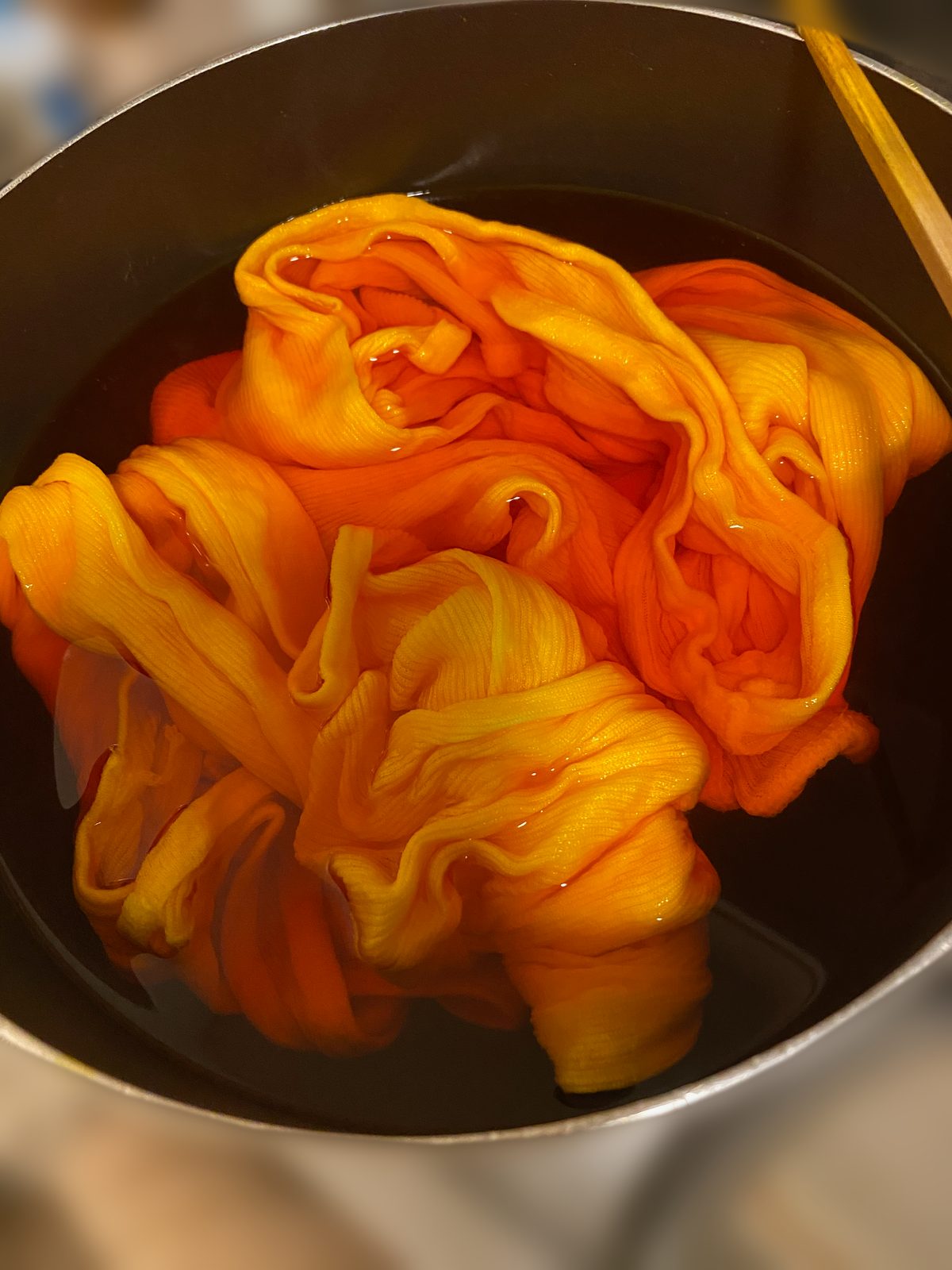
This essay is a recipe in three dyes. It walks through the saffron bath first, step by step, with every quantity given as a share of the dry cloth’s weight so that it scales to a handkerchief or a bedspread. It then says what changes when the saffron is replaced by turmeric, which costs almost nothing and behaves in almost every way differently, and by rose hips, which look scarlet in the hand and dye something much quieter. A small calculator turns the percentages into grams for whatever cloth is on your scale.
Around the recipe sits what the classical medical texts — the Bṛhat Trayī of Caraka, Suśruta and Vāgbhaṭa, with Vāgbhaṭa’s two great commentators — have to say about cloth and color. It is more than one would guess. Vāgbhaṭa reaches for the dye bath more than once when he needs a picture of how the body gives up what is foreign to it, and his commentator Aruṇadatta, explaining the verse above, names saffron outright among the colors a cloth draws out of water. The cloth, he says, extracts the color from water “mixed with kusumbha (safflower), saffron, etc., but not the kusumbha itself” — rāgaṃ haret … na kusumbhādikam, the color and not the flower. That is the whole of dyeing in a phrase, and it gives this essay its title.[1] Vāgbhaṭa and his commentators are quoted throughout from my English translation of the Aṣṭāṅgahṛdaya; the page numbers in the references locate each verse in the paperback, which prints the root text, while the commentaries are in the Kindle edition.
Before the dye: a clean cloth
Near the end of his last book, Vāgbhaṭa opens the chapter on rejuvenation with a warning that every dyer would sign. Rasāyana given to a body that has not first been cleansed is wasted, and he says so with a picture from the dye‑house.
वाजीकरो वा मलिने वस्त्रे रङ्ग इवाफलः ॥
vājīkaro vā maline vastre raṅga ivāphalaḥ ||
Aruṇadatta’s gloss is shorter still: malinaṃ hi vastraṃ na rajyate, “indeed, a dirty cloth does not take dye.” New cotton is dirtier than it looks. The fiber carries its own waxes and pectins, and woven or knitted cloth comes from the mill with sizing, softeners and handling oils that sit between the dye and the cellulose. Washing in the ordinary way does not remove them. Scouring does: a long, hot wash with a mild alkali.
Every amount below is a percentage of the dry cloth’s weight — the dyer’s “weight of fiber,” WOF. A 250 g scarf at 2% WOF needs 5 g. Write the weight down; it is the one number the whole day depends on. The worked examples use 250 g of cotton.
- Fill a pot with enough room‑temperature water for the cloth to move freely — about thirty times its weight, 7–8 liters for 250 g.
- Dissolve soda ash (washing soda) at 1–2% WOF — 2.5–5 g — and add a little pH‑neutral detergent or cellulose scour (Botanical Colors uses its own scour at about a teaspoon per 100 g of cloth). If your washing soda is the crystalline kind, use about two and a half times the weight.
- Add the wet cloth, raise the heat slowly to about 82 °C (180 °F), turning it now and then, and hold there for 30 minutes.
- Lift it out, rinse in cool water and squeeze. Go straight on to the mordant.[9]
The texts would have approved of the trouble. Caraka lists the wearing of clean clothes, nirmalāmbaradhāraṇa, among the daily disciplines that make a life long and fortunate — kāmyaṃ yaśasyam āyuṣyam alakṣmīghnaṃ praharṣaṇam, it is lovely, brings repute and long life, drives off misfortune and gladdens.[2] Suśruta, in the same kind of list, says that wearing flowers, clothes and jewels, sumano’mbararatnānāṃ dhāraṇam, increases delight.[3]
Why cotton
Vāgbhaṭa also knew cotton as a cloth with a temperament. When he chooses materials for surgical bandages, he sorts them by heat:
“Wool from sheep (āvikā), animal hide (ajina), and silk (kauśeya) are hot; linen (kṣauma) is cold. Cotton (tūla), woven fabric (santāna), cotton (kārpāsa), sinew (snāyu), and bark (valkaja) are both hot and cold.”— Aṣṭāṅgahṛdaya, Sūtrasthāna 29.57–58[1]
Cotton is the cloth of both natures — ubhayasvabhāva, Aruṇadatta calls it — warming or cooling as the case requires, between hot wool and cold linen. A dyer values it for a kindred reason: a white that will take any color without bending it. It is also, as the next section explains, a fiber that gives a delicate dye like saffron very little to hold.
The mordant: kaṣāya, the taste that binds
Monier‑Williams gives the word kaṣāya a list of senses that reads like a dyer’s inventory. It is the astringent taste and “an astringent juice, extract of juice”; it is “a decoction or infusion”; it is a color, “red, dull red, yellowish red (as the garment of a Buddhist Bhikṣu)”; and it is “colouring or perfuming or anointing the person.” Its derivative kāṣāya means “dyed of a reddish colour” and the robe so dyed.[8] The astringent, the decoction, the color and the act of coloring are one word.
The chemistry agrees with the lexicon. The puckering dryness the tongue calls kaṣāya rasa is largely the work of tannins, and tannins are what a cotton dyer uses to make a weak dye stay. Cotton is cellulose, and many plant colors have little to hold on to in it; a tannin bath followed by alum lays down a layer that the dye can grip. The Indian dyer’s tannin is the myrobalan — the fruit of harītakī, the Āyurvedic abhayā, chief of astringent fruits. Kalamkari cotton is soaked in myrobalan before the drawing begins, and buffalo milk and alum both have a part in fixing its colors.[12] Vāgbhaṭa knew alum too, as kāṅkṣī, though as a medicine: green vitriol, triphalā, alum, rose‑apple seed and dhātakī, powdered and mixed with honey, are a remedy that “causes clarity in cases of sliminess.”[1] The dyer asks the same drying, clarifying action of it.
- Pour very hot water over ground myrobalan at 15–20% WOF — about 38–50 g for 250 g — stir, and make it up with room‑temperature water to cover the cloth.
- Soak the scoured, still‑wet cloth for at least an hour, or overnight, turning it from time to time. Do not rinse.
Myrobalan alone tints cotton: light buff at low amounts, brownish yellow at high ones.[11] For the clearest saffron, stay at the low end.
- Dissolve alum (aluminum sulfate, or potassium alum) at 12% WOF — 30 g — in very hot water, and soda ash at 1.5% WOF — about 4 g — separately. Combine them in a large container: the mixture fizzes, so leave room.
- Make up the bath with room‑temperature water, add the cloth straight from the tannin, and leave it for 2 hours, or overnight.[10]
- Squeeze it out. Dye at once, or dry it and dye another day.
Cotton will take saffron without any mordant at all, and many saffron recipes skip this part. The color will be paler and will wash out sooner.
The saffron bath
Saffron is the dried stigma of Crocus sativus, Vāgbhaṭa’s kuṅkuma, kesara and kāśmīraja, “born in Kashmir.” Its color is crocin,[24] a carotenoid bound at both ends to sugars — chemically, crocetin di‑(β‑D‑gentiobiosyl) ester[19] — which is why saffron, unlike carrots or tomatoes, gives up its color to plain water. The same sugars make crocin a reluctant dye for cotton: it is happier in the water than on the fiber, and it is fragile. In a water extract kept at 25 °C, half of the principal crocin was gone in about a day, and half of all the crocin‑type pigments in about two.[19] Light is its other enemy, and warmth speeds every reaction of this kind. Three rules follow: steep the saffron on the day you dye, keep the pot covered, and never let the bath boil.
How much? One saffron seller suggests 1–3 g of threads for 250 g of cloth, which is about 0.4–1.2% WOF for “a rich, warm hue.”[13] Deeper shades, toward marigold, come from more saffron, a longer cooling in the bath, and a second dip after the cloth has dried. A scale that reads to a hundredth of a gram is worth having; saffron is sold by the gram for good reason.
- Weigh the saffron (for 250 g of cloth, 2 g is a good start). Crumble the threads between your fingers into a jug.
- Pour on about a cup of hot, not boiling, water — around 70 °C — cover, and leave it for an hour away from bright light. The liquor turns from gold to deep orange.
- Fill the dye pot with enough water for the cloth to move freely, add the saffron liquor with its threads (or strain it through a fine cloth if you want no flecks), and stir.
- Add the mordanted cloth, wet, opened out as much as the pot allows.
- Warm the bath slowly to 70–80 °C — steaming, with no bubbles breaking — and hold it there for 45–60 minutes.
- Turn and re‑open the cloth every ten minutes, pushing the parts that float back under. Folds that stay folded dye darker; cloth that rides above the liquor dyes paler.
- Turn off the heat, cover the pot and leave the cloth in the cooling bath for a few hours or overnight. Most of the depth is gained here.
- Rinse in cool water until it runs nearly clear, wash gently with a pH‑neutral soap, and rinse again.
- Dry it out of direct sun. Judge the color dry: wet cloth always looks a shade deeper than it is.
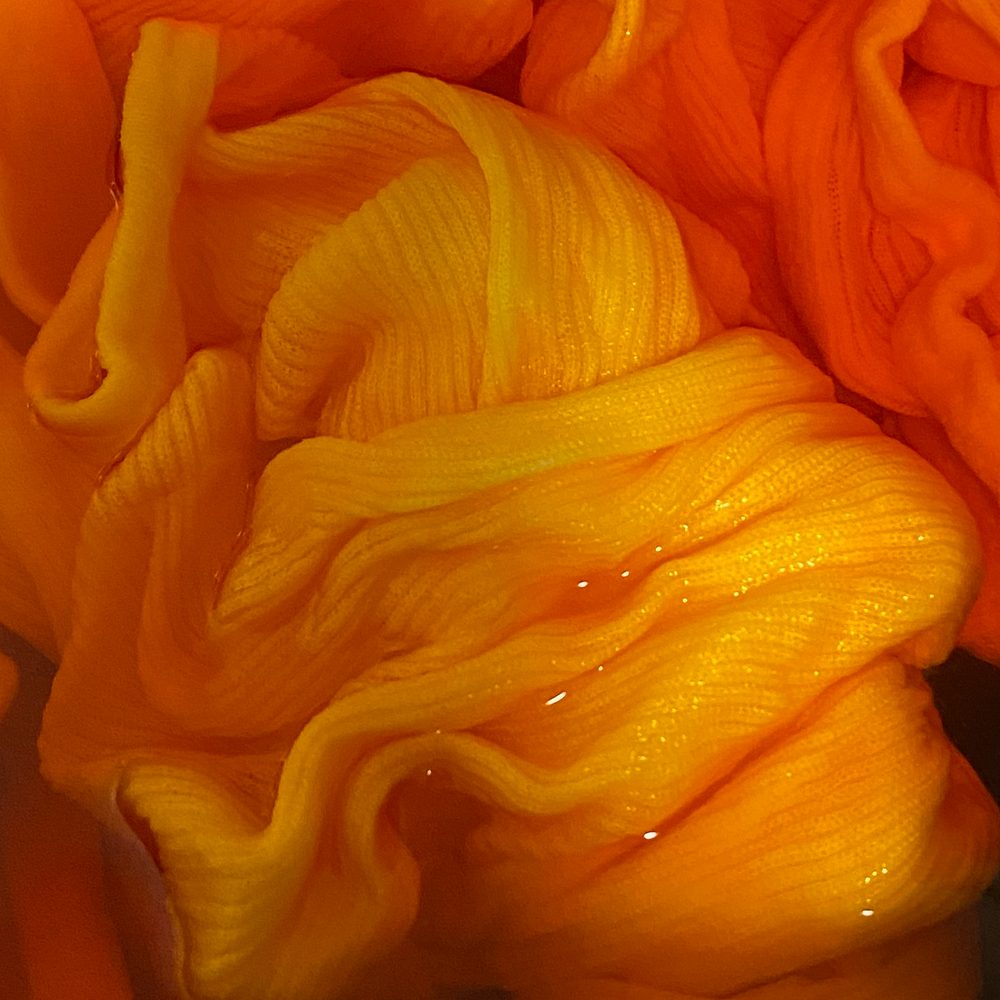
Two of these instructions are older than any modern dye manual. When the Buddhist monks of the Vinaya were first allowed to dye their own robes, they could not tell when a dye was ready, and were told: “I allow you, monks, to put a drop into water or on to the back of your nail.” And when the dye ran down one side of a hanging robe, they were told to keep turning it, and not to walk away until it had stopped dripping.[4] A drop of saffron liquor on a white saucer or a thumbnail still tells you its strength better than the color in the pot does.
How long it lasts
Saffron is a fugitive dye. The vivid orange‑yellow “quickly fades to a pale and creamy yellow.”[24] The seller’s care advice — cold hand‑washing with a mild detergent and drying away from direct sun — is meant to slow that.[13] Wash the cloth cool and gently, dry and store it out of the sun, and when it has faded, dip it again; a saffron cloth is less a thing finished than a thing kept up.
One practical caution: once alum, soda ash or myrobalan have been in a pot, keep that pot for dyeing and do not cook in it again. Wear gloves for the soda ash, and a dust mask when measuring powders such as ground turmeric.[14]
Turmeric: what changes
Many of turmeric’s Sanskrit names are names for color or for night. Haridrā is glossed by Apte as hariṃ pītavarṇaṃ dravati, “it runs to yellow.” Rajanī, which Monier‑Williams explains as “the coloured or dark one,” means the night first and turmeric second, and niśā, another word for night, is among Vāgbhaṭa’s commonest names for it.[8] He prescribes it constantly, alone and as haridrādvaya, the pair that Aruṇadatta identifies as piṇḍā, common turmeric, and pacampacā, tree turmeric. In one verse he pairs the group headed by turmeric with the group headed by sweet flag: “The group beginning with vacā and the group beginning with haridrā are destroyers of āmātīsāra (diarrhea with undigested food). They alleviate medas (fat tissue), kapha (one of the three doṣas), āḍhyapavana (excessive vāta), and disorders of stanya (breast milk).”[1]
As a dye it is saffron’s opposite in nearly every respect. Its color, curcumin, barely dissolves in water, so once it has been coaxed out of the powder it would rather sit on the fiber than stay in the bath. That makes it one of the few natural dyes that colors cotton directly, mordant or no. Ethel Mairet put it plainly in 1916: “Cotton has a strong attraction for it, and is simply dyed by working in a solution of Turmeric at 60°C. for about 1/2 hour.”[15] She also called it fugitive, and it is: turmeric fades in sunlight.
- Amount. A recipe in Spin Off uses ground turmeric at 100–200% WOF — 250–500 g for 250 g of cloth — for a deep, hot yellow;[14] less gives a lighter one, so start lower if you want primrose. Even at these amounts it costs a fraction of the saffron.
- Extraction. Turmeric needs heat to give up its color. Simmer the powder in water for 45–60 minutes and let it cool. Strain it through a fine cloth for an even color — Vāgbhaṭa’s own word for this is vastragalita, “strained through a cloth”[1] — or leave the powder in for a speckled one.
- Mordant. Scour as before; that step is never optional — and rinse the scour’s soda ash out thoroughly, since any left in the cloth will redden the turmeric. Skip the myrobalan, which would pull the yellow toward buff. Alum alone (Step 3 without Step 2) is optional; it brightens the yellow a little.
- Heat. Turmeric is not fragile. Bring the bath slowly to just below the boil over 20–30 minutes and simmer for 30–40 minutes, turning often[14] — or follow Mairet’s gentler 60 °C for half an hour. Cool in the bath as before.
- The one rule: never alkaline. Curcumin is yellow below about pH 7.4 and turns reddish brown above about pH 8.6.[22] Ordinary soap, washing soda and hard‑water detergents are on the wrong side of that line. Wash turmeric cloth only with a pH‑neutral soap, never scour it again after dyeing, and if spots go brick‑red, a rinse with a little vinegar brings the yellow back.
That last rule hides a small history of a word. In Vāgbhaṭa, kuṅkuma is saffron, and the translation renders it so throughout: in winter one should be “anointed with saffron mixed with musk” (kuṅkumena sadarpeṇa).[1] The red kuṅkum powder of the modern forehead is something else: turmeric, dried and powdered “with a bit of slaked lime, which turns the rich yellow powder into a red color.”[25] Slaked lime sits at the far end of Fig. 4. The name of the most precious yellow passed to the cheapest one, made red by alkali.
Two more turmeric verses belong here. In the urinary disorders, the patient with hāridrameha passes urine “pungent, similar to turmeric,” and burning — turmeric used as a color standard, the way a dyer would use it.[1] And in the chapter on poisons and incompatible foods, Vāgbhaṭa warns that the meat of the green pigeon, “impaled on a turmeric skewer (hāridraśūlaka) and cooked with turmeric fire (haridrāvahninā), immediately destroys life.” Hemādri takes the skewer and the fire to be of dāruharidrā, tree‑turmeric wood.[1] Even the gentlest of plants has a wrong way to be used.
Rose hips: the third pot
The rose hip does not appear in the Aṣṭāṅgahṛdaya or its commentaries. The rose itself turns up in Vāgbhaṭa’s text and its two commentaries, as far as a search of the translation finds it, only once, and as a scent: commenting on the summer regimen, Aruṇadatta quotes a verse of Suśruta on perfuming drinking water, in which a new earthen vessel is “scented with campaka (Michelia champaca), utpala (Nymphaea nouchali), vālaka (Valeriana wallichii), lotus, kubjaka (Rosa centifolia), and jasmine, as available—this excellent method of perfuming water is remembered by the wise for all seasons.”[1] The hip comes into this essay by another door, the Vinaya’s list of permitted dyes, whose sixth and last class is dye made from fruits.[4]
It is a lesson in Aruṇadatta’s principle. A ripe hip is scarlet, and the scarlet is carotenoid — chiefly lycopene and β‑carotene, the pigments of tomatoes and carrots. Rose hips, as a 2018 study of Rosa rugosa puts it, “are rich in lipid‑soluble antioxidants such as carotenoids and tocopherols.”[20] Lipid‑soluble means they stay in the shell when the shell is boiled in water. What the water does carry out is the hip’s tannin and its yellow flavonoids, so the dye is nothing like the fruit: suppliers describe soft yellows, warm ochres and earthy yellow‑oranges, or soft pink to warm orange.[16][17] The cloth takes the color that will come into the water, not the color of the flower — or here, of the fruit.
- Amount. Dried rose‑hip shells, cut or ground, at 100–200% WOF — 250–500 g for 250 g of cloth: the lower end for soft yellow to warm ochre, the upper for a stronger yellow‑orange.[16] Fresh hips work too, crushed; use more, since they are mostly water, and wear gloves, since the hairs around the seeds irritate skin.
- Extraction. Soak the shells overnight, then hold them at 80–85 °C for an hour. Strain through a fine cloth, or tie the ground shells in a cloth bag so they do not cling to the knit.
- Mordant. As for saffron: scour, myrobalan, alum. The hips bring tannin of their own,[17] which helps on cotton.
- Heat and time. Dye at the same 80–85 °C for an hour, turning, then let the cloth cool in the bath, ideally overnight.[16]
- A shift, if you want one. Because the hip’s color is mostly tannin, a brief dip in a weak iron solution (a pinch of ferrous sulfate dissolved in hot water) turns it toward gray and brown.[18] Use very little, and keep the iron and its container away from the other pots.
The hip is being studied as a cotton dye. A 2023 paper extracted dried and fresh Rosa canina fruits in water and in methanol at 60 °C for an hour and dyed cotton with them, using chitosan, made from crustacean shells, as a bio‑mordant.[21] For the home dyer the older route is simpler: the shells, a pot, and the same patience as the saffron.
Three pots side by side
The three dye days share their first and last stages and differ in the middle. Saffron wants warmth but never a boil; turmeric can simmer; rose hips sit in between, held just below a simmer for two long hours.
| Saffron | Turmeric | Rose hips | |
|---|---|---|---|
| Part used | dried stigmas (kuṅkuma, kesara) | ground rhizome (haridrā, niśā) | dried fruit shells |
| Color comes from | crocin — water‑loving | curcumin — water‑shy | tannins, flavonoids (the red stays behind) |
| Amount, % WOF | 0.4–1.2% (more for depth) | 100–200% (less for paler) | 100–200% |
| For 250 g of cotton | 1–3 g | 250–500 g | 250–500 g |
| Extraction | steep 1 h at ~70 °C, covered | simmer 45–60 min | soak overnight, then 1 h at 80–85 °C |
| Mordant on cotton | myrobalan + alum (recommended) | none needed; alum optional | myrobalan + alum |
| Dye bath | 70–80 °C, 45–60 min, never boil | near boil, 30–40 min | 80–85 °C, 1 h |
| Color to expect | clear gold to marigold | primrose to hot yellow | soft yellow, ochre, apricot |
| Watch for | light, heat, an old infusion | alkali — it turns red‑brown | iron turns it gray‑brown |
| Fastness | fugitive | fugitive | poor to medium |
- Water
- about 7.5 liters in each bath — enough to move the cloth freely
- Scour
- 5 g soda ash · about 2½ tsp scour or pH‑neutral detergent · 82 °C, 30 min
- Tannin
- 38 g ground myrobalan · 1 h – overnight
- Alum
- 30 g alum + 3.8 g soda ash · 2 h – overnight
- Dye
- 2.0 g saffron threads · steep 1 h at about 70 °C, covered, out of bright light
- Bath
- 70–80 °C for 45–60 min, turning every 10 min — never boil · cool in the bath
Medium saffron is 0.8% of the cloth’s weight, inside the 1–3 g per 250 g that the seller suggests.
What the śāstra knows about color in cloth
None of the three great compendia has a chapter on dyeing; dyeing was a trade of its own. But they lived among dyers, and when they needed a picture of something the body does, the dye‑house was close at hand. Gathered together, these passages make a small dyer’s vocabulary inside the medical texts.
The cloth takes the color, not the flower
The verse at the head of this essay comes from Vāgbhaṭa’s chapter on enemas. As Aruṇadatta explains it, the point is how basti can clear the doṣas out of a body in which doṣa and tissue have been melted together. A cloth dipped in safflower water comes out colored, but it does not come out covered in safflower. Aruṇadatta: “Just as a paṭa—cloth—extracts rāgaṃ haret—color—from water mixed with kusumbha (safflower), saffron, etc., but not the kusumbha itself. Similarly, even when doṣas and dhātus (tissues) are mixed together in a liquefied body, basti extracts the doṣas, not the dhātus.” Hemādri puts it as a rule: “even when pure and impure substances are mixed, basti extracts only the impure.”[1] What the commentators admire is selectivity, which is precisely what a dye is: one substance in a mixed bath that the fiber will take while leaving the rest.
The yellow runs first
In the chapter on venesection, Vāgbhaṭa says that when a vein is opened, “The vitiated blood flows first, like the yellow dye from safflower.” Aruṇadatta explains: “Just as from safflower, which is mixed with red dye and yellow dye, the yellow dye flows first; similarly, from vitiated and non-vitiated blood, which have become mixed together, the vitiated blood flows first.”[1] This is exact. Safflower carries two colorants, a water‑soluble, light‑fugitive yellow and the prized red carthamin; the dyer washes the yellow out with cold water first and only then draws the red with a weak alkali.[23] Vāgbhaṭa’s simile is the safflower dyer’s first rinse.
Rañjaka: the dyer within
Among the five forms of pitta, the one in the stomach is called rañjaka, the colorer: “The pitta residing in the stomach (āmāśaya) is rañjaka because it colors (rañjana) the rasa.” Aruṇadatta adds that it does so by producing rāga, the same word that names a dye’s color.[1] The body has its own dyer, and its work is to turn pale nutrient fluid into red blood.
A wash‑fastness test
The most remarkable of these passages is a laboratory procedure. When purgation (for Hemādri, emesis) has gone too far and something red is coming out, the physician must know whether it is pitta “driven out by the medicine” (bheṣajeritam) or the patient’s own life‑blood, jīva. Vāgbhaṭa gives two tests. One is to offer food mixed with it to a dog or a crow. The other is a cloth:
प्रक्षालितं विवर्णं स्यात्पित्ते शुद्धं तु शोणिते ॥
prakṣālitaṃ vivarṇaṃ syāt pitte śuddhaṃ tu śoṇite ||
Hemādri makes it a protocol: bhāvitam, moistened “two or three times”; āvānam, “slightly dried”; then washed in lukewarm water. Repeated dipping, partial drying and a wash‑off are exactly how a dyer tests whether a color is fast. In the language of this essay, pitta behaves as a true dye and the life‑blood does not. Aruṇadatta uses the same test in the prognostic chapter, where one fatal sign of raktapitta is blood vāsaso ’rañjanam, “not staining clothes”: “the living blood (jīvaśoṇita) does not stain clothes … if clothes stained by it are immediately washed, they become clean, not dyed … clothes are stained by blood mixed with pitta, and they do not become clean when washed.”[1]
Cloth as a witness
Cloth also testifies in the chapter on poisoned food. Among the signs by which a king’s physician can tell that something has been poisoned are “Turbid spots on cloth, and the shedding of threads and fibers.”[1]
Saffron in the Hṛdaya
As a medicine, saffron is hot: Vāgbhaṭa lists kuṅkuma among “substances that are hot in vīrya (potency) and hot to the touch.”[1] In the chapter on substances it completes the aromatics, and the qualities he gives belong to the group as a whole: “Tvak, patra, and elā form trijātaka (the three aromatics); with kesara (saffron), it is caturjātaka (the four aromatics). It aggravates pitta (one of the three doṣas), is sharp, hot, dry, appetizing, and digestive stimulant.”[1] The identification is not quite settled. Kesara means stamen or filament and can name either saffron or the stamens of nāgakesara (Mesua ferrea), and the translation uses both senses in different chapters. Hemādri, defending this verse, quotes the Cikitsākalikā, for which the three aromatics with nāgapuṣpa — the Mesua flower — make the four, and which adds that the group is varṇya, good for the complexion.[1]
In the seasonal regimen saffron belongs to winter. With the oil removed by astringents and a bath taken, one should be “anointed with saffron mixed with musk, and fumigated with aguru (agarwood),” sleep on a bed spread with wool, skins and silk, and go “Covered with light garments that are naturally warm.” Even the cold is dispelled by beloved women “with warm bodies due to fumigation, saffron, and youth.” Summer asks for the opposite, “very fine, thin garments,” sandal paste, camphor and jasmine.[1] The best saffron came, as Vāgbhaṭa’s name kāśmīraja says, from Kashmir, where Kalhaṇa boasted that “the saffron, iced water, and grapes, which are rare even in heaven, are common here.”[7]
Red garlands, faded clothes
Colored cloth turns up in dreams. Among inauspicious dreams Vāgbhaṭa lists “wearing red garlands and clothes,” and “seeing those wearing saffron robes” — kāṣāyiṇām, the wearers of kāṣāya. The black woman who appears “wearing faded garlands and clothes” is Kālarātri, the night of death. Among auspicious ones are “those in white clothes” and receiving “white flowers, clothes.”[1] The word for “faded” there is virāga: colorless, and also dispassionate. Rāga is color and it is passion, and the language never quite lets the two apart. In the last book, among the things that are themselves aphrodisiac, Vāgbhaṭa lists “Garlands, colorful clothes, and various ornaments.”[1]
The monks’ dye‑house
The fullest account of dyeing in early Indian literature is not medical at all. In the Vinaya, the monks first dyed their robes with dung and yellow clay and got a poor color, so six kinds of dye were allowed: from roots, stems, bark, leaves, flowers and fruits. Cold dyeing left the robes smelling, so a small pot for boiling the dye was allowed, then a basin to catch what boiled over, the drop‑on‑the‑nail test, a ladle, a pitcher and a bowl, and a trough so that the cloth would not tear. Robes spread on the ground got dusty, so a grass mat was allowed; the termites ate the mat, so a bamboo pole and cord. A robe hung by its middle dripped down both sides, so it was to be fastened by a corner; one that dripped down one side was to be turned and turned. A robe stiff with too much dye could be put back into water, and a harsh one beaten with the hands.[4] Every rule answers a mistake, and every mistake is still made in home dye pots. The robe that resulted is called kāṣāya — a word, as Part Two showed, that names a decoction before it names a color. Aruṇadatta, glossing the dream verse above, defines it as kaṣāyeṇa raktaṃ vastram, cloth colored with kaṣāya (the translation renders it “a cloth dyed with saffron”). In English the robe is “saffron”; its Sanskrit name keeps the decoction.
The dyer’s week
Kauṭilya’s Arthaśāstra, regulating the washermen who also dyed cloth, sets deadlines: pañcarātrikaṃ tanurāgaṃ, ṣaḍrātrikaṃ nīlaṃ, puṣpa‑lākṣā‑mañjiṣṭhā‑raktaṃ guru‑parikarma yatnopacāryaṃ jātyaṃ vāsaḥ saptarātrikam — five nights for a light color, six for blue, seven for cloth reddened with flowers, lac or madder, for heavy work, and for fine cloth that needs careful handling; after that, the dyer forfeits his wage.[5] The “flower” red is most likely safflower, the same kusumbha of Vāgbhaṭa’s similes. Even then a deep color was understood to take days.
A planet’s color
Jyotiṣa, finally, gives every planet a color and a cloth. Varāhamihira’s colors run, from the Sun, copper, white, deep red, green, yellow, variegated and black, so that the yellow — vyāpīta — is Jupiter’s.[6] His garments are coarse, new, damaged by fire and water, middling, strong and torn: vastraṃ sthūlam abhuktam agnikahataṃ madhyaṃ dṛḍhaṃ sphāṭitam, six words for seven planets, which tradition shares out by reading the compound agnikahata as Mars’s burnt cloth and Mercury’s wet one, leaving Jupiter the cloth neither new nor old.[6] By that reckoning a saffron cloth, once it has been worn a while, is Guru’s twice over.
A concordance
| Locus | Cloth and color | Page |
|---|---|---|
| Sū. 3.11–15 | winter: saffron with musk, aguru smoke, warm light garments; wool, skins, silk bedding | 6–7 |
| Sū. 3.38–40 | summer: very fine, thin garments; sandal, camphor and jasmine | 8 |
| Sū. 6.160 | caturjātaka with kesara | 26 |
| Sū. 7.11 | poison: turbid spots on cloth, threads shed | 29 |
| Sū. 7.44 | the turmeric skewer and turmeric fire | 34 |
| Sū. 12.13 | rañjaka pitta colors the rasa | 47 |
| Sū. 15.35–36 | the haridrādi group | 60 |
| Sū. 19.84 | cloth takes color from safflower water (Aruṇadatta: and saffron) | 75 |
| Sū. 27.38 | safflower’s yellow flows first | 92 |
| Sū. 29.57–58 | bandage cloths hot, cold, and both; cotton both | 99 |
| Śā. 5.75 | blood that does not stain cloth (Aruṇadatta’s wash test) | 127 |
| Śā. 6.52–68 | dreams: red and faded clothes, saffron robes, white clothes | 132–133 |
| Ci. 1.137 | kuṅkuma among substances hot in potency | 185 |
| Ni. 10.15 | hāridrameha, urine like turmeric | 157 |
| Ci. 8.150 | vastragalita, strained through a cloth | 227 |
| Ka. 3.34 | the white‑cloth test of pitta and life‑blood | 295 |
| U. 34.55–56 | kāṅkṣī, alum | 395 |
| U. 37.44 | kāśmīraja, saffron, in an antidote | 407 |
| U. 39.4 | like dye on a dirty cloth | 411 |
| U. 40.42 | colorful clothes among aphrodisiacs | 422 |
Loci are the Aṣṭāṅgahṛdaya’s; pages are those of the paperback of my translation, which prints the root text (the commentaries are in the Kindle edition). The rose (kubjaka) appears only in Aruṇadatta’s quotation from Suśruta on Sū. 3.30–32.
Rāga
Sanskrit has one word for the color a cloth takes and the passion a person feels, and one word, virāga, for both fading and the calm that comes after. Vāgbhaṭa’s rasāyana chapter puts the dyer’s maxim at its door: clean the cloth first, and then the color takes. A saffron cloth teaches the rest of it. The color is bought dear, goes on slowly, fades in the sun, and can be renewed; it is the color, never the flower, that stays with the cloth; and what the cloth will take depends on what it was prepared to receive.
How this was put together
The recipe follows the standard cellulose practice of present‑day natural dyers — a soda‑ash scour, a tannin bath, an alum bath — with amounts from the sources cited at each step; the saffron amounts come from a Kashmiri seller’s guidance, the turmeric and rose‑hip amounts from published recipes, and the behavior of the pigments from the studies cited. The calculator multiplies the same percentages by the weight entered, rounds saffron to a tenth of a gram and everything else to the gram, and assumes about thirty parts of water to one of cloth. The quotations from the Aṣṭāṅgahṛdaya and its commentaries were found by searching the full text of my translation for cloth, color, saffron, turmeric and dye words, in Sanskrit and in English.
The materials are kitchen‑familiar but the mordants are not food. Keep dye pots and spoons for dyeing, work with the window open when simmering, wear gloves for soda ash and iron, and keep all of it away from children and pets. Nothing here is medical advice; the verses are quoted for what they say about cloth.
References
The texts
- Vāgbhaṭa, Aṣṭāṅgahṛdayasaṃhitā, with Aruṇadatta’s Sarvāṅgasundarā and Hemādri’s Āyurvedarasāyana, in Renay Oshop, Vāgbhaṭa’s Aṣṭāṅgahṛdayam: A Full English Translation (2026); the full text, root and commentaries, can also be questioned through Ask Vāgbhaṭa. The paperback prints the root text and the Kindle edition the commentaries as well; the pages below locate each verse in the paperback. Loci: Sū. 3.11–15 with Aruṇadatta (pp. 6–7); 3.30–32 with Aruṇadatta, quoting Suśruta on perfumed water (p. 8); 3.38–40 (p. 8); 6.160 with Hemādri, quoting the Cikitsākalikā (p. 26); 7.11 (p. 29); 7.44 with both commentaries (p. 34); 12.13 with both commentaries (p. 47); 15.35–36 with Aruṇadatta (p. 60); 19.84 with both commentaries (p. 75); 27.38 with both commentaries (p. 92); 29.57–58 with Aruṇadatta (p. 99); Śā. 5.74–76 with Aruṇadatta (p. 127); 6.49–59 with Aruṇadatta and 6.65–71 (pp. 132–133); Ni. 10.15 (p. 157); Ci. 1.137 (p. 185); 8.150 (p. 227); Ka. 3.29–38 with both commentaries (p. 295); U. 34.55–56 (p. 395); 37.44 (p. 407); 39.4 with Aruṇadatta (p. 411); 40.42 (p. 422).
- Caraka Saṃhitā, Sūtrasthāna 5.95 (Mātrāśitīya): kāmyaṃ yaśasyam āyuṣyam alakṣmīghnaṃ praharṣaṇam | śrīmat pāriṣadaṃ śastaṃ nirmalāmbaradhāraṇam. Text and translation at siva.sh and carakasamhitaonline.com.
- Suśruta Saṃhitā, Cikitsāsthāna 24.65 in the numbering of the online text at siva.sh: sumano’mbararatnānāṃ dhāraṇaṃ prītivardhanam. Translated for this essay.
- Vinaya Piṭaka, Mahāvagga VIII.10–11 (Khandhaka 8, “Robes”), tr. I. B. Horner, The Book of the Discipline, vol. 4, at wisdomlib; compare T. W. Rhys Davids and H. Oldenberg, Vinaya Texts II, Sacred Books of the East 17 (1882), VIII.10.
- Kauṭilya, Arthaśāstra 4.1.19 (Kaṇṭakaśodhana, the protection of artisans), Sanskrit with R. Shamasastry’s translation at siva.sh; the rendering here was made for this essay.
- Varāhamihira, Bṛhat Jātaka 2.5 (varṇās tāmra‑sitātirakta‑harita‑vyāpīta‑citrāsitāḥ) and 2.12 (the garments), text and translation at 2.5 and 2.12.
- Kalhaṇa, Rājataraṅgiṇī, Book I, tr. Jogesh Chunder Dutt, Kings of Káshmíra, online text.
- M. Monier‑Williams, A Sanskrit‑English Dictionary (1899), s.vv. kaṣāya, kāṣāya, rajanī, haridrā, kuṅkuma; V. S. Apte, The Practical Sanskrit‑English Dictionary, s.v. haridrā — both as given at wisdomlib: kaṣāya, rajanī, haridrā, kuṅkuma.
The craft
- Botanical Colors, “How to Scour”: for cellulose, soda ash at 1–2% WOF, raised slowly to 180 °F and held 30 minutes.
- Botanical Colors, “How to Mordant Cellulose Fibers: Tannin and Alum”: tannin, then alum (aluminum sulfate or potassium alum) at 12% with soda ash at 1.5% WOF, 2 hours to overnight, without rinsing between.
- Botanical Colors, “Ground Myrobalan Pods”: 15–20% WOF; light buff at low amounts, brownish yellow at high.
- Office of the Development Commissioner (Handicrafts), Government of India, “Machilipatnam Kalamkari”: the cotton prepared with myrobalan, buffalo milk and alum; yellows from pomegranate and turmeric.
- India Kashmir Saffron, “How to Dye With Real Saffron”: 1–3 g of threads for 250 g of fabric; cold hand‑washing and drying away from direct sun.
- “Turmeric to Dye For,” Spin Off: turmeric at 100–200% of the dry fabric’s weight, simmered 45–60 minutes; the dye bath raised to just below the boil over 20–30 minutes and simmered 30–40; gloves, a dust mask, and dye equipment kept apart from cooking equipment.
- Ethel M. Mairet, Vegetable Dyes: Being a Book of Recipes and Other Information Useful to the Dyer (1916), ch. I, “Wool, Silk, Cotton and Linen” (the section on cotton), and ch. VII, “Yellow” (the section on turmeric), Project Gutenberg 24076.
- Apple Oak Fibre Works, “Rosehip Shells, Organic”: 100–200% WOF; soaked overnight, extracted at 80–85 °C for an hour, dyed an hour at the same heat and cooled overnight; soft yellows, warm ochres, earthy yellow‑oranges; colorfastness given as poor to medium.
- Kraftkolour, “Rosehip”: dried hips of Rosa canina, “soft pink to warm orange hues,” “rich in tannins.”
- “Tannins and Iron,” course handout, University of California, Santa Barbara: tannin and iron sulfate give grays and browns.
The science
- L. Maggi, M. Carmona, A. Zalacain, M. Martínez Tomé, M. A. Murcia and G. L. Alonso, “Parabens as Agents for Improving Crocetin Esters’ Shelf‑Life in Aqueous Saffron Extracts,” Molecules 14 (2009) 1160–1170: crocin as crocetin di‑(β‑D‑gentiobiosyl) ester; in the untreated extracts at 25 °C, half‑lives of 24 hours for the principal crocin and 47 hours for the crocetin esters together.
- A. Al‑Yafeai, P. Bellstedt and V. Böhm, “Bioactive Compounds and Antioxidant Capacity of Rosa rugosa Depending on Degree of Ripeness,” Antioxidants 7 (2018) 134: lycopene and β‑carotene as the main carotenoids of ripe hips.
- R. Atakan, I. Martínez‑González, P. Díaz‑García and M. Bonet‑Aracil, “Sustainable Dyeing and Functional Finishing of Cotton Fabric by Rosa canina Extracts,” Sustainability 15 (2023) 227.
- CAMEO, Museum of Fine Arts, Boston, “Turmeric paper”: “Curcumin is yellow with acids (below pH 7.4) and a reddish brown with alkalis (above pH 8.6).”
- CAMEO, Museum of Fine Arts, Boston, “Safflower”: the water‑soluble yellow removed with cold water, the red carthamin then extracted with a weak alkali.
- Wikipedia, “Use of saffron”: crocin as the main colorant; the dyed hue “quickly fades to a pale and creamy yellow.”
- Wikipedia, “Kumkuma”.
Written in November 2026, from a photograph of a dye pot and the full text of the Aṣṭāṅgahṛdaya with its two commentaries.
One cloth · Three pots · The color, not the flower
← Back to Writings