The Mind, the Hand,
and the Heart
Charaka, Suśruta, and Vāgbhaṭa — the Great Trio of Āyurveda — did not write three versions of one book. They wrote one science from three angles, and the differences between them are the point.
शारीरे सुश्रुतः प्रोक्तश्चरकस्तु चिकित्सिते॥
śārīre suśrutaḥ proktaś carakas tu cikitsite ||
Three Rivers, One Medicine
When someone asks me where to begin reading Āyurveda, they usually expect the name of a book. What they receive instead is the name of a relationship. Classical Indian medicine does not rest on a single scripture but on a braid of three — the Bṛhat Trayī बृहत्त्रयी, the "Great Trio": the Charaka Saṃhitā, the Suśruta Saṃhitā, and Vāgbhaṭa's Aṣṭāṅga Hṛdaya.[14] Two millennia of physicians have read them together, taught them together, and quoted them against one another in argument, because each does something the other two do not attempt.
It is tempting, meeting them for the first time, to treat the three as redundant — three drafts of the same encyclopedia, of which one might as well pick the thickest. The tradition itself has never read them that way. The maxim that opens this essay, repeated by vaidyas for centuries, is a seating chart: it tells you in which room each master presides. Charaka rules therapeutics; Suśruta rules the body; Vāgbhaṭa rules first principles; and Mādhava — a later master of the "Lesser Trio" — rules diagnosis. The verse is not a ranking but a division of labor, and it encodes the thesis of everything that follows here.
My shorthand for that thesis is anatomical. Charaka is the mind of Āyurveda: the philosopher-physician, endlessly asking why disease arises at all, what a person is, and what the knower owes the known. Suśruta is the hand: the surgeon, who learned the body by opening it, who numbered his instruments and rehearsed his incisions on gourds before ever touching skin. And Vāgbhaṭa is the heart — literally so, for hṛdaya means "heart," and his Aṣṭāṅga Hṛdaya is the "Heart of the Eight Limbs": the essence of both older oceans, churned into verse a student can carry in memory for life.
This essay introduces each of the three in turn — their lineages, their books, their temperaments — and then sets them side by side, because the differences between them are not flaws to be harmonized away. They are the architecture of a complete medicine: a science that thinks, works, and remembers.
Two Rivers from One Spring
Both saṃhitās open not with pharmacology but with genealogy, and the genealogies agree on the headwaters. Āyurveda, the tradition says, was not invented; it was remembered — held first by Brahmā, taught to Dakṣa Prajāpati, passed to the twin Aśvins, physicians of the gods, and from them to Indra.[1,3] At Indra's court the one river divides into two, and the two saṃhitās each tell the story of their own branch.
In Charaka's telling, when disease began to obstruct dharma on earth, the great sages assembled in the Himālaya, and it was Bharadvāja who ascended to Indra to ask for the medicine. The science came down through Punarvasu Ātreya, who taught six disciples — Agniveśa, Bhela, Jatūkarṇa, Parāśara, Hārīta, and Kṣārapāṇi — each of whom composed his own treatise. It was Agniveśa's that excelled, and it is Agniveśa's tantra that the historical Charaka later rewove into the compendium bearing his name, and that Dṛḍhabala, centuries later still, lovingly completed.[1,14]
In Suśruta's telling, the same Indra taught Dhanvantari, physician of the gods, who descended at the holy city of Kāśī (Vārāṇasī) as Divodāsa, its king. To him came seven students — Suśruta, Aupadhenava, Vaitaraṇa, Aurabhra, Pauṣkalāvata, Karavīrya, and Gopurarakṣita — asking to learn the science that removes the arrow. Śalya, the surgeon's word for a foreign body, means exactly that: an arrow, a splinter, a thing lodged where it does not belong. Suśruta set the teaching down; tradition names Nāgārjuna among the later hands that shaped the text we now hold.[3,14]
Notice what the twin genealogies quietly claim: the two schools are not rivals but siblings — the kāyacikitsā lineage of the physicians and the śalya lineage of the surgeons, separated at the same divine court, destined to be rejoined. The rejoining has a name, and the diagram below ends with it.
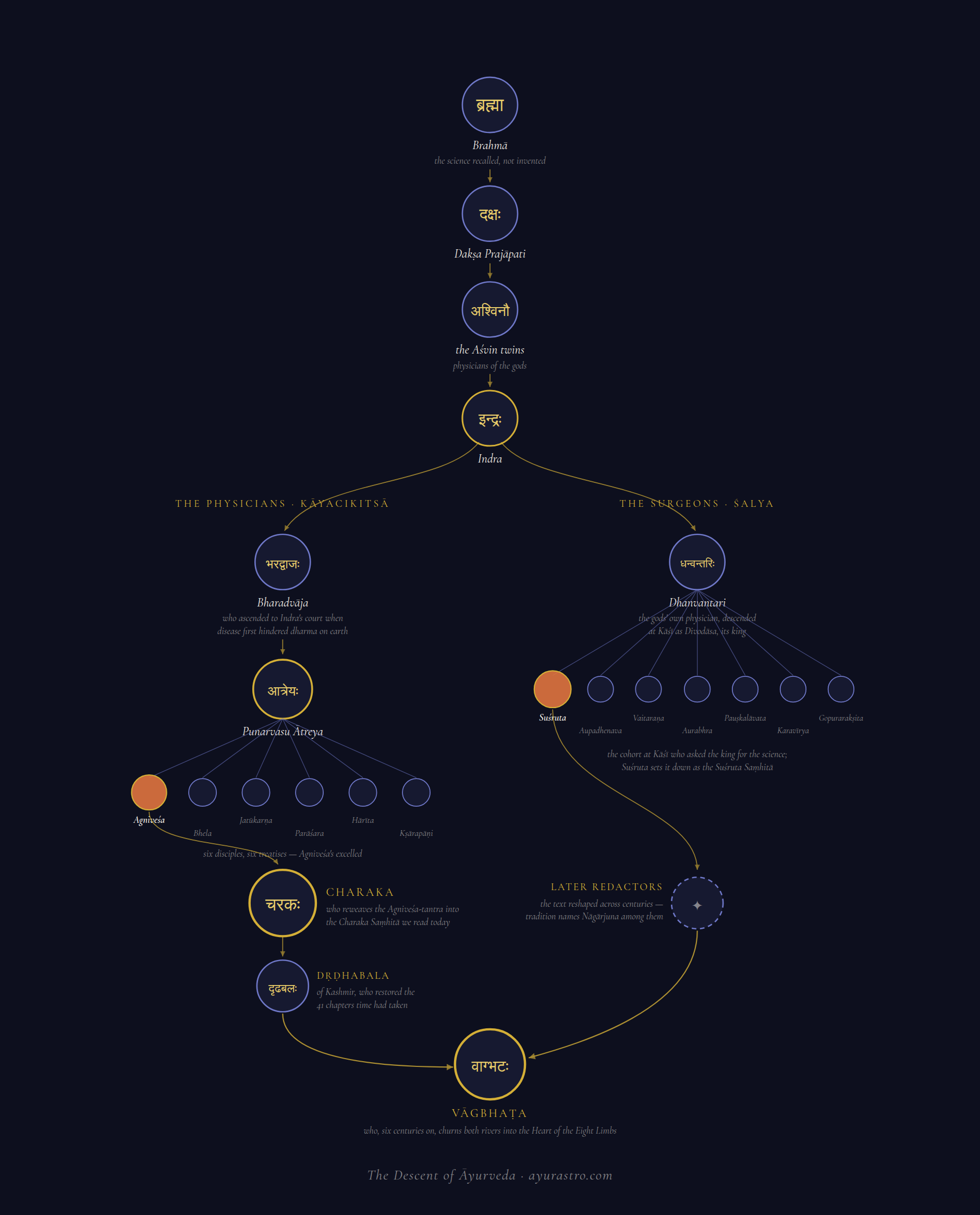
ब्रह्मा स्मृत्वायुषो वेदं प्रजापतिमजिग्रहत्।
सोऽश्विनौ तौ सहस्राक्षं सोऽत्रिपुत्रादिकान् मुनीन्॥
तेऽग्निवेशादिकांस्ते तु पृथक् तन्त्राणि तेनिरे॥brahmā smṛtvāyuṣo vedaṃ prajāpatim ajigrahat |"Brahmā, remembering the science of life, taught it to Prajāpati; he to the twin Aśvins; they to thousand-eyed Indra; he to Atri's son and the other sages; they to Agniveśa and his fellows — and each of these set down a treatise of his own." — Aṣṭāṅga Hṛdaya, Sūtrasthāna 1.3–4[5]
so ’śvinau tau sahasrākṣaṃ so ’triputrādikān munīn ||
te ’gniveśādikāṃs te tu pṛthak tantrāṇi tenire ||
Read the film as text ▾
Two Kinds of Time
Readers meeting these texts today inherit two chronologies at once, and I see no need to make them quarrel. The tradition's own memory reaches deep: a Kāśī school of surgery in the era of King Divodāsa, an oral lineage of Ātreya and Agniveśa older than writing, Suśruta remembered in the epics as a son of the sage Viśvāmitra. The manuscript scholars, reading the texts' language, philosophy, and cross-references, offer more conservative ranges: the Charaka Saṃhitā redacted somewhere around 150 bce–200 ce and completed by Dṛḍhabala of Kashmir in the fourth or fifth century; the Suśruta Saṃhitā accreting in layers over the last centuries bce and settling by about 500 ce, its Uttaratantra the latest stratum; Vāgbhaṭa composing near 600 ce.[14,9]
What is lovely is how often hard evidence winks at both accounts. The Bower Manuscript, a birch-bark medical miscellany buried in Central Asia around the sixth century, already invokes Suśruta as an authority of old.[16] The Chinese pilgrim Yijing, studying in India in the 680s, reports that the "eight arts" of medicine "formerly existed in eight books, but lately a man epitomised them, making them into one bundle" — a remark scholars have long read as the Aṣṭāṅga corpus, freshly famous.[22] And the texts are honest about their own layers: Dṛḍhabala tells us plainly which forty-one chapters he restored. In this tradition, redaction is not corruption. It is an act of reverence — each generation carrying the science forward the way a river carries silt, enriching as it moves.
The Physician's Mind
Open the Charaka Saṃhitā anywhere and you will find someone thinking out loud. The book is staged as a living symposium: sages assemble, a question is posed — what is the origin of the person? is disease born of diet, of karma, of time? — positions are argued in turn, and Ātreya settles the matter, often by showing that every disputant held a piece of the truth.[1,2] Whole chapters of the Vimānasthāna are given to the rules of scholarly debate, to how a physician should be trained, examined, and licensed by assembly. This is not incidental charm. It is the book's deepest teaching: medicine, for the Ātreya school, is a way of knowing before it is a way of doing.
The architecture is famous — eight sections, one hundred and twenty chapters — and it opens with the most quoted definitions in Āyurveda. Life, āyus, is the conjoined procession of body, senses, mind, and self; Āyurveda is the science of what helps and harms it. The whole of medicine is compressed into the trisūtra — cause, sign, and remedy.[1] Therapy stands on four pillars (catuṣpāda): physician, medicament, attendant, patient, each with four qualities of excellence. Disease flows from three roots: the misuse of the senses, the failure of judgment that Charaka names prajñāparādha — the "offense against wisdom" of doing what one knows to be wrong — and the turning of time.[1,9] To the classical three doṣas of the body — vāta, pitta, kapha — he adds two of the mind, rajas and tamas, and prescribes for the mind's diseases a therapy he calls sattvāvajaya, the conquest by clarity, alongside diet, drugs, and the daiva therapies of mantra and gem.[1,15]
Where the book's heart shows most plainly is in what it asks of the healer. The physician must reason from evidence — perception, inference, testimony, and the pragmatic yukti, judgment — and must never stop at the disease's name:
"It is the patient's inner self that is the object of the physician's knowledge. He who does not enter, with the lamp of knowledge and understanding, the inner self of the patient, cannot truly treat disease." — Caraka Saṃhitā, Vimānasthāna 4.12[1]
And the conduct that carries the knowledge is prescribed just as precisely: friendship and compassion toward the sick, gladness at the curable, equanimity before those beyond help — the fourfold bearing of the vaidya.[1] Add the long final books on rasāyana (rejuvenation) and vājīkaraṇa (vitality), and you have the full portrait of this school: a medicine whose first instrument is the examined mind, and whose last aim is not the absence of disease but the flourishing of a whole person. When I sit with a client's chart and history, trying to see the person behind the pattern, it is Charaka's voice I hear. (Readers here can put questions to the text directly through the site's Ask Charak tool, or walk one of its sūtras slowly in The Nine Causative Substances.)
The Surgeon's Hand
Cross from Charaka's symposium into the Suśruta Saṃhitā and the furniture changes. The questions are no longer why but how, exactly: how to lift a splinter of bone without tearing the vessel beside it; how to sit the patient, how the light should fall, which of the eight operations the condition calls for — excision, incision, scarification, puncturing, probing, extraction, drainage, suture.[3,4] The school of Dhanvantari held that the limb of medicine dealing with śalya — the arrow, the lodged thing — was the first and greatest of the eight, because it acts immediately, and because its instruments and its results can be seen.[3]
The book equips that conviction magnificently. It catalogues one hundred and one blunt instruments — forceps and tongs named for the birds and beasts whose beaks and jaws they imitate, the lion-mouth, the heron-mouth — and twenty sharp ones, with the instruction that the surgeon's own hand is the foremost instrument of all.[3,21] It prescribes rehearsal before practice: incisions learned on gourds and cucumbers, probing on worm-eaten wood, scraping on hide, puncture on the veins of dead animals and the stalks of water-lilies, bandaging on stuffed cloth figures, cautery on soft flesh.[3] And it insists — against the ritual anxieties of its age — that the student of the body must see the body: a properly prepared cadaver, submerged seven nights in quiet water, examined layer by patient layer with brushes of grass, "for one who would know the body with certainty must see with his own eyes."[3,4] Out of that seeing come the counts the tradition still recites — three hundred bones, seven hundred vessels, and the one hundred and seven marmas, the vital junctures a surgeon must know precisely so that he may avoid them.[3]
The triumphs are justly celebrated: the reconstruction of a severed nose from a cheek flap, its pedicle kept alive — the ancestor of all plastic surgery; the repair of torn earlobes; couching of the cataract; the cutting for bladder-stone; the management of fractures and of difficult births.[3,4,24] But Suśruta is no mere technician. His compendium reaches into medicine, pediatrics, toxicology, and psychiatry in its later sections; he raises rakta, the blood, nearly to the standing of a fourth doṣa, as a surgeon who has watched wounds would[3,14]; and it is he, not Charaka, who gives Āyurveda its most beloved definition of health:
समदोषः समाग्निश्च समधातुमलक्रियः।
प्रसन्नात्मेन्द्रियमनाः स्वस्थ इत्यभिधीयते॥samadoṣaḥ samāgniś ca samadhātumalakriyaḥ |"He whose doṣas are in equipoise, whose digestive fire is even, whose tissues and eliminations do their work in measure, and whose self, senses, and mind are serene — he is called svastha: established in himself." — Suśruta Saṃhitā, Sūtrasthāna 15.41[3]
prasannātmendriyamanāḥ svastha ity abhidhīyate ||
Theory and hand, he warns, are useless apart — the physician of book-learning alone loses his nerve before a real patient "like a coward on a battlefield," while the pure technician is simply reckless; only the two together, like two wings of one bird, carry the science aloft.[3] It is as complete a statement of craft ethics as any guild ever produced.
The Teacher's Heart
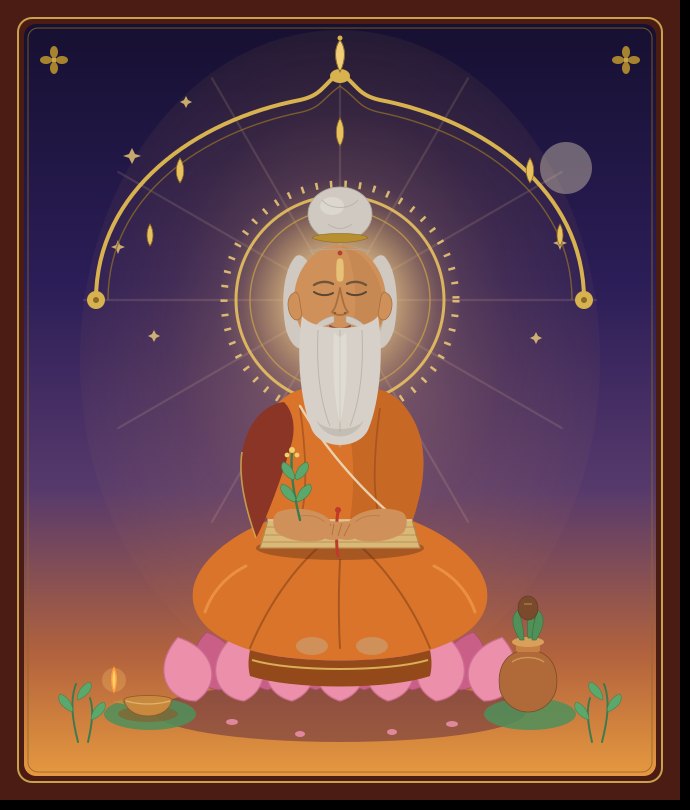
Some five or six centuries after the two great compendia settled into form, a physician from the Sindh country set himself a task that sounds almost modest and is in fact colossal: to gather the whole ocean of the eight-limbed medicine — Charaka's therapeutics, Suśruta's surgery, and the specialist schools besides — into a single work a student could actually hold. Vāgbhaṭa tells us he learned the science from his grandfather (whose name he bore), from his father Siṃhagupta, and from his teacher Avalokita; scholarly consensus places him near 600 ce, and the pilgrim Yijing's "one bundle" remark suggests his fame was already abroad within a lifetime.[5,7,14,22]
He made the gathering twice. The Aṣṭāṅga Saṅgraha, in mixed prose and verse, is the fuller collection; the Aṣṭāṅga Hṛdaya — the "Heart of the Eight Limbs" — is the distillation: about 7,120 polished verses in one hundred and twenty chapters, so ordered and so memorable that it became the most commented, most copied, most memorized medical text in the history of the subcontinent.[5,14] (Whether one Vāgbhaṭa wrote both works or a grandson finished what an elder began is a debate scholars still enjoy; the tradition, characteristically, keeps the name and lets the question rest.[14,28]) In its closing chapter the Hṛdaya describes itself as drawn like nectar from the churning of that ocean — made, it says, for students of modest effort and real need. Kerala's Aṣṭavaidya physician families have chanted it whole for a thousand years; it crossed the Himālaya into Tibetan, where it helped shape that medical canon, and its name appears among the Indian books known to the physicians of ninth-century Baghdad.[14,23]
What did Vāgbhaṭa add, beyond compression? Order, first: he moves the body (śārīra) forward, streamlines Charaka's sprawling debates into teachable sequence, and merges overlapping sections. Practicality, second: the Hṛdaya's chapters on dinacaryā and ṛtucaryā — the daily and seasonal regimens — are the tradition's finest, and its systematization of the five subtypes of each doṣa, each with its seat and duty, gave physicians the fine-grained functional map they still use.[5,15] And tenderness, third — for this is the warmest of the three books. Its very first verse does not name a god of medicine at all. It salutes a healer beyond precedent, in words each tradition may read as its own:
रागादिरोगान् सततानुषक्तानशेषकायप्रसृतानशेषान्।
औत्सुक्यमोहारतिदाञ्जघान योऽपूर्ववैद्याय नमोऽस्तु तस्मै॥rāgādirogān satatānuṣaktān aśeṣakāyaprasṛtān aśeṣān |"The diseases beginning with desire — clinging without pause, spread through the whole body, breeding restlessness, delusion, and discontent: salutation to that Unprecedented Physician who destroyed them, every one." — Aṣṭāṅga Hṛdaya, Sūtrasthāna 1.1[5]
autsukyamohāratidāñ jaghāna yo 'pūrvavaidyāya namo 'stu tasmai ||
His commentators quarrel beautifully over who the Unprecedented Physician is — the Buddha, say some; Dhanvantari or the Lord himself, say others — and the verse serenely accommodates them all.[28] It was the first verse of the Hṛdaya I ever learned to chant, and after living with all 7,120 of them while translating the work in full,[6] I can report that the opening is no accident: a book that begins by calling desire the first disease has already told you what kind of medicine it intends to practice — one in which regimen, temperament, and spirit are treated in the same breath as bile and wind.
The Complementarity
Set the three side by side and the differences stop looking like disagreements and start looking like design. Charaka reasons; Suśruta operates; Vāgbhaṭa arranges. Charaka's anatomy is functional — organs enumerated by what they do; Suśruta's is observational — structures known because he has seen them; Vāgbhaṭa's is curricular — exactly what the student needs, where the student needs it. Charaka counts three doṣas and gives the mind two of its own; Suśruta, who has watched wounds bleed, presses rakta forward as nearly a fourth; Vāgbhaṭa keeps the classical three and resolves the tension by giving blood its full clinical weight without the title.[1,3,5,14]
Most telling of all is how the books treat each other. More than once the Charaka Saṃhitā, arriving at a condition that calls for the knife — the deep abscess, the growth that must come out — simply hands the case over: such matters, it says, belong to the school of Dhanvantari.[1,2] Suśruta returns the courtesy, sending the constitutional diseases to the physicians, and his Uttaratantra reaches respectfully into their territory to round out his students' education. Neither school pretends to be the whole of medicine. That mutual deference, written into the texts themselves, is what made Vāgbhaṭa's synthesis possible at all — the two rivers had always known they belonged to one watershed.
| Charaka Saṃhitā | Suśruta Saṃhitā | Aṣṭāṅga Hṛdaya | |
|---|---|---|---|
| Lineage | School of Ātreya, through Agniveśa; completed by Dṛḍhabala | School of Dhanvantari at Kāśī; shaped by later redactors | Both streams, received through family and teachers |
| Governing limb | Kāyacikitsā — internal medicine | Śalyatantra — surgery | All eight limbs, integrated |
| Form | Prose-and-verse symposium; positions debated, then settled | Systematic operating manual; instruments, training, procedure | ~7,120 mnemonic verses; the curriculum perfected |
| The body | Enumerated by function; anatomy serves physiology | Learned by dissection; anatomy serves the knife | Condensed from both; anatomy serves the student |
| Doṣa account | Vāta, pitta, kapha — with rajas and tamas for the mind | The three, with rakta (blood) pressed nearly to a fourth | The classical three, refined into fifteen named subtypes |
| Signature gifts | Etiology, epistemology, physician's ethics, rasāyana | Marma points, 121 instruments, rhinoplasty, surgical training | Dinacaryā, ṛtucaryā, dosage, pedagogy |
| "Best in…" | Cikitsā — treatment | Śārīra — the body | Sūtra — first principles |
Three Architectures, One Spine
Lay the three tables of contents side by side and the family resemblance — and the family argument — both appear. All three share a spine: first principles (sūtra), diagnosis (nidāna), the body (śārīra), treatment (cikitsā). Around that spine, each builds according to its temperament. Charaka alone keeps a section on method and measure (vimāna) and one on prognosis (indriya) — the epistemologist's rooms. Suśruta's enormous Uttaratantra annexes the remaining specialties — eyes and ears, children, poisons, spirits — so that a surgeon's education would lack nothing. And Vāgbhaṭa quietly reorders the house itself, moving the body forward beside first principles, merging pharmacy with success-in-cleansing, and trimming every room to teachable size.
A Path for the Modern Student
The tradition long ago worked out an order of approach, and the opening maxim encodes it. Begin with Vāgbhaṭa — sūtrasthāne tu vāgbhaṭaḥ — because the Hṛdaya was built to be a first book: complete, ordered, kind to the memory. This is still how the classical families of Kerala raise their physicians. Then deepen by domain: to Suśruta for the body, reading the Śārīrasthāna with the respect owed the world's first systematic anatomist; to Charaka for treatment and, just as much, for the philosophy of the healer — the Sūtrasthāna and Vimānasthāna repay a lifetime of rereading. Only then does Mādhava's Nidāna, first of the Lesser Trio (Laghu Trayī), complete the fourfold curriculum with diagnosis.[14,15]
English readers are well served now: Sharma & Dash's seven-volume Charaka with Cakrapāṇi's commentary, Bhishagratna's pioneering Suśruta and Murthy's modern one, Murthy's three-volume Hṛdaya — joined now by my own complete English rendering[6] — and the free scholarly portals of India's National Institute of Indian Medical Heritage, which host searchable e-texts of the saṃhitās with commentaries.[1,3,4,5,6,26,27] My own daily practice braids the trio with their sister science: Charaka himself prescribes the daiva therapies alongside diet and drug, Suśruta times his procedures to tithi and nakṣatra, and Vāgbhaṭa's regimens follow the Sun through the day and the year — the physicians assumed the astrologer's sky, as the astrologer assumes the physician's body.[1,3,5]
On This Site
Companion pieces to this essay: The Nine Causative Substances (a single Charaka sūtra, slowly), The Strength of Subtlety (sūkṣmatā across the tradition), Reading the Body (diagnostic signs, East and West), and the eight diseases of the mind (which opens with the Hṛdaya's first verse). The Ask Charak tool answers questions from the Charaka Saṃhitā with citations.
Three Rivers, Still Flowing
Each master gathered his own ocean of commentary — Cakrapāṇi Datta on Charaka, Ḍalhaṇa on Suśruta, Aruṇadatta and Hemādri (and a good two dozen more) on Vāgbhaṭa — and each traveled. Fragments and citations moved along the Silk Road; the Hṛdaya crossed into Tibetan and left its fingerprints on Tibet's medical canon; Baghdad's physicians, at the height of the translation movement, could consult Indian medicine under names their bibliographers recorded with care.[10,11,12,14,23]
The strangest afterlife belongs to Suśruta. In October 1794, London's Gentleman's Magazine printed a letter describing how a Maratha bullock-driver named Cowasjee, his nose cut off in war, had it rebuilt by a craftsman using a flap of forehead skin — the living descendant of Suśruta's cheek-flap operation, preserved for two thousand years in Indian workshop practice. An English surgeon, Joseph Carpue, read the account, questioned returning officers, rehearsed on cadavers, and in 1814 performed the operation in London; his 1816 book carried the "Indian method" into every European clinic, and modern plastic surgery still names Suśruta at the head of its own lineage.[24,25] The hand, it turns out, remembers as faithfully as the mind.
So the Great Trio come down to us still doing what they always did — one thinking, one working, one teaching — three angles of vision converging on the single patient, who was never divisible in the first place. The tradition's habit of reading them together is not scholarly piety. It is the oldest clinical wisdom there is: no one faculty heals alone.
the mind, the hand, and the heart of one science.
References & Further Reading
Primary Texts — Editions & Translations
- Sharma, R. K., & Dash, B. (1976–2002). Caraka Saṃhitā: Text with English Translation & Critical Exposition Based on Cakrapāṇi Datta's Āyurveda Dīpikā, 7 vols. Chowkhamba Sanskrit Series Office, Varanasi. The standard scholarly English Charaka.
- Sharma, P. V. (1981–1994). Caraka Saṃhitā: Text with English Translation, 4 vols. Chaukhambha Orientalia, Varanasi.
- Bhishagratna, K. L. (trans.) (1907–1916). An English Translation of the Sushruta Samhita, 3 vols. Calcutta. The pioneering complete English Suśruta; freely available online.
- Murthy, K. R. S. (trans.) (2000–2002). Illustrated Suśruta Saṃhitā, 3 vols. Chaukhambha Orientalia, Varanasi. The standard modern English Suśruta.
- Murthy, K. R. S. (trans.) (1991–1995). Vāgbhaṭa's Aṣṭāñga Hṛdayam, 3 vols. Krishnadas Academy, Varanasi.
- Oshop, R. Vāgbhaṭa's Aṣṭāṅgahṛdayam: A Full English Translation. Amazon (paperback & Kindle). All 120 chapters of the Hṛdaya in plain contemporary English, by this essay's author. amazon.com/dp/B0H4QNWFY8.
- Murthy, K. R. S. (trans.) (1995–1997). Aṣṭāṅga Saṃgraha of Vāgbhaṭa, 3 vols. Chaukhambha Orientalia, Varanasi.
- Kunte, A. M. (ed.) (1880; many reprints, ed. Paradkar). Aṣṭāṅgahṛdaya of Vāgbhaṭa, with the Sarvāṅgasundarā of Aruṇadatta and Āyurvedarasāyana of Hemādri. Nirṇaya Sāgara Press, Bombay. The classic Sanskrit edition, source of the "nidāne mādhavaḥ" couplet's fame.
- Wujastyk, D. (2003). The Roots of Ayurveda: Selections from Sanskrit Medical Writings, rev. ed. Penguin Classics, London. The best single-volume introduction, with annotated selections from all three masters.
The Classical Commentators
- Cakrapāṇi Datta. Āyurveda Dīpikā (on the Caraka Saṃhitā), 11th c. CE. Available in extracted form in ref. 1.
- Ḍalhaṇa. Nibandhasaṅgraha (on the Suśruta Saṃhitā), 12th c. CE. The authoritative Suśruta commentary.
- Aruṇadatta. Sarvāṅgasundarā (c. 1220) and Hemādri, Āyurvedarasāyana (13th c.) — the two most-printed of the Hṛdaya's many commentaries; see ref. 8.
- Indu. Śaśilekhā (on the Aṣṭāṅga Saṅgraha) — the essential companion to Vāgbhaṭa's longer work.
History & Scholarship
- Meulenbeld, G. J. (1999–2002). A History of Indian Medical Literature, 5 vols. Egbert Forsten, Groningen. The definitive scholarly history; vols. IA–IB treat all three saṃhitās and their dating in detail.
- Valiathan, M. S. The Legacy of Caraka (2003); The Legacy of Suśruta (2007); The Legacy of Vāgbhaṭa (2009). Universities Press, Hyderabad. A cardiac surgeon's loving three-volume reading of the trio — the modern companion this essay most resembles in spirit.
- Hoernle, A. F. R. (1907). Studies in the Medicine of Ancient India. Clarendon Press, Oxford; and his edition of The Bower Manuscript (Calcutta, 1893–1912).
- Zysk, K. G. (1991). Asceticism and Healing in Ancient India: Medicine in the Buddhist Monastery. Oxford University Press, New York. On the milieu in which the compendia crystallized.
- Dasgupta, S. (1932). A History of Indian Philosophy, vol. II. Cambridge University Press. The classic chapter on the speculations of the medical schools.
- Kutumbiah, P. (1962). Ancient Indian Medicine. Orient Longmans, Madras.
- Filliozat, J. (1964). The Classical Doctrine of Indian Medicine: Its Origins and Its Greek Parallels (trans. D. R. Chanana). Munshiram Manoharlal, Delhi.
- Mukhopadhyaya, G. (1913–1914). The Surgical Instruments of the Hindus, 2 vols. Calcutta University. Suśruta's 121 instruments, drawn and compared with their Greek and modern counterparts.
- Takakusu, J. (trans.) (1896). A Record of the Buddhist Religion as Practised in India and the Malay Archipelago (A.D. 671–695), by I-tsing. Clarendon Press, Oxford. The "one bundle" report, ch. 27.
- Vogel, C. (1965). Vāgbhaṭa's Aṣṭāṅgahṛdayasaṃhitā: The First Five Chapters of Its Tibetan Version. Deutsche Morgenländische Gesellschaft, Wiesbaden.
The Western Episode
- "B.L." (October 1794). Letter on the Indian rhinoplasty (the case of Cowasjee). The Gentleman's Magazine, vol. LXIV, part 2, pp. 891–892. London: Nichols.
- Carpue, J. C. (1816). An Account of Two Successful Operations for Restoring a Lost Nose from the Integuments of the Forehead. Longman, London.
Online & Open-Access
- National Institute of Indian Medical Heritage (NIIMH), Hyderabad. e-Caraka and e-Suśruta — searchable e-texts of the saṃhitās with commentaries. niimh.nic.in/ebooks/ecaraka · niimh.nic.in/ebooks/esushruta.
- Charaka Saṃhitā Online. carakasamhitaonline.com — annotated translation in progress, NIIMH.
- Gode, P. K. "Vāgbhaṭa, the author of the Aṣṭāṅga-hṛdaya and his commentators," in Studies in Indian Literary History. wisdomlib.org — on the popular couplet, Vāgbhaṭa's date, and the commentarial tradition.
On This Site
- Oshop, R. Ask Charak (a cited chatbot on the Charaka Saṃhitā); The Nine Causative Substances; The Strength of Subtlety; Reading the Body; A Proposed Correspondence Between the Planets and the Eight Diseases of the Mind.
An illustrated introduction to the Bṛhat Trayī, prepared for students and the curious alike.
One science · Three masters · Eight limbs
← Back to Writings