The Nine Pantries
Wheat to the Sun, rice to the Moon, sesame to Saturn. Every jyotiṣī inherits a pantry — nine shelves of grains, spices, and fruits, one for each graha. But who stocked it, and when, and on whose authority? This essay opens the cupboard and reads the labels: the spices, fruits, vegetables, legumes, and tubers of each planet, traced source by source.
दध्योदनं हविश्चूर्णं मांसं चित्रान्नमेव च॥
dadhyodanaṃ haviś cūrṇaṃ māṃsaṃ citrānnam eva ca ||
The Question at the Stove
Sooner or later the pantry question arrives in every Jyotiṣa consultation, usually in its practical costume. A client is entering a Saturn daśā and has been told — by a grandmother, a priest, a paperback, an app — to give sesame on Saturdays. Another has been handed a little cloth bag of nine grains after a navagraha-homa and wants to know why the toor dal in it belongs to Mars. A third, more suspicious, asks the question I like best: who decided this? Because it does look suspiciously tidy, this table where every planet has its grain, its taste, its colour, its proper spice — as if a committee of the heavens had once sat down and divided up the kitchen.
The honest answer is that the table is real, old, and layered — and that the layers do not always agree. Some of its rows are śāstra in the strictest sense: you can put your finger on the verse. The taste of each planet is assigned in the Bṛhat Parāśara Horā Śāstra[1] and again, nearly word for word, by Mantreśvara[3]; the nine grains stand in a single śloka of the Phaladīpikā[3]; Varāhamihira spends a chapter of the Bṛhat Saṁhitā telling you which crops and condiments each planet presides over[4]. Other rows come not from description but from ritual — the foods fed to the planets in the grahaśānti rites of the Yājñavalkya Smṛti and the purāṇas[6,8], and the foods given away in their name when a planet turns hostile[13]. Still others belong to living practice with no verse anyone can produce, or to twentieth-century synthesis. A responsible pantry keeps these layers labelled, and that is what I have tried to do here: every mapping in this essay is tagged by the kind of authority behind it, and every tag resolves to a source you can check.
Why bother, beyond scholarly hygiene? Because the graha–food table is one of the places where Jyotiṣa and Āyurveda actually touch. The planets are assigned rasas — tastes — and taste is the load-bearing wall of Āyurvedic dietetics; the ritual dishes turn out to be a doctrine of the planets written in food; and the grains of the temple tray, weighed against the Caraka Saṁhitā's food chapter, reveal a logic that is anything but arbitrary. The pantry, read slowly, is a theology you can cook.
Four Doors to One Pantry
Foods enter the planetary pantry through four distinct doors, and half the confusion in the modern literature comes from not noticing which door a given mapping walked through.
The first door is description. The horoscopic texts characterize each graha the way a naturalist characterizes a species — its caste, its element, its garment, its gem — and among these attributes stand its taste, its grain, and its kind of plant. These are significations: when a jātaka text says the Sun's grain is wheat, it means wheat signifies the Sun in a chart, belongs to his portfolio, rises and falls with his dignity. The Bṛhat Parāśara Horā Śāstra, the Phaladīpikā, and the Uttara Kālāmṛta all speak through this door[1,3,5], and so does Varāhamihira's encyclopedic sixteenth chapter, which assigns each planet its dominion over persons, lands, and commodities — foods very much included[4].
The second door is offering. The grahaśānti — the rite of planetary appeasement that the Yājñavalkya Smṛti calls the model for all such rites[13] — feeds each planet a specific cooked dish: the menu of this essay's opening verse. Here food is not a signification but a transaction; the dish is chosen to please. The Matsya, Garuḍa, and Agni Purāṇas carry the same rite with instructive variations[8,9,10], and the Vaikhānasa householder's manual preserves a southern version whose nine dishes differ in ways we will savor[12].
The third door is gift. When a planet afflicts, one gives away the things of that planet — its metal, its cloth, its gem, and its foods — to a worthy recipient. The dāna lists of the smṛtis and purāṇas[6,8,11], systematized in late digests like the Dharmasindhu[13], are the immediate ancestors of every "donate urad on Saturdays" instruction in circulation today. Gift lists are where the food-table grew most freely: a planet that receives wheat in one digest receives jaggery, red cloth, and a red cow in the next.
And the fourth door is inference — the quiet extension of the table by rule rather than by verse. If the Sun's taste is pungent, then the pungent spices are solar; if Saturn is black, the dark foods are his; if Ketu rules the nakṣatra called Mūla, "root," the tubers drift toward Ketu. Every tradition does this, the classical ones included, and there is nothing wrong with it — so long as an inference is not dressed up as a quotation. In what follows, the tag P or M is that honesty made visible, and the inferences of this essay itself are announced as such in the text.
The Taste of Each Planet
Begin with taste, because taste is the pantry's master key. Parāśara disposes of it in a single verse: "Pungent, saline, bitter, mixed, sweet, aciduous and astringent are respectively tastes lorded by the Sun etc."[1] — that is, pungent for the Sun, salt for the Moon, bitter for Mars, the mixed platter for Mercury, sweet for Jupiter, sour for Venus, astringent for Saturn. Mantreśvara, writing in the deep south perhaps a millennium later, repeats the same seven assignments[3]. Two texts, one voice — and notice what that voice has done: it has mapped the seven grahas onto the six rasas of Āyurveda, with Mercury the convertible planet taking "mixed" so that the arithmetic closes. Āyurveda's dietetics counts exactly these six tastes, and Caraka's food chapter audits the whole kitchen through them[15]. The verse is therefore a bridge: stand on it and the whole Āyurvedic kitchen sorts itself into planetary shelves — every pungent thing reaching toward the Sun, every sour thing toward Venus.
But the bridge has an older, wobblier plank, and I would be doing you no favors to hide it. Varāhamihira, writing centuries earlier, distributes flavours differently: in the Bṛhat Saṁhitā's chapter on planetary dominions, bitter belongs to the Sun, and to Mercury, and to Saturn; Saturn takes pungent as well; Jupiter alone keeps sweet; and sour, salt, and astringent are assigned to no planet at all — Venus, the later tradition's lord of sour, receives a shelf of spices and no taste whatsoever[4]. And the moderns quietly disagree with everyone: Hart de Fouw and Robert Svoboda's Light on Life, the finest introduction in English, gives the Sun bitter and Mars pungent — swapping the two hot planets relative to Parāśara — while candidly flagging in the same breath that its own later food-list implies the opposite[20]. David Frawley declines the planet-by-planet game altogether and works in doṣa-triads: sweet feeds the kapha planets (Moon, Jupiter, Venus), pungent expresses the pitta planets (Sun, and also Mars), bitter and astringent belong to the vāta side of the ledger (Saturn, Rāhu, Mercury)[21].
What should a careful reader do with this? Not despair, and not harmonize. The disagreements are data. They tell us the rasa rule was applied more than once, in more than one century, by more than one logic — Varāhamihira grouping by effect (the harsh tastes to the harsh planets), the jātaka line grouping by temperament (the hot taste to the hot king, the salt of tears and tides to the Moon), the moderns by therapeutics (the taste that controls Mars, bitter, hung on Mars's own peg — as de Fouw and Svoboda themselves observe, the overlap is in the symbolism[20]). In this essay I take the Parāśara–Mantreśvara column as the working standard, because it is the one the living remedial tradition actually uses — and I will note, shelf by shelf, where Varāhamihira would file a food elsewhere.
| Graha | BPHS 3.34 & Phaladīpikā 2.31 Ś | Bṛhat Saṁhitā 16 Ś | Light on Life p. 79 M | Frawley 2005, by doṣa-triad M |
|---|---|---|---|---|
| Sūrya | pungent (kaṭu) | bitter | bitter | pungent (pitta triad) |
| Candra | saline (lavaṇa) | "sweet juice"; rules salt itself | salty | sweet & salty (kapha triad) |
| Maṅgala | bitter (tikta) | — | pungent | pungent, sour (pitta triad) |
| Budha | mixed (miśra) | bitter | mixed | vāta triad; bitter stimulates |
| Guru | sweet (madhura) | sweet | sweet | sweet (kapha triad) |
| Śukra | sour (amla) | no taste; spices & triphalā | sour | sour "classically ascribed" (kapha triad) |
| Śani | astringent (kaṣāya) | pungent and bitter | astringent | bitter, astringent (vāta triad) |
| Rāhu | — (see §XII) | — | — | vāta triad |
| Ketu | — (see §XIII) | — | — | pitta triad |
Table 1 · The taste attributions compared. Varāhamihira's column is the outlier — and the oldest. The nodes receive no taste in any classical list consulted for this essay.
Nine Grains, One Verse
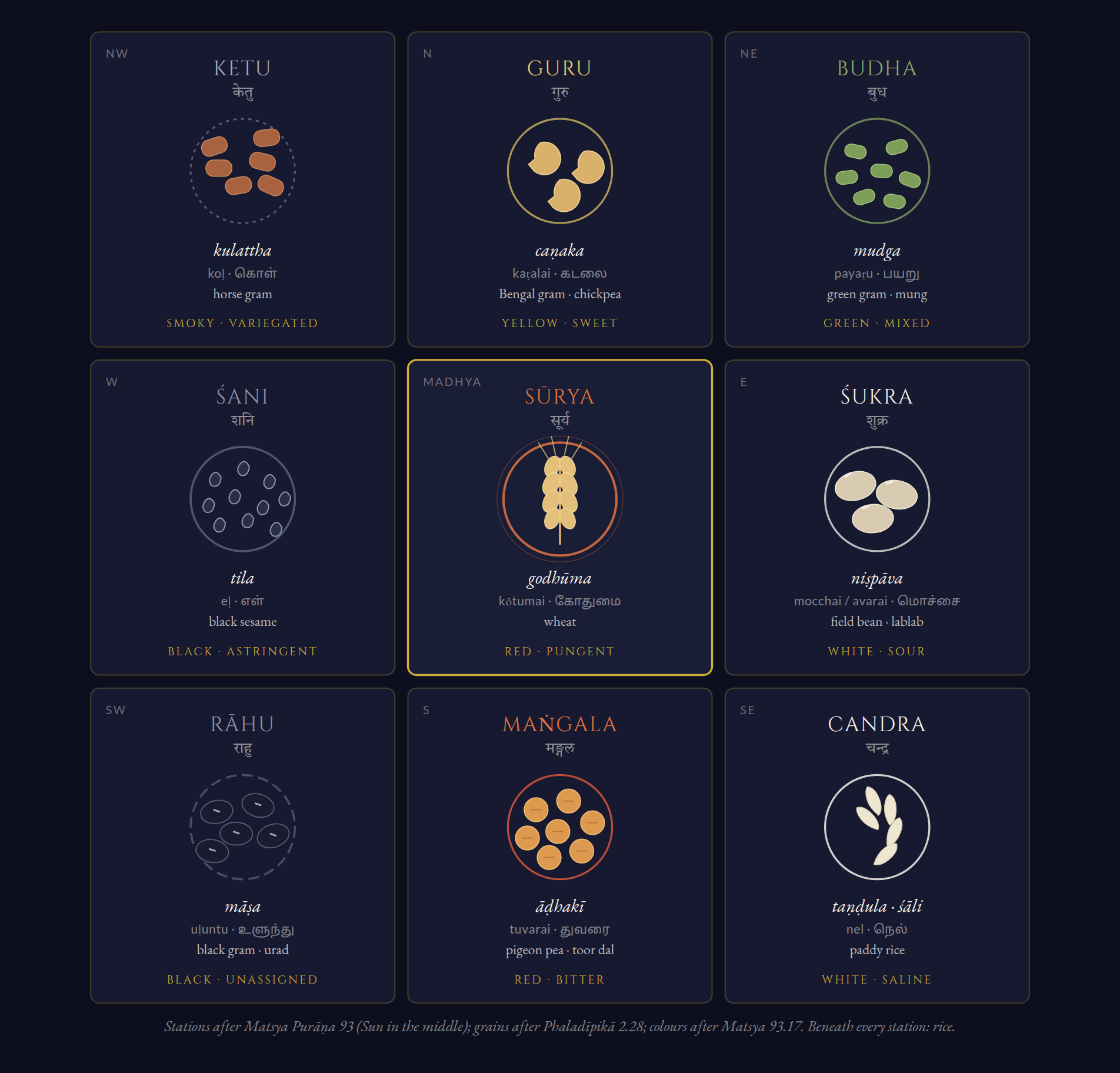
Anyone who has stood at a South Indian temple's navagraha shrine has seen the pantry's most concrete form: nine little heaps of grain, one before each planet. Tamil calls the set navatāṉiyam, the nine grains, and the University of Madras Tamil Lexicon lists them in an order every temple supplier knows by heart: kōtumai, nel, tuvarai, payaṟu, kaṭalai, avarai (or mocchai), eḷ, uḻuntu, koḷ — wheat, paddy, pigeon pea, mung, chickpea, field bean, sesame, black gram, horse gram[14]. The Lexicon does not say which grain belongs to which planet. It does not need to: the list marches in the canonical planetary order, Sun to Ketu, and the mapping is carried by the order itself.
Where does that mapping come from? Not, as one might guess, from the grahaśānti rites — the ritual books establish all nine planets on plain grains of rice and differentiate them by dish, colour, and wood, not by raw grain[8,13]. The verse the temple tray is actually performing sits in a horoscopic text: Mantreśvara's Phaladīpikā, chapter two, śloka twenty-eight. "The Sun's grain is wheat; the Moon's, rice; the grain belonging to Saturn is sesamum; that of Jupiter, Bengal gram; that of Ketu, horsegram. The grain signified by Mars is Dhal" — āḍhakī, the pigeon pea — "Mercury represents green gram; Dolichos lablab or cowgram is denoted by Venus, and black gram by Rahu."[3] Nine planets, nine grains, one śloka — the only place in the major classical texts where the full navadhānya mapping stands complete, nodes included. And Mantreśvara, his 1950 translator notes, "came from the Tinnevelly District, the Southern end of the Indian Peninsula"[3] — Tirunelveli, deep in the Tamil country. The temple tray and the śloka are not parallel traditions; they are one southern tradition, written down once in Sanskrit and daily in grain.
The north remembers the table a little differently, through the third door — gift. In the dāna scheme that Kane summarizes from the Dharmasindhu, the Sun still takes wheat and the Moon rice-in-a-vessel; but Mars receives masūra, the red lentil, not the pigeon pea; Mercury takes mung; and Saturn absorbs a whole shelf — black gram, sesame and sesame oil, and horse gram — leaving Rāhu sesame with its oil, and Ketu the cat's-eye gem[13]. The Padma Purāṇa's gift list agrees in outline: mung to Mercury, split chickpeas to Jupiter, rice to Venus, sesame and oil-cakes to Saturn, mustard, sesame, and black beans to Rāhu, and for Ketu, charmingly, "the seven kinds of grains" — the whole pantry at once[11]. When a modern manual tells you to donate red lentils for Mars, it is quoting this northern gift-line; when a temple hands you toor dal for Mars, it is quoting Mantreśvara. Both are right, by their own doors — and the doubled answer is worth keeping, because it preserves the honest seam between signifying a planet and paying one.
And the oldest layer of all may be neither. The Vaikhānasa-smārtasūtra — the South Indian householder's manual of the Vaikhānasa school, in Caland's 1929 edition — already feeds the nine planets nine differentiated messes of rice: plain rice for the Sun's station, milk-rice for the Moon's, sugar-rice, curd-rice, molasses-rice, turmeric-rice, and then, for the last three stations, sesame-rice, bean-rice, and cumin-rice[12]. Look at those final three: sesame at Saturn's place, black-gram at Rāhu's, a pungent seed at Ketu's. Centuries before the Phaladīpikā, the southern rite is already reaching for the same shelf — the dark oily seed for the dark slow planet, the black pulse for the shadow. The navadhānya did not fall from the sky entire; it crystallized, and we can watch it happen.
What the Rite Feeds Them
The oldest complete planet–food table in Sanskrit is not a list of significations at all. It is a menu. The Yājñavalkya Smṛti's grahaśānti — which Kane calls "the model of all homas in all medieval digests"[13] — prescribes, for the nine planets in order, the nine dishes of this essay's epigraph. The Mitākṣarā commentary unpacks them: guḍaudana, rice cooked with raw sugar, for the Sun; pāyasa, the milk-sweet, for the Moon; haviṣya, the ascetic's plain sacrificial food, for Mars; kṣīra-ṣāṣṭika, quick-ripening sixty-day rice boiled in milk, for Mercury; dadhyodana, curd-rice, for Jupiter; haviḥ, "clarified butter mixed with rice," for Venus; cūrṇa, "powdered sesamum mixed with rice," for Saturn; māṃsa, meat, for Rāhu; and citrānna, rice of many colours, for Ketu[6]. The same rite assigns each planet its firewood — arka for the Sun, palāśa for the Moon, khadira for Mars, apāmārga for Mercury, pippala for Jupiter, udumbara for Venus, śamī for Saturn, dūrvā grass for Rāhu, kuśa for Ketu[6,10] — a nine-plant garden still planted, station by station, at temple precincts as the navagraha-vana[24] — and its dakṣiṇā, from the Sun's milch cow to Ketu's goat, with the older translation's notes colouring even the animals to match their planets[6,7].
Set the purāṇic versions beside it and the menu starts to shimmer. The Matsya keeps most of the line but feeds Mars saṃyāva — a wheat-and-ghee sweet the translator renders "mohanabhoga" — gives Venus jaggery-rice where Yājñavalkya gave ghee-rice, and for Saturn upgrades the sesame powder to kṛsarā, a proper khichadi of "rice, sesamum and pulses, cooked in milk"[8]. The Garuḍa concurs on the outline and specifies the nodes plainly: cooked meat for Rāhu, "Vichitrannam (some thing like our modern Pilaos)," in Dutt's delicious 1908 English, for Ketu[9]. And the Vaikhānasa sūtra, as we saw, swaps Rāhu's meat for a mess of beans and gives Ketu cumin-rice — a vegetarian southern recension of the same nine-fold idea[12]. Even the colours are prescribed: the Sun's image drawn in red, the Moon's in white, Mars red, Mercury and Jupiter yellow, Venus white, Saturn and Rāhu black, Ketu the colour of smoke — "they should be dressed in the same colour of cloth and offered the same colour of flowers"[8]. (Mercury's familiar green is the dāna tradition's dissent: the Padma has him take "camphor, kidney beans, green piece of cloth"[11], and Bṛhaj Jātaka had already painted him harita, the green of grass[2]. The temple green-grocer follows the gift books, not the Matsya.)
Read as a doctrine, the menu is remarkably coherent. The two royal planets eat sweet — the Sun's sweetness fired with jaggery, the Moon's dissolved in milk. The ascetic dishes go to the ascetic planets: Mars the brahmacārī takes the renunciant's haviṣya, Saturn the servant takes ground sesame, the poor man's protein. Jupiter the brāhmaṇa receives curd-rice, the daily food of learned South India; Venus the preceptor of the asuras takes the richest simple thing in the Vedic kitchen, ghee. Mercury's dish is made of speed — rice that ripens in sixty days, for the fastest planet. And the nodes eat exactly as the nodes are: Rāhu, flesh — the appetite planet fed appetite's own food, the one dish with a death inside it; Ketu, chitrānna — many colours in one bowl, the dish with no single nature, for the planet of scattering and release. Nobody wrote that paragraph in the ninth century; but the menu implies it, and the menu is the verse.
| Graha | Yājñavalkya 1.304–305 R | Mitākṣarā gloss R | Matsya 93.19–20 R | Vaikhānasa IV.13 R |
|---|---|---|---|---|
| Sūrya | guḍaudana | rice with raw sugar | rice in coarse sugar | plain rice |
| Candra | pāyasa | milk-rice | ghee & milk-sugar rice | milk-rice |
| Maṅgala | haviṣya | hermits' sacrificial food | saṃyāva (wheat-ghee sweet) | sugar-rice |
| Budha | kṣīraṣāṣṭika | 60-day rice in milk | milk & rice | curd-rice |
| Guru | dadhyodana | curd-rice | curd-rice | molasses-rice |
| Śukra | haviḥ | clarified butter with rice | jaggery-rice | turmeric-rice |
| Śani | cūrṇa | powdered sesame with rice | kṛsarā (rice-sesame-pulse) | sesame-rice |
| Rāhu | māṃsa | meat with rice | goat's flesh | bean-rice |
| Ketu | citrānna | many-coloured rice | coloured rice | cumin-rice |
Table 2 · The grahaśānti menus compared[6,8,12]. Venus's column is the least stable — ghee, jaggery, or turmeric by recension — and the Vaikhānasa line replaces the nodes' meat with beans and cumin.
The Sun: Wheat, Heat, and the Pungent Shelf
The Sun's pantry is the pantry of vitality, and its anchor is beyond dispute: godhūma, wheat, his grain in Mantreśvara's śloka, in the temple tray, and at the head of the northern gift lists alike[3,14,13]. Caraka's food chapter reads almost like a solar hymn when it reaches wheat — "vitalizing, roborant, aphrodisiac, unctuous, stabilizing"[15] — the grain of strength for the graha of strength. Around the wheat, the rasa rule stocks the hot shelf: the Sun's taste is kaṭu, pungent[1,3], and so the great heating spices lean solar — fresh ginger, which Caraka crowns among bulbs and calls appetizer and aphrodisiac[15], black pepper, cayenne — "storehouses of solar energy," as Frawley puts it[21]. The later tradition even gave dry ginger the epithet viśvabheṣaja, the universal medicine[19] — a suitably imperial title for the king's own spice.
Two honest complications. First, Varāhamihira dissents on taste: his Sun presides over "seeds, pod-grains, bitter flavour... and over medicines"[4] — the Sun as the burning physician rather than the burning king. Second, the classical texts give the Sun no fruit or vegetable at all; the red produce one meets in modern lists — pomegranate above all — enters by the colour rule, the Sun being drawn and dressed in red in the śānti books[8], and pomegranate belongs at least as well to Venus's sour shelf, where Suśruta files it as "best of the acid kinds"[16]. At the rite the Sun eats guḍaudana, jaggery-rice[6] — sweetness with fire in it — and in the gift books he receives wheat, jaggery, copper, a ruby, a red cow[13]; Svoboda records the living upāya of feeding wheat to deer, or wheat and jaggery to a cow, on Sundays[22].
- Signature
- Red, pungent, wheat-gold. Drawn in red, red garments and flowers R[8]; taste kaṭu Ś[1,3]; robe of red silk Ś[1].
- Grain
- Wheat (godhūma / kōtumai) Ś[3] — so also the dāna books R[13].
- Spices
- Ginger, foremost of bulbs Ś[15]; black pepper, cayenne as pungent solar spices M[21]; saffron by colour and kingship P.
- Fruits
- Pomegranate and the red-gold orchard — by the colour rule only P; the verse-texts give the Sun no fruit.
- Vegetables
- None assigned classically; Varāhamihira's Sun keeps seeds, pod-grains, and medicines instead Ś[4].
- At the rite
- Guḍaudana, jaggery-rice R[6]; firewood of arka, the sun-plant R[6].
- Given away
- Wheat, jaggery, copper, ruby, red cow R[13]; wheat to deer on Sundays M[22].
The Moon: Rice, Milk, and Salt Itself
If the Sun's shelf is a fire, the Moon's is a tide. Her grain is rice[3] — and Āyurveda's finest rice at that, for Caraka calls red śāli "the best of them," curative of all three doṣas, and crowns it among all awned grains[15]. Her dish is pāyasa, rice dissolved in sweet milk[6], and milk is her food in essence: "foremost among the vitalizers and rejuvenators"[15], the one substance the body accepts as a mother's gift. Her taste is lavaṇa, salt[1,3] — the sea concentrated to a crystal — and here signification and dominion agree for once, because Varāhamihira's Moon literally rules salt, along with "sweet juice, flowers, fruits, water... paddy, barley, medicinal plants, wheat" and, expansively, "articles of food" in general[4]. Svoboda preserves the doctrine behind that generosity: the Moon rules all food, every other planet's shelf being borrowed from hers[22]. The Uttara Kālāmṛta's list for her reads like a sweet-stall inventory — "thick sugarcane," honey, wheat, salt[5] — and Caraka obliges the sugarcane at least, calling its juice cooling, unctuous, aphrodisiac[15], while rock salt, saindhava, is "the best of salts... non-irritant," the mildest member of the harshest taste[15,16].
The white and watery produce gathers to her by the colour rule: coconut, which Caraka makes cooling and strengthening[15]; the white gourd kūṣmāṇḍa, "eliminative of urine and feces, curative of all kinds of disorders" when ripe[15]; cucumbers and melons of every water-heavy kind P. In her year, says Varāhamihira, "there will be an abundant growth of wheat, rice, barley and other grains and also of excellent sugar-cane"[4] — the Moon as harvest-mother. And the living remedial kitchen keeps her Monday sweet: rice pudding, offered and shared, "since sweet is in general the most life-enhancing of the tastes"[22].
- Signature
- White, saline, brimming. Drawn in white R[8]; taste lavaṇa Ś[1,3]; ruler of "articles of food" at large Ś[4].
- Grain
- Rice (taṇḍula / nel) Ś[3] — red śāli foremost of grains, white ṣaṣṭika foremost of quick rices Ś[15].
- Spices
- Rock salt (saindhava), best of salts Ś[15,16] — the Moon's one "spice" is the sea's.
- Fruits
- Sugarcane and honey Ś[5]; coconut P with Caraka's blessing on its coolness[15]; melons by the water rule P.
- Vegetables
- White gourd (kūṣmāṇḍa) P[15]; cucumber P.
- At the rite
- Pāyasa, milk-rice R[6]; palāśa wood; a conch as her dakṣiṇā R[6].
- Given away
- Rice in a vessel, white cloth, a jar of ghee R[13]; rice pudding shared on Mondays M[22].
Mars: Two Red Dals and the Bitter Cure
Mars is where the pantry's two doors visibly disagree, and the disagreement is geographic. Ask a South Indian temple and Mars's grain is āḍhakī — tuvarai, the pigeon pea, split into the yellow-red toor dal of the southern kitchen — on Mantreśvara's authority[3,14]. Ask a northern paṇḍit and it is masūra, the red lentil, on the authority of the gift books[13] — the choice the moderns inherited, de Fouw and Svoboda listing "red lentils" for Mars without a backward glance[20]. Both are red; both are honest; they simply came through different doors. Svoboda states the underlying logic plainly: Mars's energy "displays itself most strongly in those things which best resonate with it, such as red lentils, red cloth... thorny trees, and copper"[22]. Caraka, for his part, would counsel the gentler shelf — the lentil is "astringent in action," constipating[15,16], while the pigeon pea checks kapha and pitta[15] — pulses that bind and cool a planet that scatters and burns.
His taste is tikta, bitter[1,3] — and here I side with the therapists in reading the assignment as a prescription as much as a description. Bitter is precisely the taste that pacifies pitta; "the most effective taste for controlling Mars energy," in Frawley's summary of the classical reasoning[21]. So the bitter vegetables fill his shelf: the bitter gourd, which Caraka groups among the bitters that regulate kapha and pitta[15], and the pointed gourd, paṭola, Suśruta's best of all bitter vegetables[16] — with fenugreek joining them in the later kitchen P, though Sharma's modern pharmacopoeia audits methikā as pungent rather than bitter: hot, vāta-subduing, a kindler of digestion[18]. Meanwhile Varāhamihira's Mars, ever the soldier, presides over stores rather than salads: "red fruits, red flowers, corals... jaggery, wine"[4] — the sweet fuel and the strong drink. Even the Uttara Kālāmṛta gives him, deliciously, "a good dinner"[5]. At the rite he is fed the ascetic's haviṣya, or in the Matsya a wheat-ghee sweet[6,8] — the warrior fed like a renunciant, lest he ask for seconds.
- Signature
- Red, bitter-tongued, well-fed. Drawn in red R[8]; taste tikta Ś[1,3]; "a good dinner" among his significations Ś[5].
- Grain
- Pigeon pea (āḍhakī / tuvarai) in the southern line Ś[3]; red lentil (masūra) in the northern gift line R[13] and the moderns M[20].
- Spices
- The hot end of the rack — chilies, cayenne — by pungency shared with the Sun M[21]; fenugreek P — pungent, hot, and vāta-subduing by Sharma's audit[18].
- Fruits
- Red fruits as a class, with jaggery and wine Ś[4]; jaggery itself a double-edged sweet — Caraka lists it among the least wholesome of cane products[15].
- Vegetables
- Bitter gourd Ś[15,16]; pointed gourd (paṭola), best of bitters Ś[16]; beet and carrot by the colour rule P.
- At the rite
- Haviṣya, the hermit's food R[6]; saṃyāva, a wheat-ghee sweet, in the Matsya R[8]; khadira wood R[6].
- Given away
- Coral, wheat, masūra, red bull, jaggery, red cloth, copper R[13].
Mercury: The Mixed Platter, Painted Green
Mercury's taste is miśra — mixed, all of them at once[1,3] — which is less an evasion than a portrait: the convertible planet, benefic with benefics, malefic with malefics, tastes like whatever he stands next to. His grain, though, is fixed and superb: mudga, the green gram, which Caraka names "the best of pulses" and sets in his short list of the most wholesome foods on earth[15] — light, cooling, the one dal that offends nobody, fit for the planet of adaptable intelligence. His ritual dish is made of speed: kṣīra-ṣāṣṭika, rice that ripens in sixty days, boiled in milk[6] — Caraka calls the white ṣaṣṭika best of its kind[15] — fast food in the oldest sense, for the fastest-moving graha.
His colour is a small scholarly comedy. The Matsya paints him yellow[8]; Varāhamihira had already painted him harita — grass-green — in the Bṛhaj Jātaka[2]; the Padma's gift list settles it for the marketplace with "kidney beans, green piece of cloth"[11] — and so the green door won, and mung, coriander leaf, and the whole green-grocer's stall are his in living practice P. His dominion list in the Bṛhat Saṁhitā is a surprise worth savoring: "ghee, gingelly and other oils; over seeds, over bitter flavour"[4] — the unctuous substances filed under the dry, bookish planet, a reminder that the sixteenth chapter follows its own logic of commerce rather than temperament. The therapeutic moderns use his shelf for the mind: bitter "can stimulate the mental activity of Mercury"[21], and the brain-herbs — brāhmī, gotu kola — with basil and mint among his calming aromatics, are his in the Ayurvedic-astrology synthesis[21]. The leafy greens the colour rule hands him come with Caraka's dry smile: the śāka class is mostly heavy and rough fare[15] — even the green planet's salad is to be taken with ghee.
- Signature
- Green (the gift books) or yellow (the Matsya), tasting of everything. R[8,11] · taste miśra Ś[1,3] · grass-green in the Bṛhaj Jātaka Ś[2].
- Grain
- Green gram (mudga / payaṟu) Ś[3] — Caraka's best of pulses Ś[15]; so also the Padma's gift list R[11].
- Spices
- Coriander and the fresh green herbs P; basil and mint among his calming aromatics M[21].
- Fruits
- None classically; the green orchard by colour P.
- Vegetables
- Leafy greens by the colour rule P — with Caraka's caveat on the heaviness of the śāka class[15].
- At the rite
- Kṣīra-ṣāṣṭika, sixty-day rice in milk R[6]; apāmārga wood; gold his dakṣiṇā R[6].
- Given away
- Mung, emerald, bronze vessel, blue (or green) cloth R[13,11].
Jupiter: Sweetness, Curd-Rice, and the Turmeric Question
On Jupiter every source for once agrees: his taste is madhura, sweet — Parāśara, Mantreśvara, Varāhamihira, and the moderns in unbroken chorus[1,3,4,20]. Sweet, in Āyurveda, is the taste that builds, nourishes, and blesses — the taste of ojas — and it belongs to the great benefic as naturally as expansion does. His grain is caṇaka, the chickpea[3]; the Padma has the afflicted give him "two-portioned grams" — split chana — with yellow cloth and gold[11]; and in a pleasing convergence, Varāhamihira makes the people of Viśākhā — a nakṣatra the daśā system hands to Jupiter[1] — "dealers in gingelly seeds, beans, cotton, black gram and chick peas"[4]. His ritual dish is dadhyodana, curd-rice[6], the daily bread of the learned South; the Uttara Kālāmṛta lists "curd, etc." and "sweet juice" among his significations[5]; and his Thursday vrata, in the story Svoboda retells, is kept with chickpeas and raisins[22].
Two of his popular foods deserve honest footnotes. Ghee — surely the most Jupiterian substance in the kitchen, "promotive of memory, intelligence... the best of the unctuous substances"[15] — is nowhere assigned to Jupiter in the texts consulted here; Varāhamihira files ghee, of all places, under Mercury[4], and its Jupiter-association rides on the priestly logic of the sacrifice P. And turmeric, the yellow root that modern lists hand him almost by reflex, enters classically by a side door — the Vaikhānasa rite's turmeric-rice is served not at Jupiter's station but at Venus's[12] — so his claim on it is the colour rule's, reinforced by the yellow garments of his gift-list[11] P. Sharma's pharmacopoeia only sharpens the joke: haridrā is bitter-pungent and hot, and its signature act is varṇya — "dehavarṇavidhāyinī, bestower of the body's colour," runs the nighaṇṭu verse he prints[18] — a complexion-drug wearing Jupiter's robe on what §X will show to be Venus's business. What the Bṛhat Saṁhitā does grant him is a perfumer's shelf: benzoin, jaṭāmāṁsī, costus, "salt, beans, sweet flavour, wax" and the husk of cardamom[4] — sweetness with incense in it. (That husk, coraka, is itself a member of Vāgbhaṭa's cardamom-led elādi gaṇa[17] — cardamom's own claim is weighed in §X.) His chickpea, one must add, carries Caraka's fine print — light, cooling, sweet-astringent, and (Suśruta says) no friend to virility[15,16] — the guru's grain keeping the guru's vows.
- Signature
- Yellow, sweet, expansive. Painted yellow with the Matsya's yellow cloth and flowers R[8]; taste madhura in every list Ś[1,3,4]; the saffron robe Ś[1].
- Grain
- Chickpea (caṇaka / kaṭalai) Ś[3]; split chana in the gift books R[11].
- Spices
- Cardamom husk (coraka) and the aromatic resins Ś[4]; turmeric by the yellow rule P — classically served at Venus's station[12].
- Fruits
- The sweet orchard by the rasa rule P; raisins with his Thursday chickpeas M[22]; "sweet juice" among his significations Ś[5].
- Vegetables
- None assigned; his Bṛhat Saṁhitā shelf holds salt, beans, and wax instead Ś[4].
- At the rite
- Dadhyodana, curd-rice R[6]; pippala — the aśvattha, the bodhi fig — his wood R[6].
- Given away
- Split chana, yellow garments, gold, topaz R[11]; ghee and honey by priestly custom P.
Venus: The Sour Shelf and the Spice Cabinet
Venus's taste is amla, sour[1,3] — "classically ascribed to Venus... because of its stimulating and attractive nature," as Frawley glosses it[21] — and the sour shelf is a pleasure to stock, because Āyurveda loves its members with reservations, exactly as the texts love Venus. The lime and lemon are hers: Caraka's jambīra is "appetizer, digestive-stimulant... mouth cleanser"[15], Suśruta's citron "light, acid, appetising, and pleasant"[16]. Tamarind is hers, acid and heating[16]. The pomegranate — sweet, astringent, and acid, "unctuous, hot, cordial"[15], best of the acid fruits[16] — is the shelf's crown jewel, though the colour rule keeps lending it to the Sun and Mars. Even āmalakī, the emblic that owns every taste but salt and anchors Caraka's rejuvenatives[15], leads with sour and so leans toward her P. And when Varāhamihira glosses Venus's triphalā, his translator offers a second reading almost too Venusian to be accidental: not the three myrobalans but "the three sweet fruits of grape, pomegranate and date"[4].
But the Bṛhat Saṁhitā's Venus is above all a perfumer and a spicer: "perfumes, flowers, perfumed paste... white silk, Rodhra, Patra, Coca, nutmeg, Agaru, Vacā, Pippalī and sandal"[4] — and, in the same chapter, "persons that eat good and sweet meals." Two of those words want weighing before anyone announces that cinnamon belongs to Venus. Patra, the cassia leaf, is secure. Coca is not: the lexica gloss it for this text as the cinnamon bark, and Suśruta uses it so — but the same word means coconut elsewhere in the Bṛhat Saṁhitā itself, and a banana in Apte; Iyer, wisely, leaves it untranslated[19]. The leaf for certain, then; the bark on the likeliest reading, with coconut — a no less Venusian resolution — in reserve; and true cinnamon under its own name, tvak, nowhere in the list. The living kitchen, it should be said, has never felt cinnamon as Śukra's: Frawley files it with the Sun's aromas and the vāta planets' mild spices[21]; the śāstra tag on this cell is Varāhamihira's voice, and his alone. Nutmeg, at least, needs no defence — Sharma makes jātīphala vṛṣya, an aphrodisiac, its resort the sleepless night, and the classical lexicon even counts it śukrastambhaka, a retainer of seed[18] — a spice with a thoroughly Venusian résumé. The long pepper deserves a Venus-worthy paradox: pungent on the tongue, Caraka insists it is "sweet in post-digestion... neither overmuch unctuous nor over-much hot"[15] — a hot spice that behaves, in the end, sweetly; the rasāyana chapters even prescribe a year-long course of it taken with honey and ghee[15]. Her ritual dish is the richest plain thing in the kitchen — haviḥ, ghee with rice[6] — though the recensions cannot quite hold her still: the Matsya feeds her jaggery-rice, the Vaikhānasa turmeric-rice[8,12]. Her own grain, niṣpāva, the field bean of the Tamil tray[3,14], is the one joke the tradition plays on her: Caraka finds it dry, vāta-provoking, and — of all things for Venus — "nonaphrodisiac"[15]. The goddess of rasa keeps a plain bean in the cupboard, perhaps to remember that desire, too, needs fasting days.
And what of cardamom, which the living kitchen hands to Venus almost by reflex? Varāhamihira, as we saw, files the cardamom-husk under Jupiter — but it is Vāgbhaṭa who supplies the Venusian brief. In the Aṣṭāṅgahṛdaya's own food chapter, elā stands with cinnamon's bark and leaf in the trijātaka, "the three aromatics," saffron making it four[17] — and of that company, the leaf certainly, and the bark on the likeliest reading of coca, already stand on Varāhamihira's Venus shelf. In the chapter of gaṇas, the two cardamoms lead the elādi gaṇa, the pharmacopoeia's perfume cabinet — jasmine, saffron, aguru, coca, patra, and indeed coraka among its members — whose stated work is varṇaprasādana: "It brightens the complexion and destroys itching, pimples, and boils"[17]. Elā's own ledger in the modern pharmacopoeia reads like a sketch of the planet: pungent yet sweet, cooling for all its fragrance, friend to all three doṣas, and hṛdya — dear to the heart[18]. And in the vājīkaraṇa chapter — the clinic of śukra, the very tissue the jātaka scheme hands to Venus[2] — cardamom enters the aphrodisiac electuary with cinnamon and saffron, on whose account a man "ascends like a horse, and rejoices like a sparrow"[17]. The planet-assignment remains the practice layer's; the pharmacology beneath it — fragrance, complexion, and desire — is Vāgbhaṭa's.
- Signature
- White, sour, perfumed. Drawn in white R[8]; taste amla Ś[1,3]; mistress of "good and sweet meals" Ś[4].
- Grain
- Field bean (niṣpāva / mocchai, avarai) Ś[3,14] — dry and unglamorous by Caraka's audit[15].
- Spices
- Cassia leaf (patra) and coca — likely the cinnamon bark — with nutmeg, long pepper, sandal Ś[4,19]; cardamom by the living tradition P, with Vāgbhaṭa's brief of perfume, complexion, and vājīkaraṇa behind it[17,18].
- Fruits
- The sour orchard: lime, citron, tamarind, pomegranate Ś[15,16]; grape–pomegranate–date as her triphalā Ś[4]; āmalakī by its leading sourness P.
- Vegetables
- None classically; the fermented and pickled sours of the living kitchen P.
- At the rite
- Haviḥ, ghee-rice R[6] — jaggery-rice or turmeric-rice by recension R[8,12]; udumbara wood R[6].
- Given away
- Rice, white garment, silver, sandal, camphor; a white horse R[11,8].
Saturn: Sesame, All the Way Down
No planet's pantry is as consistent as Saturn's, and none is as dark. His grain is tila, sesame — black sesame — in the Phaladīpikā, in the Tamil tray, in the Vaikhānasa's sesame-rice, in Yājñavalkya's cūrṇa of pounded sesame, in the Matsya's kṛsarā khichadi, in the gift books' "sesame and sesame oil," in the living Saturday customs without exception[3,14,12,6,8,13]. The northern dāna tradition simply hands him the whole dark shelf: "māṣa beans, sesame and sesame oil, kulittha," iron, a black cow[13]; the Uttara Kālāmṛta adds "black grains" and, tellingly, "oil"[5]. His taste is kaṣāya, astringent[1,3] — the taste that dries, binds, and slows, vāta's own flavour — though Varāhamihira, characteristically harsher, gives him pungent and bitter, plus "beans, leguminous seeds and Niṣpāva"[4], poaching Venus's bean for the pantry of scarcity. In his year, "crops found growing here and there will perish for want of water"[4]; Saturn is the one graha whose farming column is a warning.
And yet — open the sesame jar and Āyurveda's verdict is startling: tila is "unctuous, hot, sweet, bitter and astringent... a skintonic and hair tonic," and the black variety the best of all[15,16]. The darkest planet's food is a concentrated warmth — oil pressed out of a black seed — which is precisely how the remedial tradition uses him: not to starve Saturn but to oil him. The living upāyas are a folk-liturgy of this insight: black sesame and its oil offered on Saturdays[22]; roti spread with mustard oil and salt fed to crows[22]; the Saturday single meal taken with urad dal, or Johari's Saturday khichadi of split black gram and rice, with candies of black sesame and jaggery for the sweet-toothed penitent[22,23]. By the colour-and-taste rule his fruit is the jamun, the astringent black plum — a fruit Caraka names, with perfect Saturnine irony, foremost among the provokers of vāta[15] — and his tree is the śamī, his own firewood in the śānti rite, still worshipped on Saturdays[6,22].
- Signature
- Black, astringent, slow. Drawn in black with black cloth and flowers R[8]; taste kaṣāya Ś[1,3]; pungent-and-bitter to Varāhamihira Ś[4].
- Grain
- Black sesame (tila / eḷ) Ś[3] — with black gram and horse gram added in the northern gift line R[13].
- Spices
- Sesame oil and mustard oil as his unctions R[13][22]; "oil" among his significations Ś[5].
- Fruits
- Jamun, the black astringent plum — by colour and rasa P, with Caraka's vāta warning attached[15].
- Vegetables
- Beans and leguminous seeds as a class, including niṣpāva Ś[4]; the dark and dried P.
- At the rite
- Cūrṇa, sesame-powder rice R[6]; kṛsarā, the sesame-pulse khichadi, in the Matsya R[8]; śamī his wood R[6].
- Given away
- Black gram, sesame & its oil, horse gram, iron, black cow, buffalo R[13,11]; Saturday khichadi of urad and rice M[23].
Rāhu: The Black Gram and the Hungry Shelf
The nodes keep no tastes — no classical list consulted for this essay assigns Rāhu a rasa — and the maxim everyone reaches for here, śanivad rāhuḥ kujavad ketuḥ, "Rāhu is like Saturn, Ketu is like Mars," deserves its own honest footnote: it is quoted everywhere and locatable nowhere. I searched the Uttara Kālāmṛta, to which it is most often credited, and the Parāśara text besides, and found it in neither; what Parāśara actually says is smokier and stranger — Rāhu blue-black, forest-dwelling, "horrible," and "Ketu akin to Rāhu"[1]. If a reader can point me to the maxim's verse, my inbox is open. Until then it stands as the tradition's most successful piece of oral śāstra P.
His foods, though, are firmly attested, and they are Saturn's shelf with the shadows deepened. His grain is māṣa, the black gram[3] — and Varāhamihira agrees, giving Rāhu "black gram and gingelly seed"[4], urad and sesame, the two darkest seeds in the sack. The Vaikhānasa feeds his station a mess of beans[12]; the Padma's gift list gives him "mustard, sesamum, black beans, a buffalo, and a goat"[11]; Yājñavalkya and the purāṇas feed him the one dish with a death in it — meat, goat's flesh in the Matsya[6,8] — the appetite planet paid in appetite's own coin. Urad itself is Āyurveda's most double-edged pulse, and the ambivalence is almost a portrait: Caraka calls it "an excellent aphrodisiac... quickly imparts virility," heavy, hot, strengthening — and then files it among the most unwholesome of pulses, a promoter of kapha and pitta[15]. Potent and problematic at once: that is Rāhu on a plate. By the fourth door, his shelf gathers the intense and the borderline — the alliums, garlic and onion, which Āyurveda itself praises (garlic "curative of... Vata-disorders," onion "strengthening, aphrodisiac"[15]) but the smārta table excludes as tāmasika, and which living practice therefore files under the shadow planets P; the fermented, the smoked, the intoxicating P[21]. And by the nakṣatra door — Rāhu rules Śatabhiṣaj in the daśā scheme[1] — Varāhamihira's chapter fifteen supplies the shelf's wildest row: those born under it are "dealers in fish and hogs... dealers in wine"[4]. An inference, and I tag it as one; but it is the texts' own geometry, and it converges suspiciously well.
- Signature
- Black-blue, tasteless, insatiable. Drawn in black R[8]; no rasa in any classical list; "śanivad rāhuḥ" an unlocated proverb P.
- Grain
- Black gram (māṣa / uḻuntu) Ś[3] — "black gram and gingelly seed" in Varāhamihira Ś[4].
- Spices
- Mustard seed and oil R[11]; garlic and the alliums by the tāmasika rule P[15].
- Fruits
- None assigned; the fermented and over-ripe by inference P.
- Vegetables
- Onion and the pungent underground P — praised by Caraka, barred from the smārta table[15].
- At the rite
- Māṃsa, meat — goat's flesh in the Matsya R[6,8]; a mess of beans in the vegetarian Vaikhānasa line R[12]; dūrvā grass his "wood" R[6].
- Given away
- Sesame & its oil, mustard, black beans, iron, a blanket, a buffalo R[13,11].
Ketu: Horse Gram, Many-Coloured Rice, and the Root Cellar
Ketu's grain is kulattha, the horse gram[3] — koḷ, the hardiest, humblest pulse in the tray, cattle-feed and famine food, esteemed by physicians and ignored by cooks. Āyurveda knows it as a breaker: hot, astringent, acid in after-taste[15], and above all — Suśruta's claim — "curative in cases of urinary calculi"[16]: the pulse that splits stones. It is hard to invent a better food for the graha of severance and dissolution, the headless body that ends things so that they may be released. His ritual dish points the same way by opposite means: citrānna, rice of many colours[6] — "some thing like our modern Pilaos," in Dutt's rendering of the Garuḍa[9] — the dish of no single nature for the planet of no single form; the Vaikhānasa gives his station cumin-rice[12], and the Padma, most generously of all, has his gift be "the seven kinds of grains"[11] — when propitiating the planet of scattering, one scatters the whole pantry. His colour is smoke[8]; his flag-body is painted in it.
And then there is the door I have saved for him, because it bears his name. In the daśā scheme Ketu rules three nakṣatras, and the third of his three lunar mansions is Mūla — the word means "root" — whose natives Varāhamihira makes "dealers in flowers, roots, fruits and seeds"[4,1]. By this door, and I flag it plainly as this essay's inference upon the texts' own geometry, the root cellar drifts to Ketu: the elephant-foot yam that Suśruta prescribes for piles[16], the radish whose young form Caraka praises and whose overgrown form he condemns[15], the heavy āluka yams that his most-unwholesome list eyes warily[15] — the underground larder, foods that grow headless in the dark and are dug up whole. The living kitchen's Ketu-foods follow the same instincts: mixed-grain khichadis, the multigrain and the motley P. Fittingly for the mokṣa-kāraka, his is the one shelf whose logic points out of the pantry altogether: the grain that breaks stone, the dish of all colours, the root pulled free of the ground.
- Signature
- Smoke-coloured, many-grained, severing. Drawn in smoke R[8]; no rasa assigned; "Ketu akin to Rāhu" Ś[1].
- Grain
- Horse gram (kulattha / koḷ) Ś[3] — the stone-breaking pulse Ś[16].
- Spices
- Cumin, by his station's rice in the Vaikhānasa rite R[12] — Caraka's appetizing dispeller of vāta and kapha[15].
- Fruits
- None assigned; Mūla's "roots, fruits and seeds" by the nakṣatra door Ś[4] + inference.
- Vegetables
- The root cellar — elephant-foot yam, radish, the tubers — by the Mūla inference P[15,16].
- At the rite
- Citrānna, many-coloured rice R[6,8]; cumin-rice in the south R[12]; kuśa grass his wood; a goat his fee R[6].
- Given away
- "The seven kinds of grains" and gold R[11]; a cat's-eye gem R[13]; a blanket P.
Nine Shelves at a Glance
Here is the pantry entire — the working summary of everything argued above, with each cell carrying its door-tag. Where two traditions split a cell (Mars's two dals, Venus's three dishes), both tenants are listed. Treat the P and M entries as what they are: the living tradition's extensions, useful and coherent, but not verses.
| Graha | Taste Ś | Grain Ś/R | Spices | Fruits | Vegetables & tubers | Ritual dish R |
|---|---|---|---|---|---|---|
| Sūrya | pungent | wheat | ginger, black pepper M | red-gold orchard P | — (seeds & medicines Ś) | jaggery-rice |
| Candra | saline | rice | rock salt Ś | sugarcane, honey Ś; coconut, melon P | white gourd, cucumber P | milk-rice |
| Maṅgala | bitter | toor (S) · masūra (N) | chili, fenugreek P | red fruits, jaggery, wine Ś | bitter gourd, paṭola Ś | haviṣya / wheat-ghee sweet |
| Budha | mixed | mung | coriander, mint, brāhmī PM | green orchard P | leafy greens P | 60-day rice in milk |
| Guru | sweet | chickpea | cardamom husk Ś; turmeric P | sweet orchard P; raisins M | — (salt, beans, wax Ś) | curd-rice |
| Śukra | sour | field bean | cassia leaf, coca (likely cinnamon bark), nutmeg, long pepper, sandal Ś; cardamom P | lime, citron, tamarind, pomegranate Ś | pickled sours P | ghee-rice / turmeric-rice |
| Śani | astringent | black sesame | sesame & mustard oils R | jamun P | dried beans, niṣpāva Ś | sesame-rice / kṛsarā |
| Rāhu | — | black gram | mustard R; alliums P | fermented P | onion, garlic P | meat / bean-rice |
| Ketu | — | horse gram | cumin R | Mūla's roots & seeds Ś | yam, radish, tubers P | many-coloured rice |
Table 3 · The master table. Sources as argued in §§V–XIII; the door-tags mark the kind of authority, and the per-graha sections carry the citations.
What This Table Is, and Is Not
A few closing candors, so that this essay can be used and not merely believed. First: the classical record is narrower than the modern literature implies. The verse-texts assign tastes, grains, plants, and dominions; they assign almost no fruits and vegetables planet-by-planet. Nearly every produce-row in circulation today is the work of the colour rule and the rasa rule — legitimate tools, both classical in spirit, but inferences all the same. Frawley, to his credit, says this out loud: it is possible to equate individual foods with the planets, he writes, "but this is a complex matter and is best left more for an advanced study of medical astrology"[21] — and his own book therefore stops at doṣa-triads. The tag-system of this essay is my attempt at the same honesty with more granularity.
Second: the disagreements between sources are not defects to be harmonized away but strata to be read. Varāhamihira's taste-table differs from Parāśara's because the sixth century is not the same project as the jātaka compendia; the toor-versus-masūra split preserves the difference between signifying Mars and paying him; Venus's three ritual dishes are three recensions of one rite, each internally coherent. Where this essay states a mapping without qualification — wheat to the Sun, sesame to Saturn — it is because the doors genuinely agree there. Where they do not, I have kept both tenants on the shelf, labelled.
Third, and most practically: this is a table of correspondences, not a diet. Āyurvedic eating is governed by agni, doṣa, season, and constitution — by Caraka's logic, not by one's daśā — and nothing above suggests that a person in a Saturn period should live on sesame, or that Rāhu's shelf is anyone's dinner. The remedial tradition itself mostly has one give the food away, not eat it: the pantry's darkest shelves are for donation, the transaction by which a planet's substance leaves the house. Where planetary dietetics is genuinely wanted, the sober modern route is Frawley's — feed the doṣa the planet aggravates[21] — which returns the whole question, as every Ayurvedic question returns, to the person and their fire. Consider this essay the labelled pantry; the cooking still belongs to the physician, and the kitchen, as Svoboda's teacher would remind us, belongs in the end to the Moon, who rules all food[22].
When Honoured, You Will Honour
Why feed a planet at all? The Yājñavalkya Smṛti, having listed the woods and the dishes and the fees, gives the reason in the form of a boon: whoever is troubled by a graha should worship it with care, "for by Brahmā a boon has been given to them thus: when honoured, you will honour"[6]. And then the verse everyone remembers: on the planets depend the rise and fall of kings, the existence and destruction of the universe — "therefore the Grahas must be worshipped first of all"[6]. The theology is reciprocity, and the currency, remarkably, is food. Not gold first, not mantra first — the smṛti's planetary diplomacy opens with a menu.
I find I cannot look at a navagraha tray now without seeing the whole apparatus behind it — Mantreśvara's śloka holding nine grains in nine syllable-slots; the Vaikhānasa priest's nine rice-pots; Kane's digests patiently itemizing which pulse pays which planet; Caraka in the background, keeping the true accounts of every seed. The tray is the oldest interface between the sky and the kitchen: nine heaps of grain, each one a compressed verse, waiting on a stone ledge for someone to ask who decided this? — and to discover that the answer is: many someones, over many centuries, each adding a labelled shelf to a pantry that was never finished, and is not finished now.
The sky has been eating from it all along.
On This Site
Companion pieces: the planets and the eight Āyurvedic diseases of the mind maps another graha-correspondence with sources; A Kitchen in Every Pot, A Vow: What to Eat, and About Cooking carry this site's kitchen thinking; Ancient Organics Ghee and Johari's Ayurvedic Healing Cuisine review two of its staples. The nine grahas' positions today run in the Pañchāṅga tool, and their yantras are drawn in Graha Yantras.
References & Sources
Every classical quotation in this essay was checked against the translation cited, at the page linked, during the writing (August 2026). Verse numbers follow each translation’s own printed numbering, which can differ across editions.
The Horoscopic Texts
- Bṛhat Parāśara Horā Śāstra, tr. R. Santhanam (Ranjan Publications, Delhi, 1984). Chapter 3: the planetary tastes at v. 34; Rāhu and Ketu described ("Ketu is akin to Rahu") at v. 30; trees at vv. 39–40; robes at v. 44; dhātu–mūla–jīva at v. 47. The viṁśottarī rule — nakṣatra lords in a ninefold cycle from Kṛttikā — at ch. 46, vv. 12–14. Scans at archive.org and archive.org (single volume).
- Bṛhaj Jātaka of Varāhamihira, ch. 2: planetary colours at 2.5 (coppery-red Sun, white Moon, very red Mars, grass-green Mercury, yellow Jupiter, variegated Venus, black Saturn); castes at 2.7; the bodily dhātus at 2.11. Sanskrit with English, verse by verse, at wisdomlib.org.
- Phaladīpikā of Mantreśvara, tr. Panditabhushana V. Subrahmanya Sastri (2nd ed., Bangalore, 1950): the grains of the nine planets at 2.28; the flavours at 2.31; the trees at 2.37. The translator's preface places Mantreśvara in the Tinnevelly (Tirunelveli) district, flourishing about the sixteenth century. Scan at archive.org; the same translation with Sanskrit at wisdomlib.org.
- Bṛhat Saṁhitā of Varāhamihira, tr. N. Chidambaram Iyer (1884). Ch. 16, "on the dominions of the planets": Sun 16.1–5; Moon 16.7–8; Mars 16.13–15; Mercury 16.16–20; Jupiter 16.21–25; Venus 16.26–30 (with Iyer's two glosses on triphalā); Saturn 16.31–34; Rāhu 16.35–37; Ketu 16.38. Ch. 15, nakṣatra dominions: Puṣya 15.6; Viśākhā 15.14; Mūla 15.17; Śatabhiṣaj 15.22. Ch. 19, the planets' years: Moon 19.6; Venus 19.16; Saturn 19.21. At wisdomlib.org: ch. 16 · ch. 15 · ch. 19.
- Uttara Kālāmṛta, attributed to Kālidāsa, tr. V. Subrahmanya Sastri (Bangalore, 1939), Section V, the planetary significations: the Moon's list (ślokas 25½–29) includes "thick sugarcane," honey, and wheat; Mars's (30–33½) "a good dinner"; Jupiter's (38–41) "curd, etc." and "sweet juice"; Saturn's (45½–50) "black grains" and "oil." PDF of the 1939 translation; the P. S. Sastri translation (Ranjan), whose Moon-list adds salt, at archive.org.
The Ritual Books & Dharmaśāstra
- Yājñavalkya Smṛti with the Mitākṣarā, Ācārādhyāya 1.295–308 (the grahaśānti), tr. J. R. Gharpure (Bombay, 1936): the rite's purpose at 1.295; images and their materials at 1.297–298; the nine samidh woods at 1.302–303; the nine foods, with the Mitākṣarā's glosses, at 1.304–305; the dakṣiṇās at 1.306; the boon "when honoured, you will honour" at 1.307; "therefore the Grahas must be worshipped first of all" at 1.308. At wisdomlib.org.
- Yājñavalkya Smṛti, tr. Srisa Chandra Vidyarnava (Sacred Books of the Hindus XXI, Allahabad, 1918) — the corroborating translation, whose notes (after Bālambhaṭṭa) colour the dakṣiṇās: a yellow cloth, a grey horse, a black cow. archive.org.
- Matsya Purāṇa, ch. 93 (grahaśānti), tr. "A Taluqdar of Oudh" (Sacred Books of the Hindus XVII, 1916): the planets established on grains of rice, Sun in the middle, at 93.11–12; the colours at 93.17–18; the foods at 93.19–20; the samidhs and the 108 oblations at 93.27–28; the gifts at 93.60–63. archive.org.
- Garuḍa Purāṇa, ch. CI, tr. M. N. Dutt (Calcutta, 1908) — the parallel rite, with "Vichitrannam (some thing like our modern Pilaos)" for Ketu and cooked meat for Rāhu. wisdomlib.org.
- Agni Purāṇa, ch. 167, tr. N. Gangadharan: the twigs of arka, palāśa, khadira, apāmārga, pippala, udumbara, śamī, dūrvā and kuśa "offered in the fire mixed with honey, clarified butter and curd one hundred and eight times." wisdomlib.org.
- Padma Purāṇa, Sṛṣṭikhaṇḍa ch. 82, tr. N. A. Deshpande — the per-planet gifts: mung and a green cloth for Mercury (vv. 4–5); "two-portioned grams," yellow garment, and gold for Jupiter (v. 10); rice, white garment, silver, sandal for Venus (v. 17); oil-cakes and sesame for Saturn (vv. 21b–22); mustard, sesame, black beans, a buffalo for Rāhu (v. 26); "the seven (kinds of) grains and gold" for Ketu (vv. 29–30a). wisdomlib.org.
- Vaikhānasasmārtasūtra IV.13–14, "The appeasing of the planets," tr. W. Caland (Bibliotheca Indica 251, Calcutta, 1929), p. 118 ff.: nine messes presented to the planets in order — pure rice, milk-rice, sugar-rice, curd-rice, molasses-rice, turmeric-rice, sesame-rice, bean-rice, cumin-rice — with flowers of each planet's colour and 108 or 27 fuel-sticks smeared with honey, sugar, and ghee. archive.org.
- Kane, P. V. History of Dharmaśāstra, Vol. V, Part 2 (Bhandarkar Oriental Research Institute, Poona, 1962), ch. XXI: the grahaśānti as "the model (prakṛti) of all homas in all medieval digests" (p. 748); the Yājñavalkya rite summarized at pp. 749–750; the Dharmasindhu's per-planet gift lists — wheat and jaggery with the Sun's ruby, masūra with Mars's coral, mudga with Mercury's emerald, māṣa, sesame, sesame oil and kulattha with Saturn's sapphire — at c. pp. 753–754. archive.org.
- Tamil Lexicon (University of Madras, 1924–36), s.v. navatāṉiyam: "The nine kinds of grain, viz., kōtumai, nel, tuvarai, payaṟu, kaṭalai, avarai, eḷ, uḻuntu, koḷ" — the list in canonical planetary order, digitized at wisdomlib.org.
The Āyurvedic Sources
- Caraka Saṁhitā, tr. Shree Gulabkunverba Ayurvedic Society (Jamnagar, 1949). Sūtrasthāna 27, the chapter on foods and drinks, cited throughout §§V–XIII by its displayed verse numbers: the rices 27.8–13; wheat 27.21; mung ("the best of pulses") 27.23; black gram 27.24; horse gram 27.26; lentil and chickpea 27.28–29; sesame 27.30; niṣpāva (as śimbī) 27.32; pigeon pea 27.33; the bitter vegetables 27.96–97; the white gourd 27.112–113; jamun 27.140; āmalakī 27.146–147; pomegranate 27.149–150½; radish 27.168; onion and garlic 27.175–176; milk 27.217–218; ghee 27.231–234½; sugarcane and jaggery 27.237–240; honey 27.245–249; mustard 27.290; ginger 27.166 and 27.296; rock salt 27.300; cumin 27.307. Sūtrasthāna 25, the agrya lists ("red Śāli rice among grains… green gram among pulses… rocksalt among salts… the emblic myrobalan among rejuvenators… the jambul fruit among provokers of Vata"), 25.38–41. Vimānasthāna 1.16 on long pepper; Cikitsāsthāna 1c.32–35 on the long-pepper rasāyana. At wisdomlib.org.
- Suśruta Saṁhitā, Sūtrasthāna ch. 46, tr. Kaviraj Kunja Lal Bhishagratna (Calcutta, 1907) — the food chapter, source of the best-of judgments quoted: "Saindhava salt is the best of all other salts"; "Dhatri and Dadimva fruit are the best of all the acid kinds"; paṭola among the best of bitters; the black the best of sesamums; Śūraṇa "curative in cases of piles"; kulattha "curative in cases of urinary calculi." wisdomlib.org.
- Vāgbhaṭa. Aṣṭāṅgahṛdayasaṃhitā — Vāgbhaṭa's Aṣṭāṅgahṛdayam: A Full English Translation, tr. Renay Oshop (2026; the Kindle edition carries the commentaries of Aruṇadatta and Hemādri in full, the paperback the root text): trijātaka and caturjātaka, the three and four aromatics — cinnamon bark, cinnamon leaf, cardamom, saffron — at Sū. 6.160; the elādi gaṇa, led by the two cardamoms, with its varṇaprasādana ("It brightens the complexion and destroys itching, pimples, and boils") at Sū. 15.43–44; the electuary of cinnamon, cardamom, and saffron, "by this, one ascends like a horse, and rejoices like a sparrow," in the vājīkaraṇa chapter at Utt. 40.18–21.
- Sharma, Priyavrat (Ācārya P. V. Śarmā). Dravyaguṇa-Vijñāna, Vol. II (Vegetable Drugs) (Chaukhambha Bharati Academy, Varanasi; 2005 reprint) — the standard modern pharmacopoeia, cited for the rasa-pañcaka of spices the classical food chapters pass over: elā (rasa kaṭu-madhura, vīrya śīta, tridoṣahara, hṛdya, rocana-dīpana; pp. 719–721); haridrā (tikta-kaṭu, uṣṇa, varṇya — with the nighaṇṭu verse "dehavarṇavidhāyinī"; pp. 162–164); jātīphala (tikta-kaṭu, uṣṇa, vṛṣya, grāhī, its use in sleeplessness; pp. 458–461); methikā (kaṭu, uṣṇa, vātaśāmaka, dīpana, stanyajanana; pp. 823–825). With his trilingual Dravyaguṇa-Kośa (Chaukhambha Orientalia, Delhi, 1997), whose term-lexicon supplies śukrastambhaka — "jātīphalaṁ stambhakam," after Śārṅgadhara Saṁhitā 1.4.18. Scans at archive.org (Vol. II) and archive.org (Kośa).
- wisdomlib.org glossary attestations used for identifications: viśvabheṣaja, "another name for Śuṇṭhī" — dry ginger — per Rājanighaṇṭu 6.24–26; niṣpāva identified with śimbī, the lablab bean, after Bhāvamiśra; and coca — for the Bṛhatsaṃhitā "the bark of Cinnamon" (so Monier-Williams, citing Suśruta), yet the coconut at Bṛhat Saṁhitā 41.4 and a plantain in Apte — the polysemy weighed in §X.
Modern Transmissions & Scholarship
- de Fouw, Hart, & Robert Svoboda. Light on Life: An Introduction to the Astrology of India (Lotus Press, Twin Lakes, 2003): the flavours of the grahas at p. 79, with the authors' own note that their food-list implies a different assignment ("instances of the overlapping symbolisms of the grahas"); "Flowers, Food and Trees" at p. 80 — the Sun's wheat, the Moon's rice, Mars's red lentils, Mercury's mung, Jupiter's Bengal gram, Venus's beans, Saturn's sesame. archive.org.
- Frawley, David. Ayurvedic Astrology: Self-Healing Through the Stars (© 2005; Motilal Banarsidass printing): "Herbs, Foods and the Planets," pp. 100–103 — the six tastes and their planetary correspondences, the doṣa-triad diets, the planetary aromas, and the explicit deferral of planet-by-planet food tables ("best left more for an advanced study of medical astrology," p. 102). archive.org.
- Svoboda, Robert E. The Greatness of Saturn: A Therapeutic Myth (Sadhana Publications, 1997): black sesame, its oil, and iron on Saturdays; the Saturday meal with urad and the worship of the śamī tree; the weekday upāyas — wheat to deer for the Sun, rice pudding for the Moon, roti with mustard oil and salt to crows for Saturn; red lentils as the resonance of Mars, "since the Moon rules all food"; the Thursday vrata kept with chickpeas and raisins. Page references (scan pp. 99, 119, 192–202, 253–257) follow the copy at archive.org.
- Johari, Harish. Numerology: With Tantra, Ayurveda, and Astrology (Destiny Books, Rochester, 1990): the Saturday fast broken with a khichari of split urad and rice, or with candies of black sesame and jaggery (pp. 143–144); the Moon's Monday liquid fast (p. 52). archive.org.
- Maneesha, S. R., P. Vidula, V. A. Ubarhande, & E. B. Chakurkar (2021). "Astrologically Designed Medicinal Gardens of India." International Journal of Bio-resource and Stress Management 12(2): 108–120 — the navagraha-vana: the nine śānti plants of the smṛti rite still planted, station by station, at temple gardens. doi:10.23910/1.2021.2165.
A referenced essay on the foods of the nine grahas — the spices, fruits, vegetables, legumes, and tubers of each planet’s pantry — prepared for the curious of both temple and kitchen.
Nine shelves · Four doors · One kitchen
← Back to Writings