Life Begins
Why are we humans subject to the difficult effects of Rāhu and Ketu, anyway? The tradition's answer is its oldest story: an ocean churned until deathlessness rose out of it. The newest science of life's origin tells of a churned ocean too — and the two accounts rhyme, image for image, more closely than they have any right to.
किं नूनमस्मान्कृणवदरातिः किमु धूर्तिरमृत मर्त्यस्य॥
kiṃ nūnam asmān kṛṇavad arātiḥ kim u dhūrtir amṛta martyasya ||
Two Stories of One Ocean
Sooner or later, everyone who sits with a Jyotiṣa chart asks me some version of the same question — often midway through a hard Rāhu daśā, or in the strange week around an eclipse: why are we humans subject to the difficult effects of Rāhu and Ketu at all? The other grahas, whatever they deliver, are at least bodies — lights you can point to. The nodes are shadows: two massless, lightless crossing-points of celestial geometry, and yet the tradition hands them some of the chart's most serious business — obsession and severance, eclipse and upheaval, the hunger no feeding fills and the cut that asks no permission. Why should such things have any claim on us? It can seem an arbitrary arrangement, even a cruel one — until you ask where the nodes came from. For the tradition does not answer this question with a rule. It answers with a story, and the story turns out to be much bigger than astrology: it is the story of how deathlessness — how life itself — entered the world. It is also, I will try to show, a story that modern science has lately taken to telling in its own vocabulary.
The tradition's telling is an ocean. The gods are failing — their luster dimmed, their strength leaking away, death gaining on them — and they are told that the remedy cannot be seized or bargained for. It must be churned. So they uproot a mountain for a churning-rod, borrow the king of serpents for a rope, and, together with their own enemies, they grind the ocean of milk for an age of the world until it yields up its hidden treasures — poison and wine, a wish-granting cow and the moon itself, the goddess of fortune, and at last a radiant physician carrying a pot of amṛta अमृत, the nectar of non-death.[1,2,3,4] This is the Samudra Manthana समुद्रमन्थन, "the churning of the ocean" — told in the Mahābhārata, the Rāmāyaṇa, and half the Purāṇas, carved forty-nine meters long across a gallery wall at Angkor.[14] And it is in the pouring-out of what this churning produced that Rāhu and Ketu are born.
Modern science also keeps a story about deathlessness rising out of an ocean. It goes something like this: a little more than four billion years ago, the young Earth carried a warm sea rich in dissolved carbon, stirred by tides, lashed by lightning, seeping hot mineral water at its floor — and somewhere in that restless chemistry a molecule arose that could copy itself. Everything alive today, every cell of every reader of this page, is one unbroken continuation of that event. The field that reconstructs it calls itself abiogenesis — the arising of life from not-life — and its account is unfinished, contested in its middle chapters, and yet increasingly secure in its outline.[15,16,26,35]
This essay lays the two stories side by side, slowly, image by image. And I want to be exact at the outset about what such a reading claims, because it is easy to claim too much. The sages who sang the churning were not doing biochemistry, and the chemists who reconstruct the first cell are not doing theology; the myth is not a lab report that got garbled, and the science is not a myth that got footnotes. But when two human enterprises, separated by every barrier of century, language, method, and intent, reach independently for the same sequence of images — a fertile ocean, a long agitation, cooperation between opposites, poison before nectar, and a vessel that finally holds deathlessness — the rhyme itself becomes worth studying. Not as prophecy. As testimony to how deep the pattern runs, in the world and in the minds that describe it. And keep the opening question in hand as we go: before the end, the story will have answered it — three times over.
An Ocean, a Mountain, a Serpent, a Prize
There is no single canonical churning. The oldest full tellings stand in the Mahābhārata's opening book and in the Rāmāyaṇa's book of childhood; the grandest fills eight chapters of the Bhāgavata Purāṇa; the Viṣṇu Purāṇa gives the version Western readers met first, in H. H. Wilson's 1840 translation; and dozens of other Purāṇas retell it with their own emphases.[1,2,3,4,8] The composite below follows the Bhāgavata's arc, and I will flag the places where the tellings pull apart — because, as we will see, even their disagreements turn out to be interesting.
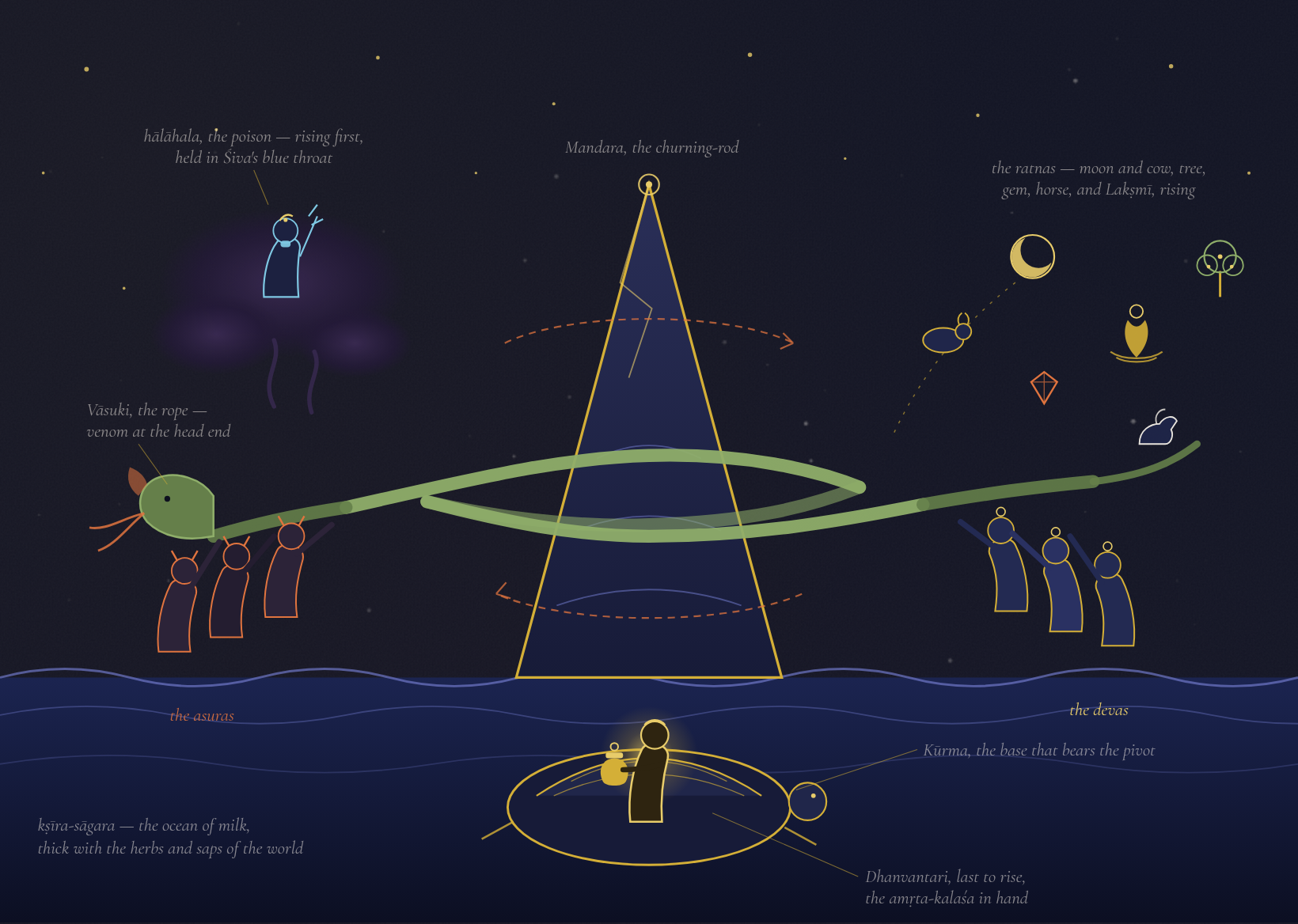
It begins with the gods losing. Cursed by the sage Durvāsā, the devas find their fortune drained and their immortality thinning; the asuras, their elder half-brothers and rivals, press the advantage. When the desperate gods reach Viṣṇu, his counsel is not a weapon but a labor, and it opens with a hard instruction: make peace with your enemies. The prize you need lies dissolved in the ocean of milk, and drawing it out will take both teams pulling — devas and asuras yoked to one work, "as a snake and a mouse trapped in one basket," until the nectar is in hand.[1] Into the sea go the potent herbs and saps of the world; for a churning-rod they uproot golden Mount Mandara; for a rope they enlist Vāsuki, the thousand-headed king of serpents, promising him a share of whatever rises.[1,2]
The asuras, out of pride, demand the head end — and are scorched by the venom-fire of the serpent's breathing while the devas hold the tail. The mountain, having no foundation, begins to sink into the sea floor; and here the Lord himself enters the machine. In the Bhāgavata and Viṣṇu Purāṇa it is Viṣṇu who becomes Kūrma, the cosmic tortoise, diving beneath the mountain to bear the pivot on his back — the second of his ten descents. (The Mahābhārata, older and plainer, knows only an unnamed tortoise-king whom the gods politely ask for help; his promotion to an avatāra of Viṣṇu belongs to the later tellings.)[1,2,3] And so the churn is assembled: base, rod, rope, and two teams facing each other across the water — and for a thousand years of the gods, they pull.[4]
What rises first is not the nectar. In the Rāmāyaṇa and the Bhāgavata, before any treasure, the sea gives up hālāhala — also called kālakūṭa, "the peak of time," time being another of death's names — a poison so total it begins to burn the three worlds together. The churning cannot continue and cannot be undone; the poison must go somewhere. It is Śiva who cups it in his palm and drinks, holding it neither swallowed nor spat in the hollow of his throat, which the venom stains the blue of a storm — and he is called Nīlakaṇṭha, Blue-Throat, ever after.[1,4] Hold that image. The essay will return to it, because the chemistry of life's origin returns to it.
Then, at last, the treasures — the ratnas, conventionally fourteen, though the texts count anywhere from nine upward.[7,8] In the Bhāgavata's order: Surabhi the wish-granting cow; Uccaiḥśravas the moon-white horse; Airāvata the four-tusked elephant; the Kaustubha gem; the Pārijāta tree whose blossoms never fade; the apsarases; then Lakṣmī herself, the goddess of fortune, choosing Viṣṇu's breast for her home; then Vāruṇī, goddess of wine.[1] In the Mahābhārata the cool-rayed moon churns up first of all.[2] And finally, in every telling, the ocean parts for a figure no earlier list contained: Dhanvantari — dark, young, garlanded, radiant — carrying in his hands a golden pot, the amṛta-kalaśa, the vessel of the nectar of non-death. The tradition would come to know him as the physician of the gods and the fountainhead of Āyurveda; the Suśruta Saṃhitā opens with him, descended at Kāśī as its king, teaching surgery to Suśruta and his cohort.[1,4,9]
The asuras snatch the pot and fall to quarreling over it. Viṣṇu, taking the form of Mohinī — enchantment itself walking — offers to pour, and pours truthfully to one row and emptily to the other. One asura, Svarbhānu, sees the trick, puts on a god's face, and sits between the sun and the moon in the devas' line. The nectar is at his throat when the two luminaries expose him and Viṣṇu's discus takes his head — too late. The head has tasted deathlessness and cannot die. It rises into the sky as Rāhu, and at the appointed junctures it swallows the sun or the moon that betrayed it — and the world watches an eclipse.[1,2] Restored by the nectar, the gods win their war, and the ocean settles over its emptied treasury.[1] (The beloved postscript — that four drops of nectar fell at the four cities of the Kumbh Melā — appears in no ancient text; scholars find the melā's link to the churning to be a graft of the last two centuries. The story, like the ocean, is still being churned.[12])
Read the film as text ▾
Four Billion Years Ago, an Ocean
Now the second story, told with the same respect. The Earth condenses about 4.54 billion years ago, dated by the lead clocks inside meteorites. While it is still gathering itself, a Mars-sized body strikes it; the collision melts the world and throws off the ring of debris that becomes the Moon.[40] The planet cools faster than one might guess. Tiny zircon crystals from the Jack Hills of Western Australia, formed 4.4 billion years ago and rattling around ever since, carry oxygen-isotope ratios that imply their parent magmas had already interacted with liquid water — an ocean, or at least the beginnings of one, within roughly a hundred and fifty million years of the planet's birth.[37]
Then comes the astonishing part: on the geological clock, life appears almost immediately. The oldest broadly accepted biosignatures — layered microbial mats and stromatolites in the 3.48-billion-year-old Dresser Formation of the Pilbara — show an ocean already competently inhabited.[38] Older claims reach further back and are argued about exactly as one would hope: carbon in 3.7-billion-year-old Isua rocks with a biological isotopic signature; putative stromatolites in the same terrain, proposed in 2016 and challenged in 2018; microscopic tubes of iron oxide in Canadian rocks that are at least 3.77 — and on one reading of the host rock's age, possibly up to 4.28 — billion years old.[39] And in 2024, a molecular-clock reconstruction dated the last universal common ancestor of all living things — LUCA, the cell from which every bacterium, archaeon, redwood, and reader descends — to about 4.2 billion years ago.[36] If that date holds, the churning was already finished, nectar delivered, within the Earth's first few hundred million years.
What happened in that window is the science of abiogenesis, and it is honest to say that the field agrees on the plot while arguing about the venue. The plot: simple carbon feedstocks accumulate; energy drives them uphill into sugars, amino acids, and the building blocks of nucleic acids; some of these assemble into polymers that can catalyze reactions — RNA foremost, since RNA can both carry sequence and do chemistry, and the ribosome at the heart of every cell is to this day a machine of RNA[24]; lipid membranes wrap the chemistry into cells; and selection, that patient churn, does the rest. The venue: a spark-lit atmosphere raining organics into the sea; a sunlit pond wetting and drying at its edges[33]; a warm alkaline vent breathing hydrogen at the ocean floor.[25,26] We will visit each, because — and this is the essay's quiet joke — every serious venue on the modern list turns out to be one of the parts of the mythic churn.
The Ocean of Milk & the Hot Dilute Soup
Begin with the ocean itself. The texts do not set the churning in the salt sea we know but in the kṣīra-sāgara क्षीरसागर, the ocean of milk — and milk is a precise image, not a decorative one. Milk is water made potent: a suspension so loaded with dissolved and floating nourishment that it turns opaque, the one liquid in ordinary human experience that is, by itself, enough to build a body from. And notice what the Bhāgavata does just before the churning begins: on Viṣṇu's instruction, the gods first cast into the sea the potent herbs and saps of the world.[1] The ocean is made rich before it is asked to yield life's prize. The myth, in its own idiom, insists on what a chemist would also insist on: you cannot churn nectar out of clean water.
Science's founding image of the early ocean is nearly the same sentence. In 1924 Aleksandr Oparin, in a small Moscow pamphlet, argued that under the young Earth's oxygen-free skies, simple carbon compounds would accumulate in the waters until a slow chemistry of droplets and gels began to organize them.[15] Five years later — independently, in a rationalist annual, with no knowledge of the Russian — J. B. S. Haldane reasoned from ultraviolet light and an unbreathing atmosphere to the same sea, and gave it the name that stuck: before life began, the primitive oceans "reached the consistency of hot dilute soup."[16] The Oparin–Haldane ocean is the kṣīra-sāgara of the modern account: not the arena of life but its broth — an ocean whose richness precedes and permits everything that rises from it.
For a generation this remained an armchair ocean. Then, in 1952, a twenty-two-year-old graduate student named Stanley Miller, working in Harold Urey's Chicago laboratory, built the churn in glass: a flask of water for the sea, a flask of methane, ammonia, and hydrogen for the sky, heat below to drive the cycle, and a spark leaping between electrodes for lightning. Within a week the water carried amino acids — glycine and alanine among them, the very residues most common in proteins today.[17] The result has been refined, criticized, and re-run under a dozen alternative atmospheres in the seventy years since, and its central lesson has survived every revision: the building blocks of life are not rare achievements. Stir energy through simple chemistry and they appear on their own, almost embarrassingly easily.
And the broth was never only local. When the Murchison meteorite fell on Australia in 1969, it proved to be freighted with amino acids of unambiguously extraterrestrial origin; carbonaceous meteorites have since yielded ribose — the sugar of RNA's own spine — and the Rosetta spacecraft tasted free glycine in the coma of a comet.[23] The feedstocks of life form wherever chemistry and energy meet, out among the stars whose road the Greeks called galaxías — the milky circle — and they have been raining into planetary oceans from the beginning. The ocean of milk, it turns out, is not smaller than the myth imagined. It is larger: the whole sky is white with it.
The Butter in the Metaphor
Why churn milk at all? Because agitation does what stillness cannot: it drives the suspended fat globules together until their thin membranes give way and the fat coalesces — cream inverting into butter, the first solid conjured out of a liquid. The origin-of-life ocean needed exactly this service performed for its oily components. Amphiphilic molecules — fatty acids with a water-loving head and a water-fearing tail — self-assemble in water, and with concentration, drying, and agitation they gather into films and hollow spheres: the raw material of the first membranes.[34] The myth's engineers chose the one household miracle in which stirring a white ocean makes new structure rise out of it — navanīta, "the fresh-come," as Sanskrit calls new butter.
The Serpent: Lightning Above, Serpentine Below
A churn needs more than broth; it needs a rope that moves — something to carry force into the water, again and again, for as long as the work takes. The myth's rope is alive: Vāsuki, king of the nāgas, his long body the transmission line between the pullers and the mountain. And the texts are unsentimental about what it is like to hold him. He breathes fire and smoking venom on the asuras who claimed the honor of the head end; in the Rāmāyaṇa it is from the serpent's own thousand mouths, gnawing the mountain in his agony, that the world-burning poison first pours.[2,4] The lesson is plain: the thing that powers the churning is also the thing that burns. Energy, at its entry point, is indistinguishable from harm.
The first scientific serpent is the obvious one — the one Miller bottled. Lightning is the sky's writhing rope: a channel of plasma lashing between cloud and sea, and in a reducing atmosphere every stroke leaves a fine ash of new molecules — cyanide and aldehydes, the very feedstocks (as we will see) from which nucleobases and amino acids assemble.[17,21] Anyone who has watched a storm walk across an ocean has seen Vāsuki at the head end: the brilliant, dangerous, indispensable delivery of force into water.
But there is a second serpent in the modern account, and its name is almost too apt to report with a straight face. When seawater seeps down into fresh mantle rock, the rock is transformed: the mineral olivine hydrates into serpentine — named, from the Latin serpentinus, for its green, scaled, snakeskin sheen. The reaction — serpentinization — releases heat, hydrogen gas, and methane, and sends warm, strongly alkaline water back up through the sea floor.[27] In 2000, oceanographers discovered what such water builds: the Lost City hydrothermal field, a grove of white carbonate towers rising as much as sixty meters off the Atlantic sea floor, venting warm alkaline fluid rich in hydrogen — a churn powered not by volcanic magma but by the serpent in the stone, and capable of running for tens of thousands of years.[27]
It is at vents of exactly this kind that one major school of origin-of-life research — begun by Michael Russell in the 1990s and elaborated with William Martin — sets the first chapters of biochemistry. The vents' porous mineral walls form networks of tiny compartments, celled like honeycomb; across those thin walls, alkaline vent water meets more acidic ocean water, and the meeting is itself a battery: a natural proton gradient of just the kind every living cell now maintains across its own membranes.[25,26,31] When the physiology of LUCA — the last common ancestor — was reconstructed from the genes shared across all life, the portrait that emerged was of an anaerobic, heat-loving, hydrogen-fed cell fixing carbon from CO₂: a creature whose résumé reads like a job posting from an alkaline vent.[35] Coiled around the mountain's root, breathing hydrogen instead of venom: the serpent, again, exactly where the churning is.
The Mountain, the Tortoise, and the Patience of Rock
Between the rope and the broth stands the mountain — and the myth is careful to say that the ocean cannot be churned by water alone. Force must be delivered through rock. This too the chemistry confirms, in its own vocabulary. Dissolved molecules meeting in open water find each other rarely and part easily; on the charged, ordered face of a mineral, they are gathered, held, lined up, and introduced. Clays such as montmorillonite — the weathered flour of volcanic rock, Mandara ground fine — do measurable work in origin-of-life experiments: they catalyze the joining of RNA's building blocks into chains, and, remarkably, the same clay particles accelerate the self-assembly of fatty membranes around them.[34] The iron-sulfur minerals of the vents go further still, foreshadowing the metal clusters that sit to this day at the catalytic hearts of our most ancient enzymes.[25,26] In the modern account, rock is not scenery. Rock is the churning-rod, the surface where the sea is worked.
And beneath the rod, the tortoise. When the mountain begins to sink — force with no foundation — Viṣṇu becomes Kūrma and takes the pivot on his back, and the whole engine finds its footing.[1,3] It is the story's quietest role and its most indispensable: the base that holds still for a thousand years so that everything above it can turn. The Earth sciences have their own name for this character — the crust, the stable floor that held its oceans patiently for the hundreds of millions of years the chemistry required; deep time itself, bearing the churn. It moves the least and carries the most.
The tortoise was old before this story found him. In the Śatapatha Brāhmaṇa — compiled centuries before the epics — Prajāpati, lord of creatures, takes the form of a kūrma to create the world, and the text reads the animal as a cosmogram:[6]
"That lower shell of it is this terrestrial world... that upper shell of it is yonder sky... and what is between the shells is the air. Thus this tortoise is these worlds." — Śatapatha Brāhmaṇa 7.5.1.2 (tr. Eggeling)[6]
The tortoise is not in the world; the tortoise is the world — earth below, heaven above, and the breathing space between, where everything happens. When the churning myth later set Kūrma under Mandara, it was making the same claim in narrative form: what bears the work of creation is the ordered cosmos itself, offering its back. A planet, in other words — one with a floor, a sky, and a patient disposition. So far as we can tell from the one example we possess, that is precisely what the origin of life required: not a miracle of chemistry so much as a place willing to hold still, wet, and warm while chemistry churned.
The Tug of Opposites
Here is the detail a lazy myth would have skipped. The gods do not churn alone. They cannot — Viṣṇu says so at the outset, and the plot enforces it. The nectar requires two teams who want opposite things, pulling in opposite directions, in alternation, neither ever winning. A rope pulled one way does not churn; it only drags. The turning that extracts the ocean's treasures is made of reversals — deva-pull, asura-pull, deva-pull — sustained so long that the pulling becomes a rhythm and the rhythm becomes a machine.[1,2]
The chemistry of life's origin is a science of exactly such reversals. A pond edge that is only wet polymerizes nothing; one that is only dry preserves nothing; but a pool that cycles — concentrating and linking its molecules each time it dries, redissolving and re-sorting them each time it wets — ratchets complexity upward with every swing.[33] A vent pore that was all hot would cook its contents, and all cold would freeze them; but a pore with heat flowing across it cycles its molecules between temperatures, concentrating them a-thousandfold, unzipping double strands at the hot wall and letting them copy at the cool one — a natural thermal cycler that, in the laboratory, selects for ever longer strands.[32] Day bakes and night spares; ultraviolet drives the cyanide chemistry by daylight that dark hours let anneal.[20,21] And the tide — the tide is the ocean pulled by two teams if anything ever was: Moon hauling one way, Earth's spin hauling the other, twice a day, for four billion years. It delights me past telling that in the Mahābhārata's version, the first thing the churning brings up is the Moon[2] — as if the story knew the churn must first produce its own best churner. The young Moon rode close then, and raised tides to match, before slowly spiraling away to its present distance.[40]
Physics has a name for what all these rhythms have in common: they hold the system away from equilibrium. Equilibrium is the technical word for the state in which nothing further can happen — chemistry's name for death. Schrödinger, in the little book that recruited a generation of physicists into biology, put it plainly: what an organism feeds on is not energy as such but order — "negative entropy" — the standing difference between poles.[43] Prigogine won his Nobel for showing that systems held far from equilibrium do not merely tolerate structure, they generate it; more recent work argues that driven matter can be pushed toward the very kinds of organization that replicate.[44] The myth's staging is the same physics in costume. The nectar does not belong to the devas' side or the asuras' side; it lives in the disagreement between them, and only as long as the disagreement is maintained. Enemies yoked to one rope, forbidden to resolve their quarrel until the prize is up: one could hardly draw a better cartoon of a dissipative system.
Poison First, Then Nectar
Now the image at the essay's center. Before the cow, the goddess, the physician, or the nectar — in the Rāmāyaṇa and the Bhāgavata — the churned ocean yields hālāhala: a poison vast enough to burn all three worlds, rising not as a punishment but as a simple consequence of the churning itself.[1,4] Work an ocean hard enough and the first thing you get is dangerous. The tellings, it must be said, disagree about the timing: the Mahābhārata brings the Kālakūṭa up last, after the nectar; the Viṣṇu Purāṇa raises it mid-parade, where the serpent-gods quietly claim it.[2,3,8] The tradition, in other words, was sure the poison belonged in the story but could never settle when — the poison arrives early, late, and midway, depending on the teller. Hold that thought; it is about to sound very familiar.
Because the chemistry's version is this: the feedstocks of life are poisons. The two molecules invoked more often than any others in origin-of-life chemistry are hydrogen cyanide and formaldehyde — the first a by-word for swift death, which kills by strangling cellular respiration; the second a pickling agent that welds proteins shut. Yet formaldehyde, condensing with itself, builds sugars — including ribose, the R in RNA. And cyanide is the true dark star of the field. In 1960 Joan Oró warmed a solution of ammonium cyanide and drew out of it adenine — the nucleobase A, letter of the genetic alphabet, half of the cell's energy currency ATP.[18] Adenine's formula is C₅H₅N₅; hydrogen cyanide's is HCN. The letter A is, formally, five molecules of poison joined in a ring[19] — nectar written in hālāhala's own atoms. Half a century later, John Sutherland's laboratory showed that cyanide chemistry, fed by sulfur and driven by ultraviolet light, generates the precursors of nucleotides, amino acids, and lipids from one common network[20,21] — the poison as the single upstream ancestor of the treasures.
And the poison keeps rising throughout the process, exactly as the disagreeing texts jointly insist. Prebiotic chemistry's chronic embarrassment is what Steve Benner calls the asphalt problem: left to itself, an energized broth of organics does not refine toward life — it runs downhill into tar, every batch of treasures degenerating into a brown, useless goo.[22] Something must hold the reactive poison — check it, store it, meter it out — rather than let it either flood the world or vanish. The myth knows the shape of that requirement precisely. The hālāhala can be neither swallowed into the belly nor spat back out; it must be held at the throat, indefinitely, by someone capable of bearing it. Śiva's answer to the poison is not destruction but containment — sequestration, a chemist would say: the reactive species bound and stabilized, on mineral surfaces, in metal complexes, within the constraints of a reaction network, until what was lethal at large becomes, held in check, the very thing from which nectar is built. The blue throat is chemistry's oldest safety protocol, worn as an ornament.[1,4]
and the poison, held rightly, is the seed of the nectar.
Fourteen Treasures, Rising in Order
After the poison, the parade. What impresses me most about the ratna sequence is not any single treasure but the story's underlying claim: that one process, sustained long enough, extracts from one ocean an entire taxonomy of unlike goods — animal and mineral, liquid and light, goddess and gem. That is precisely the modern claim as well. Sutherland's cyanosulfidic network draws nucleotide, amino acid, and lipid precursors from a single chemistry[20]; the vents' one gradient pays for carbon fixation, polymer assembly, and everything downstream[26,31]; the treasures of biochemistry are many, but the churning that raised them was one.
The tradition, characteristically, made the treasure-list a thing of beauty in its own right. A verse recited at weddings to this day — attributed, in the manner of all beloved anonymous verses, to Kālidāsa — counts the canonical fourteen. Read it closely and notice item eleven: the poison is on the list. The tradition audited the churning's output and counted hālāhala among the jewels.[7]
गावः कामदुघाः सुरेश्वरगजो रम्भादिदेवाङ्गनाः।
अश्वः सप्तमुखो विषं हरिधनुः शङ्खोऽमृतं चाम्बुधेः
रत्नानीह चतुर्दश प्रतिदिनं कुर्वन्तु वो मङ्गलम्॥
gāvaḥ kāmadughāḥ sureśvara-gajo rambhādi-devāṅganāḥ |
aśvaḥ sapta-mukho viṣaṃ haridhanuḥ śaṅkho 'mṛtaṃ cāmbudheḥ
ratnānīha caturdaśa pratidinaṃ kurvantu vo maṅgalam ||
Half the pleasure of a living myth is playing it against knowledge it never claimed to hold. So, in that spirit — offered with a wink and not as a thesis — here are the fourteen, each set beside the emergent it most resembles in the modern story. Take the pairings as a game the two accounts play together; the reader is invited to improve on them.
The Pot: Deathlessness Must Be Held
Look once more at how the nectar actually arrives. Not as a tide, not dissolved in the sea, not raining from the sky — but in a pot, in the hands of a physician. The image makes two claims, and both repay attention.
First, the vessel. Amṛta loose in the ocean would be amṛta lost: indistinguishable from the broth, claimable by no one, keeping nothing. The entire remainder of the story — the quarrel, Mohinī's pouring, Rāhu's theft — is only possible because the nectar is contained, and can therefore be carried, given, and withheld. Origin-of-life chemistry hit the same requirement from the other side. A self-copying molecule adrift in open water has no self to copy for: any improvement it invents — a faster fold, a better catalyst — leaks instantly into the commons, feeding its rivals as generously as its own descendants. Only when replicating polymers are wrapped in a membrane does evolution get a grip, because only then is there a bounded someone whose children inherit their parent's advantages. Hence the modern field's fascination with protocells: fatty-acid vesicles that assemble on the same clay that helps RNA polymerize, grow by eating smaller vesicles' lipids, divide when disturbed, and — in the laboratory's finest trick to date — shelter template-copying RNA chemistry inside themselves while it runs.[34] The kalaśa is a lipid bilayer. The nectar needed a pot before it could be nectar at all.
Second, the bearer. Of all the figures the ocean could have sent up holding life's prize, the tradition chose a physician — and made him, in the Suśruta Saṃhitā's telling, the fountainhead of Āyurveda, the knowledge (veda) of life (āyus) — of the surgeons' school of it, at least; Charaka's physicians trace their own descent through Bharadvāja instead, and no telling owns the whole river.[9,10] I write about that lineage elsewhere on this site, and I will not repeat it here; but standing where this essay stands, the choice looks almost like a thesis statement. The science of how life persists and the fact of life's arising come out of the ocean in the same pair of hands. Abiogenesis is, in the most literal Sanskrit, an āyur-veda — a knowledge of how āyus comes to be.
And what is the amṛta, read this way? Not exemption from dying — the story is bleakly clear that individual bodies, even divine ones, remain breakable. What the nectar confers is the unbroken line. Here the modern account offers its most quietly staggering fact. Every cell in your body arose by division of a previous cell; that cell from another; and so back, without one single interruption, through your ancestors, their ancestors, the first vertebrates, the first eukaryotes, to the last universal common ancestor some 4.2 billion years ago — and whatever churned chemistry preceded it.[35,36] Death is everywhere in that history, but it is always beside the line, never across it. You have never in your life met an organism, from a bacterium to a blue whale, whose chain of pourings back to LUCA was ever once broken. Life is the amṛta that has been passing from vessel to vessel since before the Moon settled into its present sky.
Nectar, Ambrosia, Amṛta — One Word Three Times
The etymologies agree with the theology. Sanskrit a-mṛta is "non-death" — and Greek ámbrotos, whence ambrosia, is the same Indo-European compound, *n̥-mṛ-to-, syllable for syllable. Nectar, the other Greek drink of the gods, parses as *nek- "death" plus *-terh₂ "overcoming": death-crossing.[13] An English speaker who calls something "nectar and ambrosia" is unknowingly saying amṛta twice. Three words, two ancient cousins of one mother tongue, and a single conviction: that deathlessness, if it exists at all, is something poured.
Mohinī's Pour, and the Head That Would Not Die
The nectar is up. Now comes the step every origin story must face and most retellings hurry past: who gets it? The ocean churned for everyone; the amṛta will not go to everyone. Viṣṇu becomes Mohinī — bewitchment given a body — and offers to serve. She seats the two hosts in rows, pours truly down one line and emptily down the other, and by the time the asuras understand the arithmetic, the future has already been distributed.[1] It is worth being honest about how strange this scene is. The gods do not win the nectar by merit or by strength; they win it by differential pouring. And differential pouring — some lines filled, others left dry, by a process that from inside looks indistinguishable from enchantment — is as good a plain-language definition of natural selection as I can construct. Once there are vessels, once there is pouring, some lineages are simply poured into more than others; and that asymmetry, iterated, is the whole engine. Selection does not deliberate. She smiles, and moves down the row.
One asura refuses the arithmetic. Svarbhānu takes a god's shape, sits in the filled row between the Sun and the Moon — the two witnesses no disguise can fool, the two timekeepers — and drinks. The discus falls when the nectar is at his throat: too late for his death, too early for his body. The head, touched by amṛta, is deathless; the trunk falls away. And the tradition, with its genius for converting narrative into astronomy, set the severed one into the sky: Rāhu, the head, who at appointed intervals swallows the Sun or Moon that exposed him — and releases them, for a head has no belly to keep what it eats. The earliest tellings know only the head; the pairing of head and trunk as Rāhu and Ketu is a later elaboration of the Purāṇic and astrological literature[2,1,11] — and it is as Rāhu and Ketu that Jyotiṣa knows them still: the two shadow-planets, the chāyā-grahas, that mark where eclipses live.
Here the myth quietly deposits a piece of real astronomy. The Moon's orbit is tilted about five degrees to the Sun's apparent path, and crosses it at exactly two points — the ascending and descending nodes. Only when Sun and Moon stand near a node can an eclipse occur; the nodes drift slowly backward through the zodiac, completing a circuit in 18.6 years, and every eclipse in your lifetime has happened at one of Rāhu's two stations. Jyotiṣa computes the nodes as rigorously as it computes any luminary — my own Pañchāṅga tool carries them daily — while remembering, in the name itself, the thirsty one who almost drank.[1,5] Even the Veda remembers the shape of the story before the story: in Ṛgveda 5.40, the demon Svarbhānu pierces the Sun with darkness, and the sage Atri, by the fourth prayer, finds the Sun and sets it back in the sky.[5]
And the head without a body? Permit me one after-dinner speculation, clearly labeled as such. Biology knows an entity that consists of replicating information which cannot metabolize, cannot grow, cannot die in any ordinary sense, and persists by slipping into the filled row wearing a borrowed face: the virus — a genome without a cell, a head without a trunk, deathless in precisely Rāhu's truncated way, forever swallowing the luminous machinery of others and forever unable to keep it. The analogy proves nothing, and I make no claim for it beyond its aptness. But the myth-makers understood something structural: that when deathlessness is being poured, there will arise, inevitably, things that get the nectar without the body — and that they will shadow the legitimate lines forever after, neither alive nor dead, punctual as eclipses.[1]
And so the question this essay opened with can finally be answered in the story's own terms — three times over, each answer deeper than the last. The astronomical answer: because we live inside the geometry. The Moon's road really does cross the Sun's at two points; the two lights that time every terrestrial rhythm really are periodically swallowed there; and a system that tracks the luminaries must track the crossings where they fail. The mythic answer: because of how the nectar was won. The churning was a joint labor ending in a broken contract — the asuras pulled too, and were poured the empty cup — and Rāhu is the unsettled remainder of that bargain: the share that was neither paid nor destroyed, only beheaded. Debt travels with treasure; whoever holds the amṛta inherits the shadow of the one who almost drank. Notice that the tradition's two nodal afflictions are precisely the two halves of his condition — Rāhu the head without a body, appetite that no tasting can fill because nothing swallowed ever arrives; Ketu the body without a head, severance that asks no permission and desires nothing at all. And the third answer, which contains the other two: because the amṛta is in us. Ten sections of this essay have been establishing that we are not the churning's spectators but its current vessels — four billion years of unbroken pouring, still turning in every cell. To carry the nectar is to stand in the row where Svarbhānu sat; what he wanted is in your keeping. The shadows do not fall on us arbitrarily. They fall on us because we are the ones holding what they are shadows of.
The Churn That Never Stopped
Every correspondence so far has run between the myth and life's beginning. The last one runs between the myth and the present tense — between the churning and what your own cells are doing while you read this sentence.
In 1961 Peter Mitchell proposed that cells do not pass energy around as chemical pieces, the way everyone assumed, but store it as a difference: a reservoir of protons pumped to one side of a membrane, straining to get back — a drawn bow, a held gradient, the deva-side and asura-side of a molecular tug.[28] The idea was resisted for the better part of two decades — the dispute is remembered in the literature, without much exaggeration, as the "ox phos wars" — before the evidence made it the textbook, and Mitchell got his Nobel in 1978.[28] But the great disclosure came in 1997, when Japanese biophysicists pinned single molecules of the enzyme that spends the gradient — ATP synthase — to a glass slide, attached a fluorescent filament to the shaft, and watched it rotate, revolution after revolution, under the microscope.[29] The enzyme is not like a rotary machine. It is one: a proton current flowing through its membrane ring spins a central camshaft inside a head of catalytic subunits, and each third of a turn presses another molecule of ATP into being. At full speed the shaft turns at something like a hundred and thirty revolutions per second.[29] That same year's Nobel in chemistry honored the men who worked out the rotary mechanism.
Now set the two machines side by side, and permit the myth its moment of triumph. A base planted in a fluid layer. A rod through the middle. A pulling force, delivered rhythmically, that spins the rod. A holding structure that keeps the head steady against the torque — the enzyme has a stator arm for exactly this, its own Vāsuki gripped tight. And what does the turning press out? ATP: adenosine triphosphate — adenine, the five-poison ring of Fig. 6, riding a sugar and three phosphates. The cellular churn's nectar is built, atom for atom, on the very molecule the hālāhala chemistry supplied. Your body carries thousands of these rotors in every mitochondrion, millions in many single cells; running day and night, they turn over roughly your own body weight in ATP every day.[30] You do not merely descend from a churned ocean. You are one — salt water to this hour, membrane-bounded, kept alive by billions of microscopic Mandaras that have not stopped spinning in four billion years.[31]
And where did cells learn the trick of paying for everything with a proton gradient? Lane and Martin's argument, which §IV set up, closes the loop: chemiosmosis is as universal among living things as the genetic code itself — an inheritance plausibly older than either kind of modern cell, learned at the porous mineral walls of alkaline vents where the gradient came free with the geology.[26,31,45] If they are right, then the first churn was the planet's — serpentine rock against carbonated sea — and life's founding invention was to miniaturize the churning: to leave the vent carrying a portable version of its geochemistry, a pot that could hold its own gradient. The myth got the tense right after all. Samudra manthana is not something that happened. It is something you are doing.
Reading the Two Stories Together
So what is one to make of the rhyme? Let me first say plainly what I do not make of it. I do not believe the singers of the Bhāgavata were encoding cyanide chemistry, and nothing in this essay should be quoted as claiming that "the ancients knew." That reading manages to shortchange both parties at once — it turns the ṛṣis into failed chemists and the chemists into redundant scribes, when the truth is that each enterprise did something the other never attempted. The myth is not data about the Hadean ocean. It is data about something else: about what the human mind, working at full poetic depth, finds structurally necessary in any account of treasure drawn from formlessness.
And that is where the rhyme stops being a parlor trick and starts being interesting. Consider what the myth insists on, against all narrative convenience: that the prize could not be seized but only churned out slowly; that the churning required a rich medium, a mineral base, a rhythmic energy delivered by something dangerous; that enemies had to pull together without ceasing to be enemies; that poison would come up with the treasure and would have to be held rather than destroyed; that the prize would need a vessel before it could be kept, and a pouring before it could matter. Not one of those constraints is decorative. Every single one reappears, in technical dress, in the modern account — not because the account descends from the myth, but because, I suspect, both descend from the same deep grammar: the way extraction-from-potential actually works, in ovens and oceans, in churned cream and churned mantle rock, wherever a difference is held long enough to turn. The storytellers had watched milk become butter and fire come from a churned stick ten thousand times. They knew, in the hands, how something comes from nothing-much. When they needed to say how deathlessness entered the world, they reached for the truest machine they knew — and the machine turns out to go all the way down.
The scientists, for their part, keep reaching back. When microbiologists found, in sediment beside an Arctic vent field called Loki's Castle, the archaea that bridge the gap between simple cells and ours, they named them Lokiarchaeota; the relatives that followed became Thor-, Odin-, and Heimdallarchaeota — the superphylum Asgard — and the first of them ever coaxed into culture was christened Prometheoarchaeum, for the titan who stole fire.[42] Our own cells, Lynn Margulis showed, are themselves a churning-alliance: two unlike and estranged lineages, archaeal host and bacterial guest, yoked into one body and pulling together ever since — every mitochondrion a deva-asura treaty that held.[41] At the exact frontier where chemistry becomes biography, the discoverers themselves stop speaking pure chemistry and start speaking myth. It seems to be what our species does at that particular door.
I would love to close with the perfect quotation, and for decades India has passed one around: that J. B. S. Haldane — the very man who gave the primordial soup its name — called the Daśāvatāra, Viṣṇu's ten descents from fish to tortoise upward, "a true sequential depiction of the great unfolding of evolution." The honest version is better than the quotation. The line cannot be traced to Haldane's pen; its earliest known appearance is a magazine profile printed twenty-eight years after his death, and the avatāra-evolution parallel itself was drawn by Indian thinkers a century before him.[46] What Haldane verifiably did was more moving: in 1957 the co-founder of origin-of-life science left Britain for India, taught at the Indian Statistical Institute, took Indian citizenship, wore khadi, and worked in Bhubaneswar until his death in 1964, having written that the opportunities for the research he loved were better there — the soup's own prophet, choosing to finish his life in the civilization that had always taught that life was churned from an ocean.[46] The quotation is apocryphal; the pilgrimage is documented. Myths, as this essay has been arguing throughout, grow where the truth is planted.
The Bhāgavata ends its churning with the nectar distributed and the war won. I would rather end where the story actually leaves us — because the story leaves us inside it. The ocean was real; its shorelines are in the zircon record. The churning was real; the vents that powered it are venting tonight. The poison was real, and its ring of five is in every letter A of every gene you carry. The pot was real, and you are made of some hundred trillion of its descendants, each one still holding its gradient against the dark. And the nectar was real — is real — an unbroken pouring, vessel into vessel, four billion years long, currently entrusted to you. The next time the Moon slips into the Earth's shadow and goes the color of hammered copper, remember whose head that is, what it almost drank, why its shadow can find you at all — and how long the churning has been turning in your own chest. Oṃ dhanvantaraye namaḥ — and gratitude, too, to the patient tortoise underneath it all.
You are what the nectar looks like, four billion years poured.
On This Site
Companion pieces to this essay: The Mind, the Hand, and the Heart traces what became of Dhanvantari's gift — the lineages of Charaka, Suśruta, and Vāgbhaṭa; Two Skies reads another pair of Sanskrit cosmological terms slowly; Bhūtas introduces the five elements that Āyurveda builds bodies from. The daily positions of Rāhu and Ketu — the churning's shadow-planets — run in the Pañchāṅga tool.
References & Further Reading
The Story — Texts & Scholarship
- Bhāgavata Purāṇa, Canto 8, chapters 5–12 (tr. G. V. Tagare, Motilal Banarsidass). The full churning arc: Viṣṇu's counsel at 8.6; Kūrma and the rising of the hālāhala in 8.7 (the poison at 8.7.18, Śiva's drinking at 8.7.36–42); the treasures in sequence in 8.8, with Dhanvantari at 8.8.31 ff.; Mohinī and the beheading of Rāhu at 8.9.24–26. Online at wisdomlib.org.
- Mahābhārata, Ādi Parva (Āstīka Parva), sections XVII–XIX in the K. M. Ganguli translation (1883–96): the moon rises first, the Kālakūṭa comes up last, the mountain rests on the unnamed tortoise-king, and the discus Sudarśana takes Rāhu's head. Online at sacred-texts.com: §XVII · §XVIII · §XIX.
- Viṣṇu Purāṇa 1.9, tr. H. H. Wilson (1840): the serpent-gods claim the poison; "Hari himself, in the form of a tortoise, served as a pivot for the mountain." sacred-texts.com.
- Vālmīki Rāmāyaṇa, Bāla Kāṇḍa, sarga 45: the poison first, from the serpent's own mouths; a thousand years of churning; Dhanvantari as "the teacher of the Āyurveda." Tr. H. P. Shastri at wisdomlib.org; verse tr. R. T. H. Griffith at sacred-texts.com.
- Ṛgveda: 8.48.3 (the soma-drinkers' cry of deathlessness); 9.113.7–11 (Soma Pavamāna — "place me in that deathless, undecaying world"); 5.40.5–9 (Svarbhānu piercing the Sun with darkness; Atri's restoration). Tr. Griffith at sacred-texts.com.
- Śatapatha Brāhmaṇa 7.5.1.1–6, tr. J. Eggeling (Sacred Books of the East 41): Prajāpati as the kūrma; the tortoise's shells as earth, sky, and the air between. sacred-texts.com.
- The caturdaśa-ratna ("fourteen jewels") memorial verse — verse 8 of a Maṅgalāṣṭakam of unknown date traditionally ascribed to Kālidāsa, still recited at weddings; the poison stands eleventh on its list. Text as commonly printed in devotional collections; wording varies across recensions.
- Bedekar, V. M. (1967). "The Legend of the Churning of the Ocean in the Epics and Purāṇas: A Comparative Study." Purāṇa (Purāṇa Bulletin) IX.1, pp. 7–61 — the standard comparative study of the tellings and their differing treasure-lists and poison-placements. wisdomlib.org.
- Suśruta Saṃhitā, Sūtrasthāna 1, tr. K. L. Bhishagratna: the king of Kāśī declaring himself Dhanvantari incarnate; Āyurveda as originally a subsection of the Atharvaveda. wisdomlib.org.
- Caraka Saṃhitā, Sūtrasthāna 1: the physicians' own descent — Brahmā to Dakṣa Prajāpati to the Aśvins to Indra to Bharadvāja — with no Dhanvantari in it. wisdomlib.org.
- Dimmitt, C., & van Buitenen, J. A. B. (1978). Classical Hindu Mythology: A Reader in the Sanskrit Purāṇas. Temple University Press — on the later pairing of the severed head and trunk as Rāhu and Ketu.
- Maclean, K. (2003). "Making the Colonial State Work for You: The Modern Beginnings of the Ancient Kumbh Mela in Allahabad." Journal of Asian Studies 62(3), 873–905 — on the modern origin of the melā's link to the churning story.
- West, M. L. (2007). Indo-European Poetry and Myth. Oxford University Press, p. 158: amṛta and ambrosia as the same compound *n̥-mṛ-to-; nektar as "death-overcoming," after P. Thieme.
- Iconography: the "Churning of the Sea of Milk" bas-relief, east gallery (south wing) of Angkor Wat, 12th century — 92 asuras and 88 devas on a panel some 49 m long; and, among many painted versions, "The Churning of the Ocean of Milk," Mandi, c. 1780–90, Metropolitan Museum of Art, acc. 1977.443.2.
The Soup & the Spark
- Oparin, A. I. (1924). Proiskhozhdenie zhizni [The Origin of Life]. Moscow. In English: The Origin of Life, tr. S. Morgulis (Macmillan, 1938), from the expanded 1936 Vozniknovenie zhizni na Zemle.
- Haldane, J. B. S. (1929). "The Origin of Life." The Rationalist Annual — the primitive oceans reaching "the consistency of hot dilute soup."
- Miller, S. L. (1953). "A Production of Amino Acids Under Possible Primitive Earth Conditions." Science 117, 528–529. doi:10.1126/science.117.3046.528. Conducted in Harold Urey's laboratory; Urey kept his name off the paper.
- Oró, J. (1960). "Synthesis of adenine from ammonium cyanide." Biochemical and Biophysical Research Communications 2, 407–412; and Oró, J. (1961). "Mechanism of Synthesis of Adenine from Hydrogen Cyanide under Possible Primitive Earth Conditions." Nature 191, 1193–1194.
- Glaser, R., Hodgen, B., Farrelly, D., & McKee, E. (2007). "Adenine Synthesis in Interstellar Space: Mechanisms of Prebiotic Pyrimidine-Ring Formation of Monocyclic HCN-Pentamers." Astrobiology 7(3), 455–470 — "adenine is formally the pentamer of hydrocyanic acid."
- Powner, M. W., Gerland, B., & Sutherland, J. D. (2009). "Synthesis of activated pyrimidine ribonucleotides in prebiotically plausible conditions." Nature 459, 239–242. doi:10.1038/nature08013.
- Patel, B. H., Percivalle, C., Ritson, D. J., Duffy, C. D., & Sutherland, J. D. (2015). "Common origins of RNA, protein and lipid precursors in a cyanosulfidic protometabolism." Nature Chemistry 7, 301–307. doi:10.1038/nchem.2202.
- Benner, S. A., Kim, H.-J., & Carrigan, M. A. (2012). "Asphalt, Water, and the Prebiotic Synthesis of Ribose, Ribonucleosides, and RNA." Accounts of Chemical Research 45(12), 2025–2034 — the "asphalt problem."
- Kvenvolden, K., et al. (1970). "Evidence for Extraterrestrial Amino-acids and Hydrocarbons in the Murchison Meteorite." Nature 228, 923–926; Furukawa, Y., et al. (2019). "Extraterrestrial ribose and other sugars in primitive meteorites." PNAS 116, 24440–24445; Altwegg, K., et al. (2016). "Prebiotic chemicals — amino acid and phosphorus — in the coma of comet 67P/Churyumov-Gerasimenko." Science Advances 2, e1600285.
- Gilbert, W. (1986). "Origin of life: The RNA world." Nature 319, 618; Kruger, K., et al. (1982). Cell 31, 147–157 (Cech's self-splicing RNA); Guerrier-Takada, C., et al. (1983). Cell 35, 849–857 (Altman's RNase P); Nissen, P., Hansen, J., Ban, N., Moore, P. B., & Steitz, T. A. (2000). Science 289, 920–930 — with Cech, T. R. (2000), "The Ribosome Is a Ribozyme," Science 289, 878–879.
The Vent & the Churn
- Russell, M. J., & Hall, A. J. (1997). "The emergence of life from iron monosulphide bubbles at a submarine hydrothermal redox and pH front." Journal of the Geological Society, London 154, 377–402.
- Martin, W., & Russell, M. J. (2007). "On the origin of biochemistry at an alkaline hydrothermal vent." Philosophical Transactions of the Royal Society B 362, 1887–1925. doi:10.1098/rstb.2006.1881.
- Kelley, D. S., et al. (2001). "An off-axis hydrothermal vent field near the Mid-Atlantic Ridge at 30° N." Nature 412, 145–149 (the discovery of Lost City); Kelley, D. S., et al. (2005). "A Serpentinite-Hosted Ecosystem: The Lost City Hydrothermal Field." Science 307, 1428–1434 (its H₂- and CH₄-bearing alkaline fluids).
- Mitchell, P. (1961). "Coupling of Phosphorylation to Electron and Hydrogen Transfer by a Chemi-Osmotic type of Mechanism." Nature 191, 144–148; on the long resistance, Prebble, J. (2002), "Peter Mitchell and the ox phos wars," Trends in Biochemical Sciences 27(4), 209–212.
- Noji, H., Yasuda, R., Yoshida, M., & Kinosita, K. (1997). "Direct observation of the rotation of F1-ATPase." Nature 386, 299–302. doi:10.1038/386299a0; rotation rates resolved in Yasuda, R., et al. (2001), Nature 410, 898–904 (≈130 revolutions per second at saturating ATP).
- Rich, P. R. (2003). "Chemiosmotic coupling: The cost of living." Nature 421, 583 — daily human ATP turnover on the order of one's own body weight.
- Lane, N., & Martin, W. F. (2012). "The Origin of Membrane Bioenergetics." Cell 151, 1406–1416. doi:10.1016/j.cell.2012.11.050.
- Baaske, P., et al. (2007). "Extreme accumulation of nucleotides in simulated hydrothermal pore systems." PNAS 104, 9346–9351; Kreysing, M., Keil, L., Lanzmich, S., & Braun, D. (2015). "Heat flux across an open pore enables the continuous replication and selection of oligonucleotides towards increasing length." Nature Chemistry 7, 203–208.
- Damer, B., & Deamer, D. (2020). "The Hot Spring Hypothesis for an Origin of Life." Astrobiology 20(4), 429–452. doi:10.1089/ast.2019.2045.
Vessels, Ancestors, Deep Time
- Hanczyc, M. M., Fujikawa, S. M., & Szostak, J. W. (2003). "Experimental Models of Primitive Cellular Compartments: Encapsulation, Growth, and Division." Science 302, 618–622; Adamala, K., & Szostak, J. W. (2013). "Nonenzymatic Template-Directed RNA Synthesis Inside Model Protocells." Science 342, 1098–1100.
- Weiss, M. C., Sousa, F. L., Mrnjavac, N., Neukirchen, S., Roettger, M., Nelson-Sathi, S., & Martin, W. F. (2016). "The physiology and habitat of the last universal common ancestor." Nature Microbiology 1, 16116. doi:10.1038/nmicrobiol.2016.116.
- Moody, E. R. R., et al. (2024). "The nature of the last universal common ancestor and its impact on the early Earth system." Nature Ecology & Evolution 8, 1654–1666 — LUCA at ≈4.2 Ga (95% credible interval 4.09–4.33). doi:10.1038/s41559-024-02461-1.
- Wilde, S. A., Valley, J. W., Peck, W. H., & Graham, C. M. (2001). "Evidence from detrital zircons for the existence of continental crust and oceans on the Earth 4.4 Gyr ago." Nature 409, 175–178.
- Noffke, N., Christian, D., Wacey, D., & Hazen, R. M. (2013). "Microbially Induced Sedimentary Structures Recording an Ancient Ecosystem in the ca. 3.48 Billion-Year-Old Dresser Formation, Pilbara, Western Australia." Astrobiology 13, 1103–1124; Baumgartner, R. J., et al. (2019). "Nano-porous pyrite and organic matter in 3.5-billion-year-old stromatolites record primordial life." Geology 47, 1039–1043.
- The contested elders: Ohtomo, Y., et al. (2014). "Evidence for biogenic graphite in early Archaean Isua metasedimentary rocks." Nature Geoscience 7, 25–28; Nutman, A. P., et al. (2016). Nature 537, 535–538, challenged by Allwood, A. C., et al. (2018). Nature 563, 241–244; Dodd, M. S., et al. (2017). "Evidence for early life in Earth's oldest hydrothermal vent precipitates." Nature 543, 60–64 — host rocks "at least 3,770 and possibly 4,280 million years old."
- Hartmann, W. K., & Davis, D. R. (1975). "Satellite-Sized Planetesimals and Lunar Origin." Icarus 24, 504–515; Canup, R. M., & Asphaug, E. (2001). "Origin of the Moon in a giant impact near the end of the Earth's formation." Nature 412, 708–712; Williams, G. E. (2000). "Geological constraints on the Precambrian history of Earth's rotation and the Moon's orbit." Reviews of Geophysics 38, 37–59.
- Sagan, L. (Margulis) (1967). "On the origin of mitosing cells." Journal of Theoretical Biology 14, 225–274 — the endosymbiotic origin of the eukaryotic cell.
- Spang, A., et al. (2015). "Complex archaea that bridge the gap between prokaryotes and eukaryotes." Nature 521, 173–179 (Lokiarchaeota, named for the Loki's Castle vent field on the Arctic Mid-Ocean Ridge); Zaremba-Niedzwiedzka, K., et al. (2017). "Asgard archaea illuminate the origin of eukaryotic cellular complexity." Nature 541, 353–358; Imachi, H., et al. (2020). "Isolation of an archaeon at the prokaryote–eukaryote interface." Nature 577, 519–525 (Candidatus Prometheoarchaeum syntrophicum).
Wider Readings & Biography
- Schrödinger, E. (1944). What is Life? The Physical Aspect of the Living Cell. Cambridge University Press — life as fed on "negative entropy."
- Prigogine, I. — Nobel Prize in Chemistry, 1977, "for his contributions to non-equilibrium thermodynamics, particularly the theory of dissipative structures"; England, J. L. (2013). "Statistical physics of self-replication." Journal of Chemical Physics 139, 121923.
- Lane, N. (2015). The Vital Question: Energy, Evolution, and the Origins of Complex Life. W. W. Norton / Profile Books — the best general-reader account of the vent-and-gradient story this essay leans on.
- On Haldane in India: Encyclopaedia Britannica, "J.B.S. Haldane"; McOuat, G. (2017). "J.B.S. Haldane's passage to India: reconfiguring science." Journal of Genetics 96(5), 845–852. The oft-quoted Daśāvatāra remark's earliest known print appearance is a posthumous profile — "Haldane: Life of a Prodigious Mind," Science Reporter 29 (1992), p. 46 — and remains untraced in Haldane's own writings; the avatāra–evolution parallel itself was drawn by Keshub Chandra Sen and others in the 1870s.
On This Site
- Oshop, R. The Mind, the Hand, and the Heart (Dhanvantari's lineage into Suśruta, and the Great Trio); Two Skies: Ākāśa and Diś; Bhūtas; and the Pañchāṅga tool, which computes Rāhu and Ketu daily.
A spiritual essay on the churning of the ocean and the sciences of life's origin, prepared for the curious of both temples and laboratories.
One ocean · One churning · Poison first, then nectar
← Back to Writings