The Beak & the Blade
The surgeons of ancient Kāśī worked from a kit of one hundred and twenty-one instruments — jaws copied from herons and lions, blades gauged in lentils and hairs, sutures tied with the heads of ants. A tour of Suśruta's operating table, drawn piece by piece.
यस्माद्धस्तादृते यन्त्राणामप्रवृत्तिरेव तदधीनत्वाद् यन्त्रकर्मणाम् ॥
yasmād dhastād ṛte yantrāṇām apravṛttir eva tad-adhīnatvād yantra-karmaṇām ||
The Hand Comes First
Every apprenticeship begins with an inventory. Somewhere near the beginning of his training, a surgical student at Kāśī — modern Vārāṇasī, perhaps twenty-five centuries ago — would have been walked down a wall of instruments and made to learn them the way one learns a language: by families, by shapes, by verbs. One hundred and one blunt instruments, the yantras यन्त्र. Twenty sharp ones, the śastras शस्त्र. And behind them a bench of substitutes — leeches, caustics, fire, splinters of bamboo, the surgeon's own fingernails — for the day the proper tool is missing or the patient is a frightened child.
Then, having numbered them, the teaching undercuts its own arithmetic with the verse that opens this essay: the greatest instrument in the room is the hand. The whole kit is only the hand, extended — lengthened into a probe, hardened into a saw, narrowed into a needle, made crueler or kinder as the wound requires. I know of no other ancient text, in any tradition, that begins its equipment chapter with that particular piece of humility.
This essay is a guided tour of that wall. We will meet the six families of blunt instruments and the twenty sharp ones by name; run a thumb, carefully, along Suśruta's edge specifications — which are given in units of lentils and split hairs; open the practice garden where students rehearsed on gourds and water-bags before ever touching skin; stand in the consecrated operating room, where the pre-surgical checklist reads like a cross between a modern OR setup and a fire ritual; and finally follow a single operation — the reconstruction of a nose — as it walks out of Sūtrasthāna 16 and into a Poona courtyard in 1794, trailed by two astonished British surgeons, on its way to founding modern plastic surgery.
He is one of the three master authors of Āyurveda — with Charaka and Vāgbhaṭa, the Bṛhat Trayī, whom I introduced together in a companion essay.[26] There, Suśruta was "the hand" of the trio. Here we open the hand and see what it held.
The Science of the Arrow
The surgeon's art is named for a wound. Śalya शल्य means an arrow, a dart, a splinter — by extension, any foreign thing lodged where it does not belong, and by further extension anything in the body that must be found, grasped, and removed. Śalya-tantra, first of the eight limbs of Āyurveda in Suśruta's own ordering, is the science of the arrow's removal. The name remembers a battlefield: the Suśruta Saṃhitā's surgical chapters read, in places, like the field manual of an army medical corps — how to draw barbed points, how to judge a splinter's track by the wound's angle, how to close what the arrow opened.
The tradition sets the teaching in the holy city of Kāśī, where Dhanvantari, physician of the gods, is said to have descended as Divodāsa, its king. Seven students came to him asking for the science; the one who set it down gave the compendium his name — Suśruta, "the well-heard."[1,15] The man is beyond the reach of the historians; the text is not. Scholarship reads the Saṃhitā as a work in layers — a core perhaps composed in the last centuries bce, reshaped and supplemented for centuries after, reaching its received form by roughly the Gupta era, with tradition naming a Nāgārjuna among its redactors.[15] (The dating question deserves its own diagram, and it has one — Fig. 2 of the companion essay.[26]) What no one disputes is the result: the most systematic account of surgery to survive from the ancient world, in six sections and 186 chapters — anatomy, pathology, procedure, pharmacy — of which the two chapters that concern us here, Sūtrasthāna 7 and 8, are the tool-chest.
Suśruta's own defense of his specialty has a surgeon's directness: of the eight limbs of medicine, this is the one that acts at once, with instruments, on disease that has taken physical form — the limb the other limbs call when medicine must not only persuade the body but reach into it.[1] The reaching, though, is done with metal. And so, before a single disease is treated, the Saṃhitā stops to count its tools.
And, ruling them all, the hand.
A Grammar for the Kit
Before the instruments, the verbs. Suśruta reduces all of surgery to eight fundamental acts — the aṣṭavidha śastra-karma, the eightfold work of the blade — and the entire kit exists to conjugate them.[9,12] A surgeon excises (chedana), incises (bhedana), scrapes (lekhana), punctures (vedhana), probes (eṣaṇa), extracts (āharaṇa), drains (visrāvaṇa), and sews (sīvana). Two and a half millennia later, strip the robotics and the optics away from any operating room and this is still, almost embarrassingly, the complete list.
Against those eight verbs, the Saṃhitā sets three classes of nouns. The division is worth internalizing now, because everything that follows hangs from it:
The Blunt · 101
Graspers, levers, tubes, probes, and accessories — instruments that hold, move, look, and fetch, but do not cut. Six families, detailed in Sūtrasthāna 7. Their signature work: extraction.
The Sharp · 20
The edged steel: scalpels, saws, scissors, trocars, hooks, needles. Twenty patterns, detailed in Sūtrasthāna 8, each with prescribed dimensions, edge gauge, and grip.
The Substitutes
"After-instruments," for when steel is unavailable or unwise: bamboo skin, rock crystal, glass, leeches, caustic alkali, fire, fingernails, even certain rough-edged leaves.
Note the temperament of this taxonomy. It is not a museum catalogue but a decision tree: what must be done → what family does it → which member does it best. The Saṃhitā even closes its instrument chapters with the reminder that new tools may be invented as need arises — the list is open at the end.[6,7] What follows, then, is not an inventory frozen in amber but a snapshot of a working system at the moment someone wrote it down.
One Hundred and One Blunt Instruments
The yantras are made, the text says, mostly of iron — loha, with substitutes permitted where metal cannot be had — and their business ends are explicitly zoomorphic: they are built "with mouths like those of beasts and birds," and named accordingly.[1,6] A well-made yantra is about eighteen finger-breadths long — an aṅgula is the width of the surgeon's own finger, so the instrument is sized to the hand that will wield it — and free of the twelve listed defects, among them: too thick, too long, too short, of poor iron, crooked, loose-jointed, soft-mouthed, and unable to hold what it has caught.[6] The families, with their census:
| Family | Count | Form | Work |
|---|---|---|---|
| svastika स्वस्तिक | 24 | Cruciform forceps — two arms crossed and riveted, jaws modeled on animal and bird mouths | Gripping and drawing foreign bodies, above all from bone |
| saṃdaṃśa संदंश | 2 | Tongs or tweezers, sprung or bolted, about sixteen aṅgulas | Plucking śalyas from skin, flesh, vessels, and sinews |
| tāla ताल | 2 | Flat scoop-levers, single and double, like one or both jaws of a fish, twelve aṅgulas | Lifting objects out of the ear, nose, and other channels |
| nāḍī नाडी | 20 | Tubes — open at one end or both, of many bores and lengths | Reaching, viewing, and treating within channels: specula for piles and fistula, enema and syringe nozzles, smoke-pipes, cupping horns and gourds |
| śalākā शलाका | 28 | Rods and probes of graded girth and tip: earthworm-faced, arrow-faced, serpent-hood, spoon-faced; six tipped for cautery, others capped with cotton | Probing tracks, cleaning channels, applying caustics and collyrium, carrying fire |
| upayantra उपयन्त्र | 25 | The accessories: rope, twine, braided hair, silk thread, bark, creeper, cloth, pebble and stone, hammer, magnet, the palms and soles, fingers, tongue, teeth, nails… | Everything a hand might reach for — binding, pressing, striking, drawing iron out with a lodestone |
Each family rewards a longer look. The svastika yantras — cruciform forceps, crossed like the auspicious mark they are named for — come in twenty-four patterns, and the pattern names are a bestiary: jaws after the lion, the tiger, the wolf, the hyena, the bear, the cat, the jackal, the deer; beaks after the crow, the heron, the osprey, the vulture, the falcon, the owl, the kite, the drongo.[1,6] This is not whimsy; it is specification. Every animal mouth is a distinct geometry of grip — crushing, piercing, holding fast, reaching deep — and the menagerie is a way of writing a parts catalogue in a culture that memorized its textbooks in verse. Say "heron-beak" to a surgeon who has watched a heron fish, and the tool is already half-designed.
Among the twenty-four, the Saṃhitā plays a favorite without hesitation:
"The kaṅkamukhas are the best of all instruments, inasmuch as they can be inserted and withdrawn without the least difficulty, can grasp and draw out a śalya with the greatest ease, and are applicable to every part of the body." — Sūtrasthāna 7.19, tr. Bhishagratna[1,6]
Hold a modern artery forceps — the hemostat that hangs in its dozens in every operating room on earth — next to a heron's head, and the family resemblance is hard to unsee. The kaṅkamukha's virtues, as the verse gives them, are exactly the virtues a modern instrument nurse would list: atraumatic entry, secure grip, universal reach.
The nāḍī yantras — the tubes — are the family with the longest future ahead of it. Twenty kinds are counted: slit-windowed specula for examining and treating piles and fistula, nozzles for enemas and urethral syringes, pipes for inhaling medicated smoke, horns and gourds for cupping and drawing blood.[6] A tube, Suśruta understood, is two gifts in one — a road for instruments and light to travel in, and for disease and fluid to travel out. The endoscopist and the catheter designer are working, at the far end of a long corridor, in the nāḍī family's workshop.
The śalākās — twenty-eight rods and probes — grade from a whisper to a brand: blunt earthworm-faced probes for tracing a sinus, serpent-hood rods, spoon-faced scoops, cotton-capped swabs for cleaning, fine rods with lentil-shaped tips for painting collyrium along the eyelid, and six whose heads — shaped like the rose-apple fruit, or like a small goad — are meant to be heated and used for cautery.[6] And the upayantras, the twenty-five "accessories," are the most disarming list in the chapter: rope and twine, braided hair, silk thread, bark and creeper, cloth for bandaging, a round pebble, a hammer, the magnet — prescribed for drawing out iron splinters, a full two millennia before the ophthalmologist's electromagnet — and then, without a change in tone, the surgeon's own palms, soles, fingers, tongue, teeth, nails, and breath.[1,6] The list ends where the verse at the head of this essay begins: the body itself is the original instrument case.
To animate all this hardware, the chapter supplies the verbs — twenty-four yantra-karmas, two dozen things a blunt instrument does: binding, lifting, lowering, rotating, pressing, expanding, churning, drawing, sucking, searching, straightening, washing, filling, cleansing…[6] Reading them aloud feels like watching a pair of gifted hands at speed. Which is the point. "Of all instruments," the chapter has already said, "the hand is chief."
Twenty Edges
Where chapter 7 is a menagerie, chapter 8 is an armory. The twenty śastras are the cutting kit: knives broad and narrow, a saw, scissors, trocars, an awl, hooks, needles, probes with teeth. The full set is drawn below — not from surviving originals, of which there are none, but from the text's own descriptions and the long tradition of reconstruction that runs from Ḍalhaṇa's twelfth-century commentary to Girindranath Mukhopadhyaya's great 1913 study, which set Suśruta's instruments beside their Greek, Roman, and modern European counterparts, plate after plate, and let the reader draw the obvious conclusion.[2,5,14]
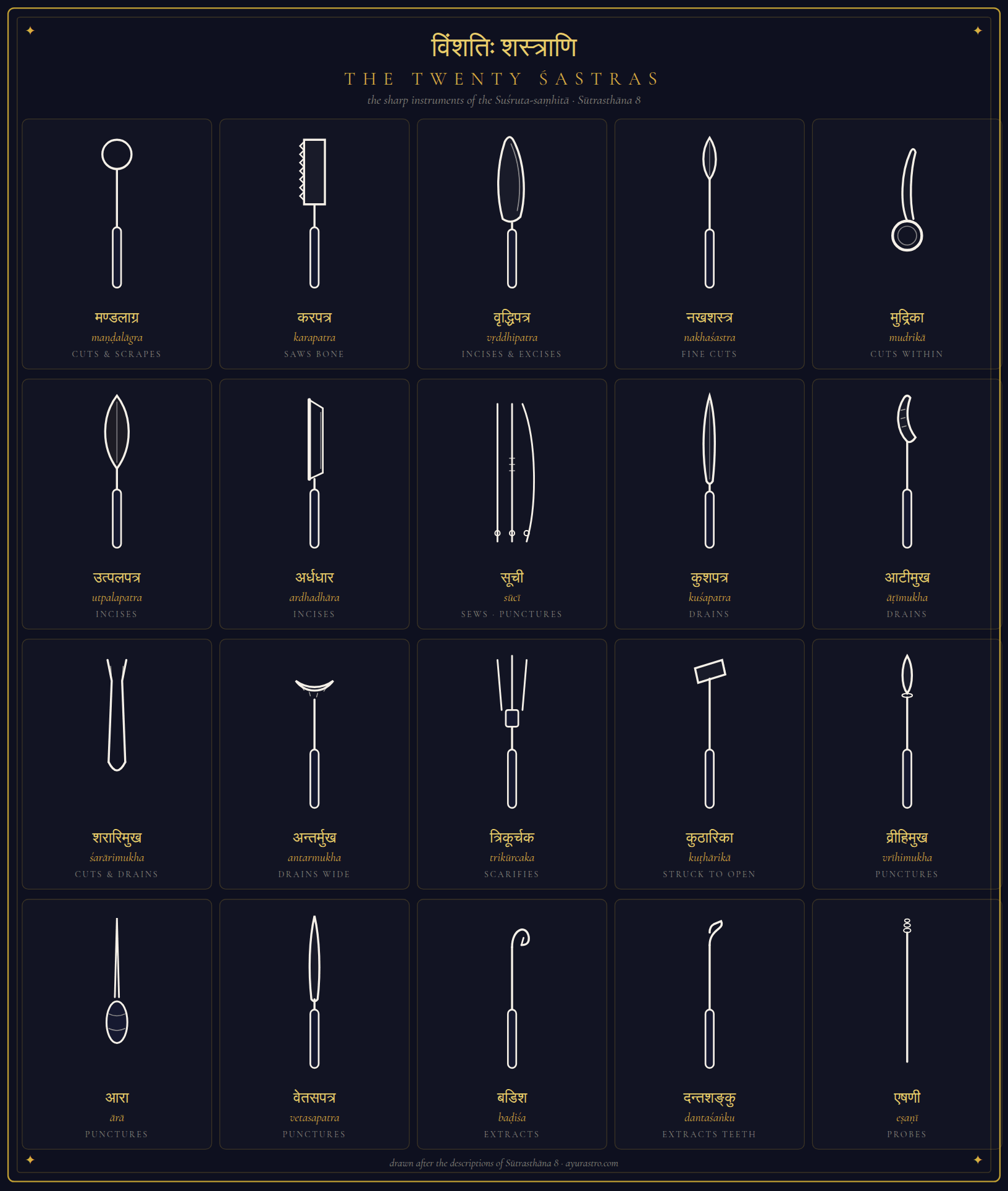
Read as a set, the twenty resolve back into the eight verbs. The maṇḍalāgra, its blade ending in a little disc, and the karapatra, the saw, do the cutting-and-scraping work — the saw being the one instrument excused from the rule that edges must never be jagged.[7] The razor-like vṛddhipatra — the workhorse scalpel — leads the incisors, with the lotus-petal utpalapatra, the half-edged ardhadhāra, the little nakhaśastra, and the ring-mounted mudrikā, which rides a fingertip to cut where only a finger can reach. For draining: the grass-blade kuśapatra, the bird-beaked āṭīmukha, the scissors called śarārimukha, the crescent antarmukha with its edge on the inside of the curve, the three-pointed trikūrcaka. For puncturing: the struck kuṭhārikā — a chisel of a knife, rested over a vein that lies on bone and tapped with the fingers, exactly as an osteotome is tapped today — with the rice-grain trocar vrīhimukha, the awl ārā, the cane-leaf vetasapatra, and the needle. For extracting: the fish-hook baḍiśa and the tooth-lever dantaśaṅku. For finding the way: the eṣaṇī, a probe with the face of an earthworm, "to be pushed on in the manner of a worm."[2,7]
Then the chapter does something almost anachronistically modern: it publishes tolerances. Handles must sit well in the fist, blades must be of "good and pure iron," edges must be even; the whole instrument, says the text, should be so keen that it divides a hair.[7] Fineness is specified per operation on a scale of everyday objects — the lentil and the human hair:
The metallurgy is equally deliberate. Blades are forged of pure iron and then tempered — and the text distinguishes three quenches: into alkali for edges that must cut through arrow-shafts and bone, into water for flesh, into oil for the fine work of veins and sinews.[7] A smith who quenches in oil is trading hardness for toughness — a blade less likely to chip in delicate use — and it is difficult to read the passage as anything other than exactly that trade, made knowingly. Edges are renewed on a whetstone the color of black gram, honed on a slab of slate, and the instruments live, each wrapped and slotted, in a case of śālmalī wood, fourteen finger-breadths long — the ancestor of the velvet-lined instrument roll.[7] Eight defects are listed for the sharp kit as twelve were for the blunt: crooked, blunt, notched, rough, too thick, too thin, too long, too short. And each class has its prescribed grip — the incising knives held at the junction of blade and handle, the scraping blades with the palm turned slightly up, the trocar concealed in the fist with thumb and forefinger on its point, the probes and hooks taken at the root.[7] It is a paragraph of hand-positions: the text teaching fingers, across twenty-five centuries, where to sit.
The needle, and the ant
Suturing gets its own small treatise within the treatise. Three needles: round-bodied and two aṅgulas long for the places where flesh is thin and near joints; three-edged and three aṅgulas for the fleshy places; curved like a bow for the scrotum and the abdomen, where a straight needle would ask the tissue to do the bending.[7,12] Thread of flax and hemp, of bark fiber, of braided horsehair, of sinew — and four named stitch patterns, among them the continuous, the interrupted, and the blanket stitch that modern manuals still call by homely names.[12] Stitches must be neither too tight nor too loose, and never so deep that the needle's track becomes a new wound.
And then, for the one suture no thread can reach, the Saṃhitā reaches outside the toolbox entirely. When the intestine has been perforated or severed, its ends are to be pressed gently together — and large black ants applied along the seam, one by one, to bite it closed:
"Large black ants should be applied even to the perforated intestines … and their bodies should be severed from their heads after they have firmly bitten the perforated parts with their jaws. After that the intestines with the ant-heads attached to them should be gently pushed back into the cavity and reinstated in their original situation." — Cikitsāsthāna 2.39, on injuries to the bowel, tr. Bhishagratna[1,13]
The ant-heads stay behind as a ring of biological clips — self-locking, non-irritant, and left to be absorbed or passed — around an anastomosis that must never be opened again to have stitches removed. Surgical staplers and absorbable clips took up the same problem in the twentieth century; the logic — fasten the bowel with something you never have to retrieve — is the ant's, first. It is the single detail of the kit that most reliably makes modern surgeons look up from the page.
Open the Cabinet
Catalogues are best read with the hands. Below, the kit is hung in a single case — every one of the twenty śastras, nine representatives of the yantra families gathered around the instrument that rules them all, and five of the substitutes. Touch any tool (or tab to it and use the arrow keys) and it will introduce itself: its name and what the name means, its chapter, its work, and the instrument on a modern tray that carries its lineage.
“the hand” — foremost of instruments
Its modern descendant
Every instrument in the cabinet, as text
| Instrument | Family | Source | What it did | Modern descendant |
|---|---|---|---|---|
| maṇḍalāgra मण्डलाग्र “circle-face” — the round-tipped blade | śastra | Sū. 8 | A knife ending in a small disc; cuts and scrapes in one motion — for trimming growths and scraping the walls of sinuses and fistulous tracks. | ring curette / raspatory |
| karapatra करपत्र “hand-leaf” — the saw | śastra | Sū. 8 | A toothed blade for dividing bone — the one instrument excused from the rule against jagged edges. | the amputation saw |
| vṛddhipatra वृद्धिपत्र “razor-leaf” | śastra | Sū. 8 | The workhorse scalpel, shaped like a barber's razor; the commentators treat it as the default blade where none is named. | the scalpel |
| nakhaśastra नखशस्त्र “nail-knife” | śastra | Sū. 8 | A small blade for work at the scale of a fingernail — trimming, nicking, splitting the small and superficial. | fine tenotomy knife |
| mudrikā मुद्रिका “signet-ring” | śastra | Sū. 8 | A little blade mounted on a finger-ring, so the edge goes exactly where the palpating finger already is — for the throat and other unseen places. | guarded finger-knife |
| utpalapatra उत्पलपत्र “blue-lotus petal” | śastra | Sū. 8 | A leaf-shaped lancet, edged on both margins, for clean incisions. | double-edged lancet |
| ardhadhāra अर्धधार “half-edge” | śastra | Sū. 8 | A single-edged knife — one side blade, one side spine — for controlled opening where the far edge must not cut. | the bistoury |
| sūcī सूची “the needle” — in three patterns | śastra | Sū. 8 | Round-bodied and two aṅgulas long for thin flesh near joints; three-edged and three aṅgulas for fleshy places; bow-curved for the scrotum and abdomen. Threaded with flax, hemp, horsehair, or sinew (Sū. 25). | the needle set — straight, cutting, curved |
| kuśapatra कुशपत्र “kuśa-grass blade” | śastra | Sū. 8 | A long narrow blade like a blade of sacrificial grass, for laying a swelling open and letting it flow. | narrow bistoury / fistulotome |
| āṭīmukha आटीमुख “āṭī-bird beak” | śastra | Sū. 8 | A curved blade hooked like a water-bird's bill, its edge on the inner curve — it drains as it withdraws. | curved bistoury |
| śarārimukha शरारिमुख “śarāri-bird face” — the scissors | śastra | Sū. 8 | Two blades on a sprung bow, named for a long-billed bird; for threads, dressings, and tissue alike. | surgical scissors |
| antarmukha अन्तर्मुख “inward-mouth” | śastra | Sū. 8 | A crescent whose edge lies on the inside of the curve — it embraces a swelling and opens it along its whole width. | inside-curved fistula knife |
| trikūrcaka त्रिकूर्चक “three-tuft” | śastra | Sū. 8 | Three needle-points on one ferrule, for many small openings at once — measured bleeding from a surface. | multi-point scarifier |
| kuṭhārikā कुठारिका “little axe” | śastra | Sū. 8 | A chisel-edged blade set crosswise, rested on a vein that lies against bone and tapped with the fingers — a controlled blow where pressure will not enter. | the osteotome, still struck |
| vrīhimukha व्रीहिमुख “rice-grain mouth” | śastra | Sū. 8 | A trocar with a swelling, grain-shaped point; concealed in the fist and driven with thumb and forefinger — for tapping fluid from cavities. | trocar and cannula |
| ārā आरा “the awl” | śastra | Sū. 8 | A cobbler's awl admitted unashamed into surgery, for boring where a needle is too slight. | surgical awl / perforator |
| vetasapatra वेतसपत्र “cane-leaf” | śastra | Sū. 8 | A slender willow-leaf blade for fine puncture and slit openings. | narrow-blade knife |
| baḍiśa बडिश “fish-hook” | śastra | Sū. 8 | A sharp hook to seize and lift — a growth to be excised, a śalya to be steadied, a wound-edge to be held aside. | sharp hook / skin retractor |
| dantaśaṅku दन्तशङ्कु “tooth-peg” | śastra | Sū. 8 | An angled lever for teeth and their roots, and for fragments seated in bone. | the dental elevator |
| eṣaṇī एषणी “the seeker” | śastra | Sū. 8 | A probe with an earthworm's face, “to be pushed on in the manner of a worm” — reading a sinus's depth and direction before any blade is committed. | probe and director |
| kaṅkamukha कङ्कमुख “heron-beak” — best of the 24 svastikas | yantra | Sū. 7.19 | Cruciform forceps with a heron's bill: enters without difficulty, grips surely, and works in every part of the body — the text's own favorite. | artery forceps — the hemostat |
| saṃdaṃśa संदंश “tongs” | yantra | Sū. 7 | Sprung or bolted tweezers, about sixteen aṅgulas, for śalyas lodged in skin, flesh, vessels, and sinew. | dissecting & splinter forceps |
| tāla ताल “the scoop-lever” | yantra | Sū. 7 | Single or double flat blades like the jaws of a fish, twelve aṅgulas, for the ear, the nose, and the body's other corridors. | aural scoop / ear forceps |
| nāḍī नाडी “the tube” — here, the piles speculum | yantra | Sū. 7 | Twenty tubular instruments: slit-windowed specula for piles and fistula, enema and syringe nozzles, smoke-pipes, cupping horns and gourds. A road in for instruments and light; a road out for what must leave. | speculum & catheter — the endoscope's ancestry |
| hasta हस्त “the hand” — foremost of instruments | yantra | Sū. 7 | “Without the hand no instrument moves at all: every act of every tool depends on it.” The kit is the hand extended; the chapter says so before it says anything else. | still the foremost — now gloved |
| śalākā शलाका “the rod” — here, earthworm-faced | yantra | Sū. 7 | Twenty-eight rods graded by tip and girth: the earthworm-faced pair trace tracks; others carry cotton swabs, collyrium, or medicine to their appointed depths. | bougie / applicator |
| jāmbavauṣṭha जाम्बवौष्ठ “rose-apple-lip” — the cautery rod | yantra | Sū. 7 | Six śalākās end in fruit-shaped heads meant to be heated glowing — the fire-side of the probe family, for agnikarma. | the electrocautery tip |
| ayaskānta अयस्कान्त “the lodestone” | yantra | Sū. 7 | Among the twenty-five upayantras: a magnet, prescribed for extracting iron points lodged where fingers cannot go. | the eye surgeon's magnet |
| rajju रज्जु “rope & cloth” — the accessory drawer | yantra | Sū. 7 | Rope, twine, braided hair, silk thread, bark, creeper, cloth, pebble and hammer, and — the list continues without blinking — the surgeon's own palms, fingers, tongue, teeth, and nails. | bandage, tourniquet, mallet |
| kṣāra क्षार “the caustic” — plant-ash alkali | anuśastra | Sū. 11 | Prepared to graded strengths, it excises, incises, and scrapes without a blade — usable even where knives are unwise; the text calls it foremost among the sharp and the subsidiary alike. | chemical cautery / silver nitrate |
| agni अग्नि “fire” — the cautery | anuśastra | Sū. 12 | Cautery by heated rods, honey, or oil, ranked above even kṣāra — for what fire has treated, the text says, does not return; and it stanches as it works. | electrocautery / diathermy |
| jalaukā जलौका “the leech” | anuśastra | Sū. 13 | Twelve kinds catalogued, six of them safe: bloodletting for the delicate — kings, children, the old, and the frightened. A whole chapter of care for their keeping and use. | hirudotherapy — back on the flap ward |
| sphaṭika स्फटिक “crystal” — with glass & corundum | anuśastra | Sū. 8 | Keen mineral flakes where steel is unavailable or too fearsome — the oldest of all edges, kept without embarrassment in the kit. | the disposable lancet's ancestor |
| nakha नख “the trained fingernail” | anuśastra | Sū. 8 | For the smallest work the text permits the surgeon's own nail — kept, one assumes, in scrupulous trim. | the gloved fingertip |
When the Knife Stays Sheathed
The substitute kit is where the Saṃhitā's bedside manner shows. Sharp instruments, chapter 8 concedes, are not always available — and not always wise. For children, for the old, for "those who are afraid of the knife," and for wounds in delicate places, the surgeon reaches instead for the anuśastras: the skin of young bamboo, whose silica edge takes a real bevel; flakes of rock crystal, glass, and corundum; certain rough-margined leaves for the gentlest scraping of eyelid and tongue; the surgeon's own fingernail, for work at the smallest scale; and the three great non-metal powers — caustic, fire, and the leech.[2,7]
What is remarkable is that these three are not treated as lesser. The text ranks kṣāra, the prepared plant-ash caustic, above the sharp and subsidiary instruments together, because it excises, incises, and scrapes without steel and reaches where steel should not go (Sū. 11). Fire outranks even the caustic: what agnikarma has treated, says chapter 12, does not recur — and the cautery seals bleeding as it works. And the leech, jalaukā, gets a full chapter of its own (Sū. 13) as the tenderest instrument of bloodletting, prescribed for princes, children, elders, and the frightened; twelve varieties are described, six safe, with instructions for their keeping that read like the care of small horses. Modern reconstructive wards, which order medicinal leeches by the jar to salvage congested flaps and reattached fingers, have quietly conceded the point.[7]
and not even the best one it knows.
The Practice Garden
An instrument list is only half a surgical education; the other half is a safe place to fail. Sūtrasthāna 9 — yogyā-sūtrīya, "the chapter on practice" — builds one, and it is difficult to read today without recognizing the modern simulation lab, complete in every principle: task-specific models, graded difficulty, rehearsal to fluency before patient contact.[8] The student cuts gourds before skin, punctures lotus stalks before veins, and bandages a stuffed doll before a burned limb:
The pairings are not casual. A gourd's rind resists and then gives, like skin; a water-bag punishes an overdeep excision instantly and washably; hide with the hair on teaches the scraper how much is enough; a lotus stalk's soft channel stands in for a vein; the wandering bore of a woodworm is precisely a fistula's track. Even the failure modes are curated. And when the exercises are done, the chapter widens: the student of śalya must also have seen. Śārīrasthāna 5 prescribes the dissection — a properly prepared body, sheathed in grass and left seven nights in a slow stream, then brushed apart layer by layer with whisks of grass and split bamboo, "so that the eye may be trained in every member, outer and inner."[3,13] Among ancient medical traditions this insistence on human dissection is nearly unique; the Saṃhitā states it as a plain requirement of competence.
"An intelligent physician who has tried his prentice hand in surgery … will never lose his presence of mind in his professional practice." — Sūtrasthāna 9, tr. Bhishagratna[1,8]
Presence of mind — that is what the garden is for. The gourds are cheap; the composure they buy is not. Twenty-four centuries later, when surgical educators built box trainers and virtual simulators and said, in so many words, see one, simulate many, then do one, they were re-planting Suśruta's garden with electricity.
The Consecrated Theatre
Sūtrasthāna 5 stages the operation itself, and its opening move is a checklist. Before the first incision, the surgeon lays out —
"…the blunt and the sharp instruments, caustic, fire, probe and director, horns, leeches, a gourd, cotton, lint, thread, leaves, bandages, honey, clarified butter, lard, milk, oil, soothing decoctions, pastes and plasters, a fan, cold and hot water, and cauldrons…" — Sūtrasthāna 5, the pre-operative array (abridged), tr. Bhishagratna[1,9]
— along with "devoted and steady-handed attendants." Any modern reader who has watched a scrub nurse count instruments onto a Mayo stand will feel the hair on their arms rise a little. The patient sits facing east, having eaten lightly or, for abdominal work, not at all; the surgeon stands facing west, positioned so that his own shadow does not fall into the wound. The incision is to be bold and single rather than timid and repeated, avoiding the marmas — the body's hundred and seven vital points, which Suśruta has mapped elsewhere with an accuracy that still organizes how Āyurveda thinks about anatomy — and always along, never across, the grain of the part.[9]
But the checklist's first items, before any of the hardware, are these: white mustard seed, whole rice, and offerings — worship of the chosen deity, gifts to the physicians and the twice-born, and a moment chosen for its auspiciousness. The text is explicit that elective surgery begins at an elected time: a favorable tithi and nakṣatra, a benign muhūrta.[9] The same instinct governs the gentlest operation in the book — the piercing of an infant's earlobes, done "in the sixth or seventh month, on a day of the bright fortnight marked by auspicious stellar combinations," with the child in the nurse's lap, the lobe backlit by sunlight so the natural pore shows, and a sweet in the mouth (Sū. 16).[10] Emergencies excuse the calendar; choices never did.
The sky above the table
This is the corner of the operating room where this site happens to live. Suśruta's theatre assumes what Jyotiṣa assumes — that a beginning takes the character of its moment, and that a wise physician chooses beginnings the way he chooses instruments. The reader who wants to see today's tithi, nakṣatra, and muhūrta laid out the classical way can consult the Pañchāṅga tool on this site; the reader who wants the deeper correspondence between the healer's art and the sky may enjoy the essay on the planets and the eight diseases of the mind. Suśruta would have found nothing exotic in either; he would only have asked why the muhūrta page loads so slowly by candlelight.
After the knife, the care continues in the same double register — ritual and hygiene braided so tightly that separating them feels like an anachronism. The dressed patient is lodged in a clean chamber, garlanded, surrounded by friends, guarded — the text says — against spirits; and that guarding is done with smoke:
"For ten consecutive days the room of the patient should be diligently fumigated, morning and evening, with the fumes of white mustard, ariṣṭa (nimba) leaves, clarified butter, and salt, made into a kind of incense…" — Sūtrasthāna 19, on the care of the wounded, tr. Bhishagratna[1,11]
Neem and mustard smoke, twice daily, around a fresh wound; lamps kept burning; the dressing changed on a fixed cadence that slows in winter and quickens in the rains; the wound never scratched, never pressed, guarded from wind and from joy too vigorous.[11] The rakṣoghna rites — "demon-destroying" — earn their name either way: whether one counts the demons in the old way or with a microscope, the protocol is aimed at exactly the invisible agents that make wounds go bad. Suśruta did not know what we know. He behaved, to a remarkable degree, as if he did.
The Proof That Traveled
If a single operation had to stand for the whole kit, it would be the one at the end of Sūtrasthāna 16: nāsā-sandhāna, the making of a nose. Noses were judicially and vengefully amputated in the ancient world; Suśruta's chapter answers with a complete reconstructive procedure — a template, a vascularized flap, an airway, and an aftercare plan:
Read the steps in modern order and the astonishment compounds: measure the defect with a template; raise a flap of living tissue with its blood supply intact; freshen the recipient bed so it will take; fix the flap; stent the airway with two reed tubes; dress, oil, and feed the patient; revise once healed. That is not a folk remedy. That is plastic surgery, in its complete logical skeleton, and the tradition kept it alive as a living craft — the Saṃhitā's cheek flap evolving in practitioners' hands into the forehead flap — for century after quiet century.[3,20]
Then, in March 1792, in the wars of Tipu Sultan, a Maratha bullock-driver named Cowasjee, who served with the British army, was captured and had his nose and a hand cut off. What followed became one of the great hinge-moments in medical history: near Poona, an artisan — the famous letter says a man of the brick-makers' caste — rebuilt Cowasjee's nose from a pedicled forehead flap while two British surgeons, Thomas Cruso and James Findlay, looked on; the painter James Wales took his portrait; and in October 1794 a letter signed "B.L.," with an engraving, laid the whole procedure before the readers of London's Gentleman's Magazine, adding that the operation "has been practised from time immemorial" in India.[21,22,24]
A London surgeon named Joseph Constantine Carpue read that letter and spent years questioning officers returned from India about the method. On 22 October 1814 he performed it — the first modern European rhinoplasty — on an officer whose nose had been destroyed by mercury treatments; at the removal of the dressings, the patient's friend is recorded crying, "My God, there is a nose!" Carpue published his Account of Two Successful Operations in 1816; in Berlin, Carl Ferdinand von Gräfe repeated the operation and, in his 1818 Rhinoplastik, gave the field its name.[20,21,23,24] To this day, reconstructive-surgery textbooks call the pedicled forehead flap the Indian flap. It is Suśruta's cheek flap, moved a few inches up the same face, still doing the same work.
The nose is only the loudest of the kit's descendants. The couching of cataract — a fine probe entering at the white of the eye to displace a clouded lens, described in Uttaratantra 17 — made Suśruta a founding figure of ophthalmic surgery, and the operation was performed across Asia and Europe in nearly the same form into the eighteenth century, when Daviel's lens extraction finally superseded it.[18,19] Perineal lithotomy for bladder stone (Cikitsāsthāna 7) has the same long shadow. And the quieter genealogies are everywhere in the cabinet above: the heron-beak in the hemostat, the nāḍī tubes in the speculum and the catheter, the vrīhimukha in the trocar, the lodestone in the eye-surgeon's magnet, the ant-heads in the stapler, the leech back on the microsurgical ward with a hospital procurement code. None of this requires romance about unbroken transmission; instruments answer to anatomy, and anatomy has not changed. But that is precisely the point Mukhopadhyaya made with his comparative plates in 1913: hold the descriptions of Sūtrasthāna 7 and 8 against a Victorian instrument catalogue, and the two kits recognize each other.[14]
The Foremost Instrument
It would be easy to end with the hardware — the hundred and twenty-one shapes, the split hair, the lentil's-width of permitted edge. But the Saṃhitā itself refuses to end there, and we should follow it. The chapter that numbers the instruments begins by dethroning them; the chapter that trains the hand ends by praising not dexterity but presence of mind; and the chapter that stages the operation surrounds the steel with ghee, mustard smoke, chosen hours, and steady friends. The kit, in Suśruta's ordering of things, is the outermost of several concentric instruments: around the blade, the hand; around the hand, the trained and composed mind; around the mind, the well-chosen moment under a consulted sky.
That ordering is the oldest thing in the book, older than any single tool in the cabinet — and it is the one piece of Suśruta's equipment that has never needed updating. Instruments rust, and are reforged, and turn up two and a half millennia later in stainless steel with catalogue numbers. The hand that holds them is issued once. Suśruta's first instruction, before the first incision, is to know which one is foremost.
References & Further Reading
Primary Text — Editions & Translations
- Bhishagratna, K. L. (trans.) (1907–1916). An English Translation of the Sushruta Samhita, 3 vols. Calcutta. The pioneering complete English Suśruta, quoted throughout this essay unless otherwise noted; superseded in scholarship but freely readable online — e.g. at wisdomlib.org.
- Murthy, K. R. S. (trans.) (2000–2002). Illustrated Suśruta Saṃhitā, 3 vols. Chaukhambha Orientalia, Varanasi. The standard modern English rendering.
- Wujastyk, D. (2003). The Roots of Ayurveda: Selections from Sanskrit Medical Writings, rev. ed. Penguin Classics, London. Annotated translations of key Suśruta passages, including the dissection method and the rhinoplasty.
- National Institute of Indian Medical Heritage (NIIMH), Hyderabad. e-Suśruta — searchable e-text of the Saṃhitā with commentaries. niimh.nic.in/ebooks/esushruta.
- Ḍalhaṇa (12th c. CE). Nibandhasaṅgraha, the authoritative commentary on the Suśruta Saṃhitā — the source of much of what tradition knows about the instruments' shapes; available within ref. 4.
The Chapters Behind This Essay
- Sūtrasthāna 7 (yantra-vidhi) — the 101 blunt instruments: the six families, the animal-mouthed svastikas, the kaṅkamukha's praise, the twelve defects, the hand as foremost. Read in Bhishagratna's translation.
- Sūtrasthāna 8 (śastrāvacāraṇīya) — the 20 sharp instruments: shapes, sizes, grips, edge gauges, tempering, the śālmalī-wood case, the eight defects, the anuśastras. Read.
- Sūtrasthāna 9 (yogyā-sūtrīya) — the practice curriculum: gourds, water-bags, hides, lotus stalks, worm-eaten wood, the wax plank, the linen doll. Read.
- Sūtrasthāna 5 (agropaharaṇīya) — preliminaries: the pre-operative array, the positions of patient and surgeon, the auspicious moment, the conduct of incisions. Read.
- Sūtrasthāna 16 (karṇavyadha-bandha-vidhi) — the piercing and repair of earlobes, and, at the chapter's end, the nāsā-sandhāna rhinoplasty. Read.
- Sūtrasthāna 19 (vraṇitopāsanīya) — the care of the wounded: the guarded chamber, the ten days of mustard-and-nimba fumigation, the seasonal dressing cadence. Read.
- Sūtrasthāna 25 (aṣṭavidha-śastrakarmīya) — the eight operations assigned to diseases; the three needles, the suture materials, and the four named stitches.
- Cikitsāsthāna 2 (sadyo-vraṇa) — traumatic wounds, including the reduction of protruded bowel and the black-ant suture of perforated intestines (2.39; the ants recur at Cikitsāsthāna 14). Read. For the cadaveric method, see Śārīrasthāna 5; for couching, Uttaratantra 17.
History & Scholarship
- Mukhopadhyaya, G. (1913–1914). The Surgical Instruments of the Hindus, with a Comparative Study of the Surgical Instruments of the Greek, Roman, Arab and the Modern European Surgeons, 2 vols. Calcutta University. Still the great reference: Suśruta's 121 instruments reconstructed, drawn, and set beside their descendants.
- Meulenbeld, G. J. (1999–2002). A History of Indian Medical Literature, 5 vols. Egbert Forsten, Groningen. Vol. IA treats the Suśruta Saṃhitā's textual layers and dating in definitive detail.
- Valiathan, M. S. (2007). The Legacy of Suśruta. Universities Press, Hyderabad. A modern cardiac surgeon's full-length reading of the Saṃhitā.
- Hoernle, A. F. R. (1907). Studies in the Medicine of Ancient India. Clarendon Press, Oxford. The pioneering Western scholarship on the Saṃhitā's anatomy and its history.
The Instruments in Modern Eyes
- Kansupada, K. B., & Sassani, J. W. (1997). "Sushruta: The father of Indian surgery and ophthalmology." Documenta Ophthalmologica 93(1–2), 159–167. springer.com.
- Grzybowski, A., & Ascaso, F. J. (2014). "Sushruta in 600 B.C. introduced extraocular expulsion of lens material." Acta Ophthalmologica 92(2), 194–197. doi:10.1111/aos.12037 — with the necessary caveats on what "cataract surgery" meant.
- "Sushruta, the father of rhinoplasty." Hektoen International: A Journal of Medical Humanities (July 2024). hekint.org.
- British Library, Untold Lives: "Britain's first nose job." bl.uk — Carpue's 22 October 1814 operation and its Indian sources.
The Western Episode — Primary Documents
- "B.L." (October 1794). Letter on the Indian rhinoplasty (the case of Cowasjee), with engraving. The Gentleman's Magazine, vol. LXIV, part 2, pp. 891–892. London: Nichols.
- Carpue, J. C. (1816). An Account of Two Successful Operations for Restoring a Lost Nose from the Integuments of the Forehead. Longman, London.
Accessible Chapter Guides Online
- Easy Ayurveda's chapter-by-chapter renderings of the instrument chapters: Sūtrasthāna 7 · Sūtrasthāna 8.
- Pocket Ayurveda's verse-by-verse presentations, with the Sanskrit text quoted in this essay: chapter 7 · chapter 8.
On This Site
- Oshop, R. The Mind, the Hand, and the Heart — Charaka, Suśruta, and Vāgbhaṭa (the companion essay, with the lineage and dating diagrams); Rebirth — a Transgendering Surgery Creates a New Life; The Planets and the Eight Diseases of the Mind; Ask Charak; the Pañchāṅga tool.
A tour of the śalya surgeon's kit, prepared for students and the curious alike. All instrument drawings are this essay's own, made from the text's descriptions.
One hundred and one yantras · Twenty śastras · One hand
← Back to Writings