First published 26 October 2017 · revised and expanded 30 October 2026.
Quartered squash under dollops of ghee and sprigs of rosemary, finished with goat cheese and dates, with walnuts roasting alongside.
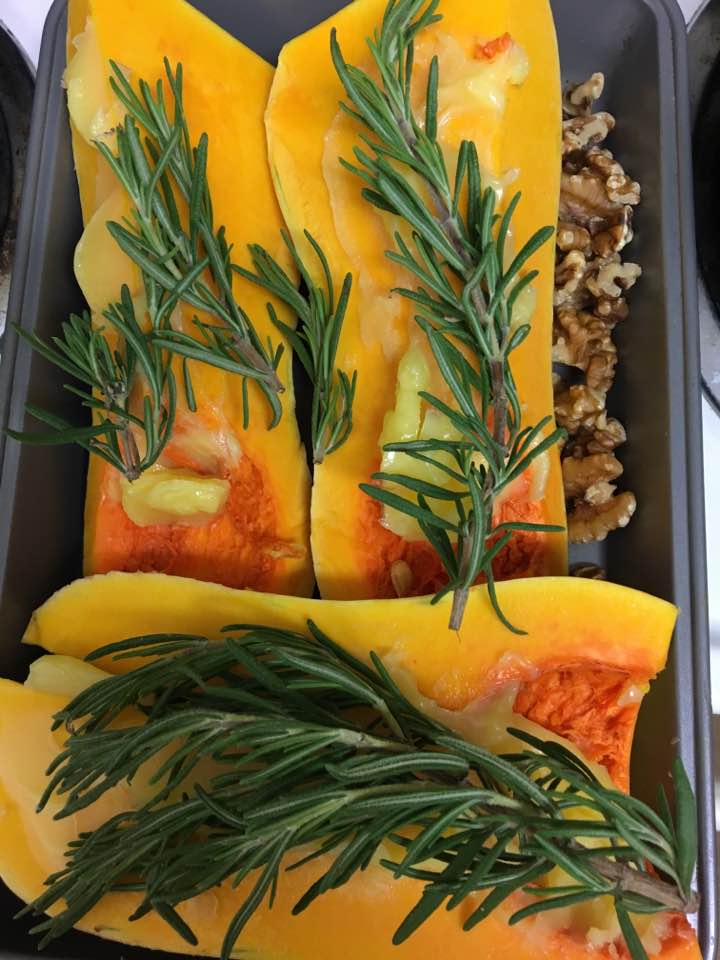
This is really easy! The walnuts and rosemary are said to be so good for the brain, and after eating this, it sure feels that way!
- Oven
- 395 °F
- Time
- 45–55 minutes, plus 5
- Season
- autumn
- Bonus
- toasted squash seeds
What you need
All organic
- 1 medium-largebutternut squash
- 4–6 ozgoat cheese
- 2–3 ozwhole walnuts
- ½–1 ozrosemary sprigs
- 3–6 tbspghee
- ½ lbdates
Method
-
1 Heat the oven
Preheat the oven to 395 °F.
-
2 Cut the squash
Slice off the ends of the cleaned squash. Then slice the squash in two longways, and then slice each half in half again.
Clean out the seeds and strings. You may want to save them (see the postscript).
-
3 Dress it
Arrange the squash pieces in a baking dish. Dollop the ghee on them. Align the rosemary sprigs on top. In the sides of the dish, add the walnuts, as in the photograph above.
-
4 Bake
Bake for 45 to 55 minutes. While it is baking, pit the dates and crumble or cube the goat cheese.
-
5 Finish
After the 45 to 55 minutes of initial baking, pull the squash pan out and add the dates and cheese. Return it to the oven for 5 minutes only, to melt the cheese, or you can just let the dates and cheese stay firm without this last melt.
Serve!
P.S. You can toast or bake the squash seeds and extra walnuts separately with a bit of ghee and salt and pepper for 10 minutes, for a fun snack for the next day or as part of the hors d’oeuvres for this meal.
The Āyurveda of the dish
Quoted from my translation of Vāgbhaṭa’s Aṣṭāṅgahṛdayam.1
An autumn plate
For autumn, Vāgbhaṭa recommends “the sweet, bitter, and astringent tastes” (Sū. 3.56). Squash, dates, cheese and ghee make this a sweet dish through and through.
The squash
Butternut is a squash of the Americas, Cucurbita moschata; the variety itself was bred by Charles Leggett of Stow, Massachusetts, in the mid-1940s.2 Vāgbhaṭa knew its Old World cousins, the gourds, which
… generate kapha and vāta. They are purgative, constipating, abhiṣyandi (obstructing channels), sweet in post-digestive taste (svādupākarasa), and heavy. Among creeper fruits, kūṣmāṇḍa (ash gourd) is the best. It conquers vāta (one of the three doṣas) and pitta (one of the three doṣas).
Aṣṭāṅgahṛdayam, Sū. 6.87–88
Heavy and sweet, then, like the dish as a whole.
Goat cheese
Goat’s milk is the light one: “due to the animals drinking little water, exercising, and eating pungent and bitter foods,” it “is light” (Sū. 5.24). Cheese is another matter. Vāgbhaṭa’s nearest equivalents, the thickened and curdled milks kilāṭa, kūrcikā and their kin, “are strength-promoting. They increase semen, sleep, and kapha; they are constipating, heavy, and harmful to the doṣas” (Sū. 5.41). A rich finish, best in small amounts.
Dates and walnuts
Dates (kharjūra) belong to Vāgbhaṭa’s group of rich fruits, which
… are nourishing, heavy, cold, remove burning sensation, emaciation, and consumption, purify rakta-pitta (bleeding disorders), have a sweet post-digestive taste, are unctuous, constipating, and increase kapha and semen.
Aṣṭāṅgahṛdayam, Sū. 6.121–122
Walnuts (akṣoḍa) are in the same list but fall under the exception in the very next verse: “Vātāma (almond) and others are hot in potency, increase kapha and pitta, and are purgative” (Sū. 6.123), which Hemādri extends from the almond through the rest of the list. So the dates are the cooling, pitta-soothing part of the dish, which suits a season when Vāgbhaṭa says pitta, “accumulated during the rainy season,” flares up (Sū. 3.49).
Ghee
Three to six tablespoons: Vāgbhaṭa calls ghee “the best among unctuous substances, cooling, and supremely maintains youth” (Sū. 5.39). For a kapha constitution, use the low end of that range, and fewer dates.
Curious about another ingredient? Ask Vāgbhaṭa answers from the same translation, with the verses quoted.
Sources
- Vāgbhaṭa, Aṣṭāṅgahṛdayam, in Vāgbhaṭa’s Aṣṭāṅgahṛdayam: A Full English Translation, tr. Renay Oshop (2026) with Aruṇadatta’s Sarvāṅgasundarā and Hemādri’s Āyurvedarasāyana. Loci quoted: Sūtrasthāna 3.49, 3.56; 5.24, 5.39, 5.41; 6.87–88, 6.119–123 (with Hemādri). Paperback pp. 8–9, 13–14, 21, 23 (root text); commentaries quoted from the Kindle edition. In short quotations the translation’s parenthetical glosses are sometimes omitted.
- “The strange history of the butternut,” Farmer’s Weekly, accessed 30 October 2026.
More recipes: Peanut Curry Poha · Proper Chai Tea · Mung Bean Pudding · Turnip and Asparagus Spring Soup · Haluska and Black-Eyed Peas · Gluten-Free Protein Bread · Dental Pain Herbal Tea