The Ten Descents
Viṣṇu comes down ten times, and a child takes ten months of the moon to come down into the world. Every schoolchild since Haeckel has heard that the embryo replays the history of life. Set the ten avatāras beside the ten months of the womb — as the vaidyas, the jyotiṣīs and the embryologists each describe them — and ask, honestly, what rhymes.
निरैतु जीवो अक्षतो जीवो जीवन्त्या अधि ॥
niraitu jīvo akṣato jīvo jīvantyā adhi ||
Two Descents
The word is the same. An avatāra अवतार is a descent — from ava-√tṝ, to cross downward, the verb the dictionaries gloss as “to descend (as a deity) in becoming incarnate.”[25] And the chapter of every Āyurvedic classic that describes how a human being is assembled in the womb is called garbhāvakrānti गर्भावक्रान्ति, from ava-√kram, to step down into — a word Monier-Williams renders without ceremony as “descending (into a womb), conception.”[25] The god descends; the child descends. The tradition counts ten of the first and, in its oldest layer, ten of the second: the Ṛgveda already knows the daśamāsya, the ten-month child, and prays it down alive.[32] Caraka, Suśruta and Vāgbhaṭa describe the womb month by month; Varāhamihira assigns each of the ten months a planet; the Bhāgavata Purāṇa — the same book that catalogues the avatāras — has the sage Kapila narrate the fetus's ten months to his mother, and its child is daśa-māsya too when the birth-wind turns it head-down.[27,28,29,30,34]
Two tens, then, and one verb. I have wanted to lay them side by side for a long time — not because I think the Purāṇas were doing embryology, but because two sequences that the same civilization chose to count in ten and to call by the same word deserve at least to be looked at together. And there is a third sequence in the room that will not leave. Since 1866 a slogan has floated over every embryology lecture: ontogeny recapitulates phylogeny — the development of the individual replays the evolution of the species. Ernst Haeckel coined it, drew the famous grid of embryos to prove it, and was accused of fraud for the drawings within eight years; the strong form of his law has been dead for a century, and a subtler thing has taken its place.[59,61,62] Meanwhile, a Victorian idea that the ten avatāras themselves encode evolution — fish, tortoise, boar, man-lion, and so up to the perfected human — has become, in India, almost common sense, though it is younger than the telephone.[65,66,67]
So there are three ladders here, and the question of this essay is which rungs actually line up. The method is the one I used in Life Begins: resonance, not prediction.[72] I will not claim that the sages foresaw the blastocyst. I will show you the four registers — the Purāṇic ten, the Āyurvedic ten, the Jyotiṣa ten, and the embryologist's forty weeks — on one instrument, and I will label every correspondence with what kind of thing it is: a Text when the sources themselves say it, an Order when the two sequences simply put the same event in the same place, an Image when the correspondence is mine, offered as poetry and nothing more. Some months will surprise you. The seventh, on which every register agrees, surprised me.
Ten Months, Four Ways of Counting
The Purāṇic ten. The canonical list is late and the tradition knows it: the Bhāgavata counts twenty-two descents and then says they are innumerable, “like rivulets flowing from inexhaustible sources of water.”[5] But by the time of the Padma, Garuḍa and Matsya Purāṇas the ten had settled into a formula — matsyaḥ kūrmo varāhaś ca nṛsiṃho vāmanas tathā, rāmo rāmaś ca kṛṣṇaś ca buddhaḥ kalkī tataḥ smṛtaḥ: fish, tortoise, boar, man-lion, dwarf, the two Rāmas, Kṛṣṇa, Buddha, Kalki.[1,2,3,4] Kṣemendra wrote his Daśāvatāracarita on that list in 1066; Jayadeva sang it a century later in the hymn Odissi dancers still perform — though his eighth is Balarāma and Kṛṣṇa is the one being addressed, and the Śrī Vaiṣṇava lists of Vedānta Deśika drop the Buddha altogether.[6,7,8] I use the Padma formula, the one most of the world means by “the ten,” and note the Balarāma variant where it matters.
The Āyurvedic ten. Caraka's Śārīrasthāna 4, Suśruta's Śārīrasthāna 3 and Vāgbhaṭa's Śārīrasthāna 1 all walk the womb month by month, and — this is the first honest thing to say — they disagree. Caraka's first month is a kheṭabhūta, a “jelly-like mass”; Suśruta's and Vāgbhaṭa's is kalala. Suśruta lets the heart manifest in the fourth month and with it the sentient principle, so that the fetus begins to want things and the mother becomes dauhṛdinī, two-hearted; Caraka's fourth month is merely sthiratva, stability, and he starts the two-hearted state a month earlier, with the senses; Vāgbhaṭa moves consciousness to the fifth month and never uses the word dauhṛda at all, speaking instead of the mother's śraddhā, her cravings, which it is “not desirable to disregard” because the fetus's heart “is born of the mother, and … is connected with the mother's heart.”[27,28,29] Suśruta gives the fifth month to manas and the sixth to buddhi; Caraka gives them to flesh-and-blood and to strength-and-complexion; Vāgbhaṭa's sixth is a list — “snāyu (ligaments/sinews), sirā (veins), hair, strength, complexion, nails, and skin.”[27,28,29] They converge again only at the seventh month, which all three call complete, and at the eighth, whose unsteady ojas all three fear. The Bhāgavata's own chapter and the little Garbha Upaniṣad add two more month-lists, both different again.[30,31] A tradition that agreed on everything would be less interesting; one that disagrees about consciousness and agrees about the seventh month is telling us something, and we will come back to what.
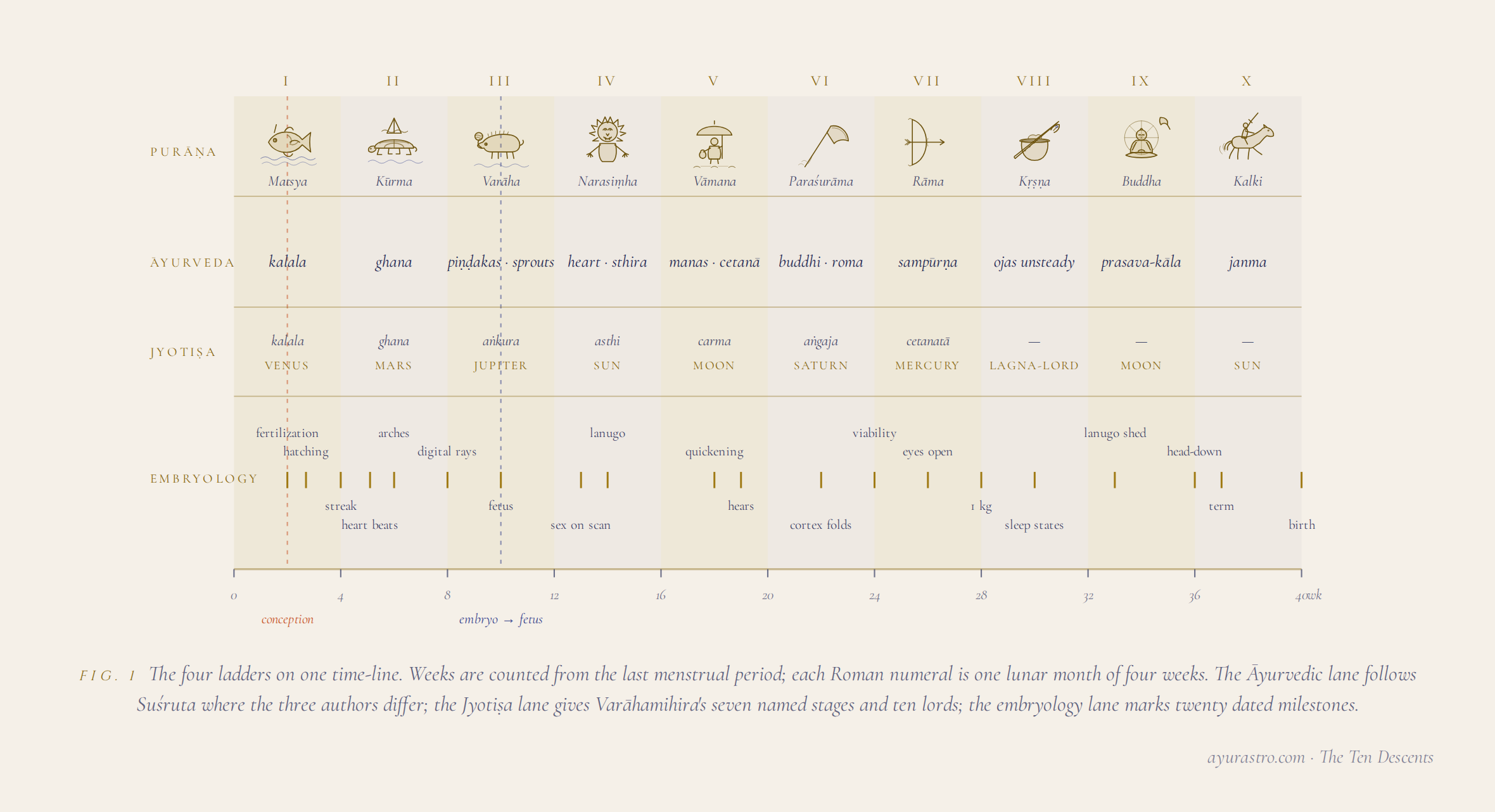
The Jyotiṣa ten. Varāhamihira, in the chapter of the Bṛhat Jātaka on conception, gives the ten months in a single verse: seven stage-names — kalala, ghana, aṅkura, asthi, carma, aṅgaja, cetanatā: jelly, mass, sprout, bone, skin, hair, consciousness — and ten lords: Venus, Mars, Jupiter, the Sun, the Moon, Saturn, Mercury, then the lord of the conception-ascendant, then the Moon and the Sun again.[34] The commentators supplied the missing three stages (the child feeds through the cord; it is filled with cares; it is born) and the rule that a month whose lord is afflicted at conception is a month of danger.[34] Two of these lords, we will see, match the Āyurvedic stage of their month with a precision that looks deliberate.
The embryologist's forty weeks. Obstetrics counts from the first day of the last menstrual period, so that a pregnancy is 280 days, forty weeks — which is to say, exactly ten lunar months of twenty-eight days.[58] The arithmetic is the reason the instrument below can exist: month n of the tradition is weeks 4(n−1) to 4n of the chart, with conception falling in the second week. (Embryologists proper count from fertilization, two weeks less; I convert throughout and say so.[36]) The forty weeks divide into an embryonic period, the first eight after fertilization, in which the body plan is laid down and the creature looks least like a person, and a fetal period of growth and maturation.[36,37]
Four ladders, then, each of ten rungs. Figure 1 lays them out on one time-line; the instrument in the next section lets you climb them.
The Gestation Clock
The clock below is the whole essay in one object. Its ring is the ten months; the pointer is the week; the drawing at its centre is the child as the embryologists describe it at that week, and the panel beside it reads, for whatever month the pointer is in, what Caraka, Suśruta and Vāgbhaṭa say, what the Bhāgavata and the Garbha Upaniṣad say, what Varāhamihira says, what the textbooks say (the dots on the inner track are the dated milestones, and they light as the pointer passes them), and what the Victorian evolutionists said. The last line of the panel is my own reading of the month, with its correspondences labelled Text, Order or Image. Drag the pointer, press play for a thirty-five-second tour, click an avatāra on the ring, or use the keyboard: arrows move a week, the digits jump to a month. Everything in it is also written out below as a table, for those who read on paper.
- Āyurveda
- Bhāgavata · Garbha Up.
- Bṛhat Jātaka 4.16
- Embryology
- The evolution reading
The clock as a table · all ten months, four registers
| Month | Avatāra | Āyurveda, month by month | Bhāgavata & Garbha Upaniṣad | Bṛhat Jātaka 4.16 | Embryology (LMP weeks) | Evolution reading |
|---|---|---|---|---|---|---|
| I wks 0–4 |
मत्स्य Matsya the fish that outgrew every vessel |
Caraka: kheṭabhūta — “a jelly-like mass” with an unmanifest body (Śā. 4.9) Suśruta: kalala — a gelatinous substance is formed (Śā. 3.18) Vāgbhaṭa: “In the first month, the garbha is unmanifest; after one week, it becomes a kalalī (a jelly-like mass)” (Śā. 1.37) |
Bhāg. 3.31: one night: kalala; five nights: budbuda, a bubble; ten days: karkandhu, a jujube (3.31.2) Garbha Up.: one night: kalala; seven nights: a bubble; a half-month: a lump; one month: hardened |
kalala · Śukra (Venus) | Ovulation, fertilization, the free-floating blastocyst, and landing. | the fish |
| II wks 4–8 |
कूर्म Kūrma the tortoise beneath the churning-rod |
Caraka: ghana — the mass hardens into a knot, a tendon, or an egg (male, female, neuter) (Śā. 4.10) Suśruta: the mahābhūtas, “cooked by cold, heat and wind,” condense into ghana (Śā. 3.18) Vāgbhaṭa: “In the second month, from the kalala, it becomes a dense mass (ghana), a fleshy mass (peśī), or a tumor-like mass (arbuda). From these, in order, come males, females, and eunuchs” (Śā. 1.49–50) |
Bhāg. 3.31: after the jujube, a lump of flesh or an egg; by one month a head (3.31.2–3) Garbha Up.: by the second month a head |
ghana · Kuja (Mars) | The embryonic period proper: axis, heart, arches, buds, tail — the phylotypic stage. | the amphibian / reptile |
| III wks 8–12 |
वराह Varāha the boar who lifted the earth on his tusk |
Caraka: all the sense-organs and all the limbs emerge together (Śā. 4.11); with the senses, sentience, and the two-hearted state begins (Śā. 4.15) Suśruta: five lump-like buds appear where the two hands, two feet and the head will be (Śā. 3.18) Vāgbhaṭa: “In the third month, the five parts of its body become manifest: the head, the two thighs, the two arms, and the generation of all subtle organs. And simultaneously with the head and other parts, there is also the knowledge of pleasure and pain” (Śā. 1.54–55) |
Bhāg. 3.31: by two months the arms, legs and limbs; by three, nails, hair, bone, skin, genitals and orifices (3.31.3) Garbha Up.: by the third month, the feet |
aṅkura · Guru (Jupiter) | Fingers separate, the tail is gone, bone begins, and the embryo becomes a fetus. | the land mammal |
| IV wks 12–16 |
नरसिंह Narasiṃha neither man nor beast, neither inside nor outside |
Caraka: the fetus becomes stable (sthiratva) and the mother grows heavy (Śā. 4.20) Suśruta: the heart becomes manifest, and with it the sentient principle (cetanā-dhātu); the fetus desires sense-objects and the woman is called two-hearted, dauhṛdinī (Śā. 3.18) Vāgbhaṭa: “In the fourth month, the limbs become distinct” (Śā. 1.57); “its heart is born of the mother, and that is connected with the mother's heart. Therefore, it is not desirable to disregard the cravings of a pregnant woman” (Śā. 1.52–53) |
Bhāg. 3.31: by four months the seven dhātus (3.31.4) Garbha Up.: in the fourth month the belly and hips |
asthi · Ravi (the Sun) | A recognizably human fetus, furred like a beast: bone, sex, lanugo. | the man-beast |
| V wks 16–20 |
वामन Vāmana the small one whose three steps measured the worlds |
Caraka: flesh and blood increase more than in any other month; the mother grows thin (Śā. 4.21) Suśruta: the mind (manas) awakens, more alert (Śā. 3.30) Vāgbhaṭa: “and in the fifth, consciousness” (Śā. 1.57) |
Bhāg. 3.31: at five months, hunger and thirst (3.31.4) Garbha Up.: in the fifth month the spine |
carma · Candra (the Moon) | Quickening: the first felt steps; the skin is sealed with vernix; hearing begins; the scan measures. | early, small man |
| VI wks 20–24 |
परशुराम Paraśurāma the immortal who cut and restored |
Caraka: strength and complexion (bala, varṇa) increase more than in other months (Śā. 4.22) Suśruta: the intellect (buddhi) arrives (Śā. 3.30) Vāgbhaṭa: “In the sixth month, snāyu (ligaments/sinews), sirā (veins), hair, strength, complexion, nails, and skin develop” (Śā. 1.57) |
Bhāg. 3.31: at six months, wrapped in the amnion, it moves in the right side (3.31.4) Garbha Up.: in the sixth month mouth, nose, eyes and ears |
aṅgaja · Śani (Saturn) | Viability; eyebrows and lashes; the cortex begins to fold and to prune. | the tool-user |
| VII wks 24–28 |
राम Rāma the complete man |
Caraka: the fetus develops in all ways (sarvair bhāvair āpyāyyate) (Śā. 4.23) Suśruta: all the limbs and members more markedly developed (Śā. 3.30) Vāgbhaṭa: “In the seventh month, the fetus, complete with all its parts, is nourished by all the bhāvas (elements)” (Śā. 1.58) |
Bhāg. 3.31: from the seventh month, endowed with consciousness (labdha-bodha) (3.31.10) Garbha Up.: in the seventh month joined with the jīva |
cetanatā · Budha (Mercury) | Thalamus meets cortex; the eyes reopen; the anatomical minimum for experience. | civilised man |
| VIII wks 28–32 |
कृष्ण Kṛṣṇa the eighth child, born at midnight |
Caraka: mother and fetus take ojas from each other again and again; each is by turns joyful and dejected; birth now is risky, and the wise call the eighth month “not to be counted” (Śā. 4.24) Suśruta: ojas becomes unsteady; a child born now does not live (Śā. 3.30) Vāgbhaṭa: “In the eighth month, ojas (vital essence) moves back and forth between the mother and the child repeatedly. Due to this, they both become emaciated and elated; a child born then does not survive” (Śā. 1.62–63) |
Bhāg. 3.31: head to belly, back and neck bent like a bow; caged like a bird (3.31.8–9) Garbha Up.: in the eighth month complete in all parts |
(commentary: it feeds through the cord) · the lord of the conception-lagna | The butter month: fat is laid down, sleep states appear, the lungs ripen. | the rajasic → sattvic man |
| IX wks 32–36 |
बुद्ध Buddha who remembered his births and turned the wheel |
Caraka: from the ninth month to the tenth is the time of delivery (Śā. 4.25) Suśruta: born in the ninth, tenth, eleventh or twelfth month; otherwise something is amiss (Śā. 3.30) Vāgbhaṭa: the ninth-month regimen: “unctuous rice with meat juice … or gruel with much fat, and the previously mentioned anuvāsana (oil enema),” and “a picu (a piece of cloth or cotton soaked in oil) in her yoni” (Śā. 1.67–68) |
Bhāg. 3.31: frightened, bound sevenfold, it prays with folded hands to be free of wombs (3.31.11–21) Garbha Up.: in the ninth month complete in all marks and knowledge, it remembers its former births and vows: if I am freed from this womb I will practise Sāṅkhya and Yoga — I will take refuge in Maheśvara |
(commentary: filled with cares) · Candra (the Moon) | It sheds its fur, turns head-down, and settles into sleep and waking. | the awakened man |
| X wks 36–40 |
कल्कि Kalki who ends an age and begins another |
Caraka: past the eighth month even by a day, the ninth to the tenth is the time of birth; longer is abnormal (Śā. 4.25) Suśruta: the child is born (Śā. 3.30) Vāgbhaṭa: “Even if one day has passed in that [eighth month], thereafter is the time for delivery. After a year, if retained in the womb by vāta, it causes disorders” (Śā. 1.66) |
Bhāg. 3.31: the ten-month-old (daśa-māsya), still praising, is thrust head-down by the birth-wind; it comes out breathless, its memory struck away, and falls to the ground (3.31.22–24) Garbha Up.: at the door of the womb, pressed as by a machine, born in great pain, it is touched by the vaiṣṇava wind and forgets its births and deaths |
(commentary: it is born) · Ravi (the Sun) | Term. Birth. The sword and the first breath. | the future |
The Fish That Outgrew Its Jar
The oldest Indian flood story is a fish story, and it is a story about growth. In the Śatapatha Brāhmaṇa a tiny fish swims into Manu's hands as he washes and asks for shelter: keep me in a jar, it says, and when I outgrow the jar dig me a pit, and when I outgrow the pit carry me to the sea, and I will save you from what is coming. Manu does; the fish grows past every vessel; and when the flood rises Manu ties his ship to the great fish's horn and is towed to the northern mountain.[9] The Bhāgavata retells it with a king's cupped hands, a water-jug, a well, a lake, and finally an ocean “full of dangerous sharks,” the fish outgrowing each within a night.[10] The Purāṇas made this fish the first descent of Viṣṇu, and put the whole of what we would call biology inside a single motif: a small living thing in water, growing faster than any container.
The womb's first month is water, jelly, and a container outgrown. Caraka calls what is there a kheṭabhūta, a jelly-like mass with no manifest body, its limbs “existent and non-existent”; Suśruta and Vāgbhaṭa call it kalala, and Vāgbhaṭa adds that the embryo is unmanifest until, “after one week, it becomes a kalalī (a jelly-like mass).”[27,28,29] The Bhāgavata is more exact still and counts in nights: kalala after one, budbuda, a bubble, after five, karkandhu, something the size and shape of a jujube, after ten.[30] Varāhamihira names the month kalala and gives it to Venus — Śukra, whose name is also the word for semen, and whose body-rulership in his own list is śukra, the seed.[34,35] The first month belongs, in every register, to a wet, unformed, growing thing.
The embryologist's first month is mostly waiting and then a great deal of swimming. Counting from the last period, the ovum is released around the fourteenth day and met in the fallopian tube; the zygote divides as it drifts, becoming by the fourth day after fertilization a morula — a mulberry of sixteen to thirty-two cells — and by the fifth a blastocyst, a hollow sphere with a knot of cells at one pole that will become the embryo. All of this happens inside a shell, the zona pellucida, that has surrounded the egg since the ovary. On the fifth or sixth day the blastocyst, grown too large for it, breaks the shell and slips out: embryologists actually call this hatching. Only then, free and swimming, can it land on the uterine wall — implantation begins on the sixth or seventh day and is finished, the wall sealed over it, by the twelfth.[37,38,39] Fourteen days after fertilization, as the traditional first month closes, a line appears on the disc of cells — the primitive streak — and the body has an axis.[38]
Text Image What the texts share is the jelly; what the essay adds is the fish. I did not expect the blastocyst to have a jar it outgrows and breaks, or a fortnight of swimming free before it lands; but it does, and the word the embryologists chose for the breaking is the word one uses for an egg. Manu's fish is a parable of a living thing whose growth outruns every vessel offered to it. So is the first month of every one of us.
The Tortoise at the Waist of the Hourglass
When the gods and the demons churn the ocean of milk, the mountain they use for a churning-rod begins to sink, and Viṣṇu becomes a tortoise and dives beneath it, so that the whole rotation turns on his back.[12] The tortoise is older than Viṣṇu's descents: in the Śatapatha Brāhmaṇa it is Prajāpati himself, who “made” the creatures and is therefore called kūrma, and whose shell is at once the earth, the sky, and the space between; “this tortoise,” the text adds, “is the same as yonder sun.”[11] What the second descent supplies is not motion but steadiness — an axis held still under an immense turning. Every other treasure comes out of the churning; the tortoise is what lets the churning happen.
The second month in the texts is ghana: the jelly becomes dense. Caraka says the mass hardens into a knot, a tendon or an egg, and reads the sex from the shape; Suśruta gives the physics — the great elements, “cooked by cold, heat and wind,” condense; Vāgbhaṭa follows him: “from the kalala, it becomes a dense mass (ghana), a fleshy mass (peśī), or a tumor-like mass (arbuda). From these, in order, come males, females, and eunuchs.”[27,28,29] The Bhāgavata's count reaches the head at one month and the arms and legs at two; the Garbha Upaniṣad puts the head at two months.[30,31] Varāhamihira names the month ghana and gives it to Mars, the planet that in his scheme rules the marrow — a heat-and-blood planet for the month Suśruta says is cooked.[34,35]
The embryologist's second month is the one on which the whole of comparative anatomy turns, and it goes fast. Sixteen days after fertilization the notochord forms, a stiff rod down the midline that is the axis around which the vertebrate body is built. Neural folds rise beside it and close into a tube; on the twenty-second day, at Carnegie stage 10, the heart — still a tube — begins to beat.[36,38,39] Over the next ten days the embryo develops the features every vertebrate embryo develops: a row of somites down the back, four pharyngeal arches at the neck with clefts between them that look, and only look, like gill slits; paddle-shaped limb buds; a tail that reaches its greatest length around the thirty-eighth day and then, over the following week, is resorbed.[38,40] The heartbeat can be seen on a transvaginal scan from about the sixth week of the chart.[44] The first blood cells, made in islands on the yolk sac, are in circulation by the fourth week, and before the month ends the liver has begun to take over their manufacture — the first of three hand-overs, yolk sac to liver to marrow, that the blood makes before birth.[41] By the end of the month, forty-two days after fertilization, the hand-plate shows digital rays, and the first movements can be seen on ultrasound.[39,45]
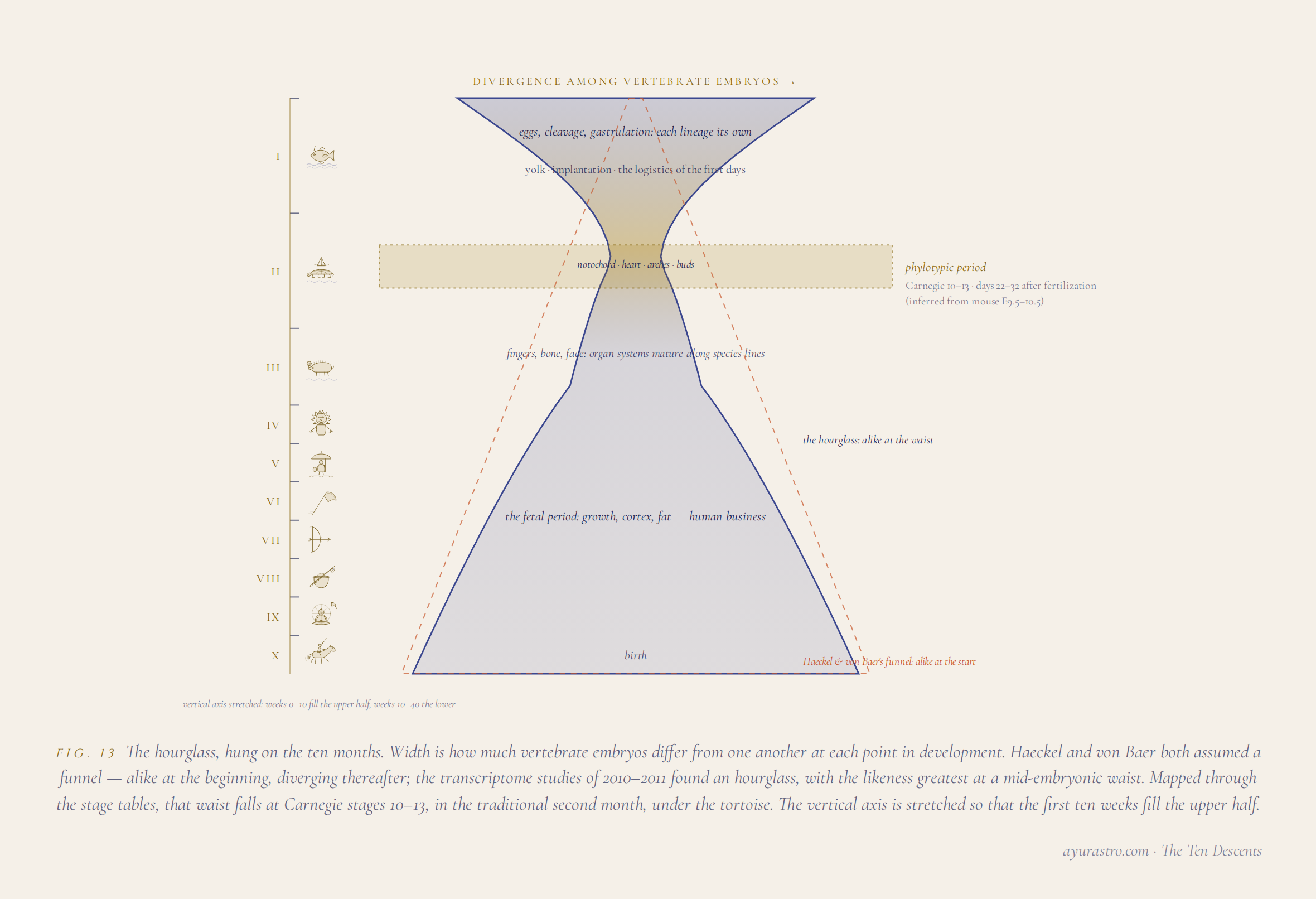
This is also the window that the modern successor to Haeckel's law singles out. The hourglass model — to which section XIII returns — holds that vertebrate embryos are most alike not at the start of development but in the middle, at a “phylotypic period” of organogenesis; in the mouse that period is embryonic days 9.5 to 10.5, which the stage tables map onto human Carnegie stages 10 to 13, days 22 to 32 after fertilization.[39,64] The waist of the hourglass, in other words, falls in the traditional second month — the month of the tortoise.
Text Order Image The density is textual. The position is structural, and it is the most important structural fact in this essay: the one stretch of development in which a human embryo really does resemble the embryos of fish, turtle and chick — the only stretch in which the old slogan retains any truth — is the second month, and the second descent is the animal that holds the axis still while everything turns. The notochord as Mandara and the first heartbeat as the churning are my images; I offer them as such. But the tortoise sitting exactly at the waist of the hourglass is not something I arranged.
The Boar Lifts the Earth
The earth has gone under. In the Yajurvedic telling a boar seizes her and raises her from the waters, and “she extended (aprathata), she became the earth (pṛthivī)” — the name of the ground is the memory of that stretching.[13] The Śatapatha knows the boar as Emūṣa; the Bhāgavata has him burst from Brahmā's nostril the size of a thumb, grow to a mountain, dive to the bottom of the cosmic ocean, find the earth, and carry her up on the point of his tusk.[13,14] The third descent is the one that makes solid ground out of what had been submerged, and stretches it.
The third month in the texts is the month of sprouting. Suśruta sees “five lump-like buds” at the places where the two hands, the two feet and the head will be, with the finer division of parts still too subtle to see; Vāgbhaṭa says the same — “the five parts of its body become manifest: the head, the two thighs, the two arms, and the generation of all subtle organs,” and “simultaneously with the head and other parts, there is also the knowledge of pleasure and pain”; Caraka, characteristically, refuses the sequence and says all the sense-organs and all the limbs emerge together, and that from the moment the senses exist the fetus stirs, wants things it knew in a former life, and makes its mother two-hearted.[27,28,29] The Bhāgavata's third month brings nails, hair, bone, skin, the organ of generation and the orifices.[30] Varāhamihira calls the month aṅkura, the sprout, and gives it to Jupiter, the planet of increase.[34]
The embryologist's third month is when the embryo becomes a fetus, and it is a month of solidifying and drawing-in. Bone begins: the clavicle ossifies first, in the sixth week after fertilization, then the femur and tibia around the forty-fourth day.[38,39] The fingers, which were a webbed paddle, separate as the tissue between them dies on schedule — programmed cell death sculpts the hand between days forty-seven and fifty-six.[39,42] The tail stump is gone. The tooth germs of the milk teeth have formed along a lamina in the jaw.[38] At day fifty-six, Carnegie stage 23, the embryonic period ends: the creature is about thirty millimetres from crown to rump, has every organ system in rudiment, and is henceforth a fetus.[36,39] Its eyelids fuse; its heartbeat, from about the tenth to twelfth week of the chart, can be heard with a Doppler probe.[38,48] And in the tenth week after fertilization something happens that no one who has not studied embryology expects: the midgut, which had grown too fast for the abdomen and spent the previous month herniated out into the base of the umbilical cord, is drawn back inside, rotating as it goes.[38]
Text Order Image The sprouting is textual in every register and the buds are literally there. The order is right too: the third month is when a soft thing gains ground — bone, digits, a body that will no longer be mistaken for anything but a small human. The boar lifting a submerged earth on the point of his tusk and stretching it out is the essay's image for the gut drawn up out of the cord and back into the body, for the skeleton beginning to harden, and for the tooth-buds — but it is also, perhaps, the image that Vāgbhaṭa's gātra-pañcaka, the five parts, would have suggested to a poet who had seen a three-month fetus: five points of solid ground rising out of the water.
Neither Man nor Beast, Neither Inside nor Out
Hiraṇyakaśipu has made himself unkillable by a boon of exclusions: not by any created being, not by man or beast, not indoors or outdoors, not by day or night, not on the ground or in the sky, not by any weapon.[15] Viṣṇu's fourth descent is the answer to a riddle. Out of a pillar, at his devotee's word, bursts a form “neither that of a man nor that of a lion,” who takes the demon on his lap in a doorway and opens him with his nails.[15] (The twilight hour that makes it neither day nor night is the commentators' addition; the verses give the doorway, the lap and the nails.[15]) Narasiṃha is the avatāra of the threshold: a being defined by being two things at once, in the place between.
The fourth month is the month the texts disagree about most, and the disagreement is about exactly this: when does the thing inside become a someone? Suśruta is unambiguous. In the fourth month the limbs are distinct and the heart becomes manifest, and because the heart is the seat of the cetanā-dhātu, the sentient principle, consciousness appears with it; the fetus now “expresses its desire for things of taste, smell and so on” through its mother's cravings, and the woman with two hearts in her is called dauhṛdinī, whose wishes must be honoured lest the child be born crooked, lame or blind.[28] Caraka says only that the fetus becomes stable and the mother heavy; Vāgbhaṭa, that “the limbs become distinct” — and, a few verses earlier, that the fetus's heart “is born of the mother, and … is connected with the mother's heart. Therefore, it is not desirable to disregard the cravings of a pregnant woman.”[27,29] The Bhāgavata gives the month the seven dhātus; Varāhamihira names it asthi, bone, and gives it to the Sun — the planet that, in his own second chapter, rules bone.[30,34,35]
The embryologist's fourth month, weeks twelve to sixteen of the chart, is the month in which the fetus becomes unmistakably human and, at the same time, furred like an animal. The skeleton is now widely ossified and shows on ultrasound; sex can be told on the scan with ninety-six percent accuracy at thirteen weeks; the male external genitalia are complete by the month's end.[38,43] And at about three months after fertilization the skin sprouts lanugo — a fine, downy hair that will spread from the head down over the whole body by the fifth month and be shed again before birth, a coat that no adult human wears and every fetus does.[38] A mother carrying her second child may feel the first flutter of movement in these weeks.[38]
Text Order Image Bone is textual twice over in the Jyotiṣa — the stage is asthi and the lord is the Sun, who rules asthi — and the manifest heart is Suśruta's. The threshold is structural: the fourth month opens the second trimester, the passage from the perilous first months to the settled middle ones, and Caraka's word for it is sthiratva. The rest is image, but I think it is a good one. A being neither wholly inside its mother nor separate from her, its heart joined to hers so that its desires speak in her mouth; a face that has just become human on a body wearing a lion's coat: if you wanted an icon for the fourth month, the man-lion on the threshold with a child on his lap would do.
Three Steps
The dwarf is the descent that measures. The Ṛgveda already praises Viṣṇu as the one “who measured out the earthly regions,” within whose three strides all creatures live;[16] the Bhāgavata gives the strides a story. A small brahmacārī with a staff, an umbrella and a water-pot comes to the sacrifice of King Bali and asks for three paces of land; when the gift is sealed he grows, and one stride covers the earth and the next the heavens, and there is nowhere left to put the third.[17] What is asked for is tiny and complete; what it becomes is the measure of everything.
The fifth month in the texts is the month of the mind and of the skin. Suśruta: “the mind (manas) awakens, more alert”; Vāgbhaṭa, who places consciousness a month later than Suśruta does, puts it here — “in the fourth month, the limbs become distinct, and in the fifth, consciousness”; Caraka gives the month flesh and blood.[27,28,29] The Bhāgavata gives it hunger and thirst — the first wants of a mouth.[30] Varāhamihira names the month carma, skin, and hands it to the Moon.[34] And here is one of the two matches that look deliberate: in the first verse of his second chapter Varāhamihira had said that the Moon is the manas, the mind, of the Cosmic Man — so the month in which Suśruta wakes the mind is the month the astrologer gives to the mind's planet.[28,35]
The embryologist's fifth month is the month of quickening. Fetal movement began in the second month, on the ultrasound screen; but between eighteen and twenty weeks of the chart most first-time mothers feel it for themselves — a step from inside.[38,45] The skin, which is being sealed by a waxy coat of vernix caseosa, is by now covered in lanugo from crown to sole.[38,39] Hearing begins: at nineteen weeks a fetus first moves in response to a tone of 500 hertz, within the range of a speaking voice.[46] And this is the month of the anatomy scan, when the fetus is measured limb by limb and its every part checked against a table — the small, complete thing taken as the measure.
Text Order Image Skin and mind are textual — Varāhamihira's carma and Moon, Suśruta's manas — and the Moon-for-mind concordance between the two authors is one of the essay's genuine findings. Quickening sits in the fifth month in every obstetric text, so the position is structural. The three steps are mine: the first stride the mother feels; the brahmacārī who has just learned to hear; the small one measured, and found to contain everything.
The Axe
Rāma of the Axe is the descent that cuts. At his father's command the boy beheads his own mother, then asks as his boon that she live again, and she rises “as if from sleep”; later, with the axe that gives him his name, he clears the earth of its warrior caste twenty-one times; and he is one of the deathless — the Bhāgavata says he lives still, calm, weapons laid down, on Mount Mahendra.[18] The sixth descent is violence in the service of restoration, and a being who cannot die.
The sixth month in the texts is hair, sinew and intellect. Varāhamihira names it aṅgaja, which his translator glosses as hair, and gives it to Saturn — who in the second chapter rules the sinews and is himself described as “hard-haired.”[34,35] Vāgbhaṭa's sixth month begins with sinews and hair — “snāyu (ligaments/sinews), sirā (veins), hair” — and continues through “strength, complexion, nails, and skin”; Caraka's is strength and complexion; Suśruta's is buddhi, the intellect, arriving a month after the mind.[27,28,29] The Garbha Upaniṣad gives the sixth month the mouth, nose, eyes and ears.[31]
The embryologist's sixth month, weeks twenty to twenty-four, is the month of viability and of the cortex. Eyebrows and eyelashes appear, and the fused eyelids begin to part.[39,48] The brain's smooth surface begins to fold — the Sylvian fissure at twenty-two weeks, the central sulcus at twenty-four — and axons from the thalamus begin to enter the cortical plate.[49,50] Behind that folding is a cull: the developing nervous system makes far more neurons than it keeps, and in many neuronal populations between a fifth and four-fifths, often about half, die on schedule in the weeks that follow.[52] The lungs' type II cells begin to make surfactant at twenty-four weeks; the cochlea becomes functional.[38,46] And at twenty-two to twenty-four weeks a fetus becomes able, sometimes, to live outside its mother: in the American cohort of 2013–2018, eleven percent survived birth at twenty-two weeks, forty-nine at twenty-three, seventy at twenty-four.[54]
Text Order Image Hair and sinew are textual across three authors, and Saturn-for-sinew is the second of Varāhamihira's deliberate-looking matches. Viability at the sixth month is structural — the textbooks put it here, and nowhere else. The axe is image, twice over: the pruning of a brain that keeps only what it needs, and the cut that could now, for the first time, be survived. The sixth-month fetus is the first that could live severed from its source. That is what a cirañjīvin is.
The Complete Man
Of all the descents, Rāma is the one the tradition calls simply complete. The Bhāgavata says he ruled so that the age was like the Satya-yuga and cared for his subjects as a father;[19] the later devotional epithet, maryādā-puruṣottama, the highest man within the bounds, is not in the old texts but says what they mean. The seventh descent is not a hybrid, a dwarf or an executioner. It is a person, whole.
And the seventh month is the one month on which every register agrees. Caraka: “the fetus develops in all ways.” Suśruta: all the limbs and members more markedly developed. Vāgbhaṭa: “the fetus, complete with all its parts, is nourished by all the bhāvas.”[27,28,29] The Bhāgavata: “from the seventh month, endowed with consciousness,” labdha-bodha.[30] The Garbha Upaniṣad: “in the seventh month it is joined with the jīva.”[31] Varāhamihira: cetanatā, consciousness — the last of his seven named stages — under Mercury, who is speech and intelligence in the Cosmic Man.[34,35] Six sources that could not agree in which month the mind arrives all agree that by the seventh the person is there.
What the embryologists put in the seventh month, weeks twenty-four to twenty-eight, is the closest thing neuroscience has to a threshold of experience. The axons that carry sensation from the thalamus to the cortex — the wiring without which nothing felt in the body can reach the part of the brain that could know it — grow into the cortical plate in these weeks and begin to make working synapses; the reviews that ask when a human being could first be conscious put the anatomical floor at twenty-four to twenty-eight weeks, while noting that the fetus in the womb is kept, by its own chemistry, mostly asleep.[50,51] The eyelids reopen.[48] Hearing widens to the low tones of a voice heard through a wall.[46] Sleep begins to sort itself into active and quiet states.[53] And survival at birth, which was a coin-toss a month ago, reaches ninety-four percent by twenty-eight weeks.[54]
Text Order The seventh month needs no image. Completion and consciousness are textual in six sources, and the modern threshold falls in the same month — the same position on both ladders, without any metaphor to carry it. Rāma, the complete man, is the least poetic pairing in this essay and the strongest. When I said in the prelude that a tradition which disagrees about the fourth month and agrees about the seventh is telling us something, this is it: the arrival of a mind is hard to date, and everyone who has looked closely has dated it later than they first guessed.
The Eighth Child
Kṛṣṇa is the eighth descent and he was the eighth child. A voice from the sky tells Kaṃsa that the eighth child of the woman in his chariot will kill him; he imprisons her and kills her infants one by one — six of them — and the seventh is spirited from her womb into another woman's; and the eighth is born at midnight in a prison, the guards asleep and the doors open, and carried across the Yamunā before dawn to be raised as a cowherd's son and steal butter.[20] His birthday is the eighth of the dark fortnight; the vow bears the number in its name, Janmāṣṭamī.[26] Of the ten, he is the only one whose story is a story of a dangerous gestation.
The eighth month is the month the Āyurvedic texts fear. All three say the same strange thing: ojas, the vital essence, passes back and forth between mother and child — “again and again,” Caraka says, through the channels that carry nourishment; “repeatedly,” says Vāgbhaṭa, so that “they both become emaciated and elated” — and because the ojas is unsteady, a child born now is at risk.[27,28,29] Caraka calls the birth merely vyāpattimat, hazardous, and the month agaṇya, “not to be counted on”; Suśruta and Vāgbhaṭa say flatly that “a child born then does not survive,” and Suśruta prescribes an offering of meat to the demons who take it.[27,28,29] Greek medicine held the same belief, and Reiss and Ash traced it from a Hippocratic treatise on the eighth-month child through the Talmud to their own obstetric patients in the 1980s — a superstition, they called it, but one that two ancient medical traditions arrived at independently.[33] Varāhamihira's eighth month is the only one whose lord is not a planet but the lord of the conception-ascendant — the native's own — as if the chart's self had to stand guard.[34]
The embryologist's eighth month, weeks twenty-eight to thirty-two, is the month of butter. The fetus weighs about a kilogram at twenty-eight weeks and will gain two and a half more by term, most of it in the last ten weeks and much of it fat: the newborn is twelve to sixteen percent fat, and nearly all of that is laid down from now on.[55] The lungs' surfactant becomes sufficient to keep them open by thirty-two weeks.[38] The pupils begin to respond to light; active and quiet sleep become recognizable; the mother's antibodies, crossing the placenta, reach about half her own level.[48,53,56]
Text Order Image That the eighth month is perilous is textual in three Āyurvedic authors and, independently, in Hippocrates; that the eighth descent was himself the eighth child, hunted in the womb, is textual in the Bhāgavata. Whether the ancient fear had a basis is another question — eight-month babies do very well today, and there is no reason to think they fared worse than seven-month babies then, whatever the physicians wrote — but the position of the fear on both ladders is the same. The butter is mine. Yet the eighth month is the month in which the child begins to store its fat, and the picture of an ojas that is stolen back and forth between two hearts, by a child who will grow up to be the thief of butter, is one I could not leave out.
Remembering the Births
The Buddha is the descent the Purāṇas admit with a wince. The Bhāgavata names him — “the son of Añjanā, in Kīkaṭa” — as a deluder of the enemies of the gods; the Viṣṇu Purāṇa tells the same story of a shaven mendicant on the Narmadā who talks the demons out of the Veda.[5,21] Jayadeva, a Vaiṣṇava poet, has none of that: his Buddha is “moved by deep compassion,” condemning the slaughter of animals in sacrifice.[6] And the Buddhist texts themselves tell what the awakening consisted of. In the first watch of the night he remembered his former lives — “one birth, two births, three births … a hundred thousand births”; in the second he saw beings passing according to their deeds; in the third the taints were destroyed, and he knew: birth is exhausted.[24]
Now read the Garbha Upaniṣad's ninth month. “In the ninth month it is complete in all its marks and in knowledge, and it remembers its former births … and it vows: if I am freed from this womb I will practise Sāṅkhya and Yoga, which destroy evil and grant the fruit of liberation; if I am freed from this womb I will take refuge in Maheśvara.”[31] The Bhāgavata's fetus, in the same weeks, “frightened, bound sevenfold” — sapta-vadhri, the very name of the Ṛgvedic seer of the birth-hymn — prays with folded hands to the Lord who put it there, and asks only never to enter a womb again.[30] The ninth month, in the two Vaiṣṇava texts that describe the womb from inside, is a month of remembering births and resolving on release. Varāhamihira's commentators call it the month in which the child “is filled with cares,” and give it back to the Moon.[34] Caraka says simply that from the ninth month the time of delivery has begun.[27]
The embryologist's ninth month, weeks thirty-two to thirty-six, is a month of shedding and turning. The lanugo, the animal coat of the fourth month, is shed.[38] The cortex has most of its folds.[49] The fetus turns head-down — a quarter are breech at twenty-eight weeks, three or four percent at term — and by thirty-six weeks the four behavioural states of the newborn, quiet and active sleep, quiet and active waking, are organized and recognizable.[53,57] At thirty-four weeks a fetus will turn its head toward a face-shaped pattern of light shone through the abdominal wall.[48] Hearing reaches up through the octaves.[46] And the mother's antibodies pour across in the final weeks until the child carries more than she does — the last thing given before birth is immunity.[56]
Text Order Image This is the second of the essay's two strongest pairings, and like the seventh month it is textual on both sides: the ninth-month fetus of the Upaniṣad does, in its dark, exactly what the Bodhisattva did under the tree in the first watch. That the child's states of sleeping and waking settle in the ninth month is structural — “awake” has a date. The turning head-down as a wheel set turning, and the animal coat shed before the awakening, are images; so is the antibody as the mother's last compassion. I have not resisted them.
The Descent Still to Come
Kalki has not come. The Bhāgavata says he will: at the close of the Kali age, when kings have become thieves and bodies have grown small, in the house of a brāhmaṇa named Viṣṇuyaśas in the village of Śambhala, mounted on the swift horse Devadatta, with a sword, to end the age and begin a new one.[22] He is the only descent whose story is entirely in the future tense, and the only one whose work is not to save something within the world but to end the world's present cycle so that another can start.
The tenth month is birth, and here every text is unanimous and a little afraid. Caraka: past the eighth month even by a day, from the ninth to the tenth is the time of delivery, and longer is abnormal; Suśruta: born in the ninth, tenth, eleventh or twelfth month, otherwise something is wrong; Vāgbhaṭa: “even if one day has passed in that eighth month, thereafter is the time for delivery,” and “after a year, if retained in the womb by vāta, it causes disorders.”[27,28,29] The Bhāgavata describes the mechanism: the ten-month child, still praising, is seized by the birth-wind and thrust out head-first, breathless, “its memory struck away,” and falls to the ground and cries.[30] The Garbha Upaniṣad has the same forgetting and gives the wind a name: “at the door of the womb, pressed as by a machine, born in great pain, it is touched by the vaiṣṇava wind, and then it does not remember its births and deaths.”[31] Both modern translators render vaiṣṇava as “all-pervading”; the word is also, plainly, “Viṣṇu's.” The last of Viṣṇu's descents, in this text, is the breath that makes us forget the others. Varāhamihira gives the month to the Sun, the soul of the Cosmic Man — the month of coming into light.[34,35]
The embryologist's tenth month is term. Thirty-seven weeks is “early term,” thirty-nine “full term,” and forty is the two hundred and eightieth day from the last period — ten months of the moon exactly.[58] A fetus of thirty-eight weeks hears its mother's voice through her body and its heart quickens; to a stranger's voice it slows.[47] Then the wind: labour, the passage, the cord cut, and the first breath, which the newborn draws itself. What the Ṛgveda prayed for three thousand years ago is what the delivery room still prays for — niraitu jīvo akṣato, may it come forth alive, unharmed.[32]
Text Order Image The end of an age is textual: Kalki ends the Kali-yuga, and birth ends the womb; the ten-month count is Vedic, Purāṇic and obstetric alike. The sword as the knife on the cord is my image, and so is this: that each newborn is Kalki, the descent still to be lived, arriving with its memory struck away into an age that is only beginning. Vāgbhaṭa's chapter is called the descent into the womb; the tenth descent is the descent out of it.
What Haeckel Said, and What Survived
In 1866 Ernst Haeckel, Darwin's most zealous apostle in Germany, wrote the sentence that would outlive everything else he wrote: Die Ontogenesis ist die kurze und schnelle Recapitulation der Phylogenesis — the development of the individual is a short and rapid recapitulation of the development of the lineage.[59] He meant it literally. The human embryo, he held, climbs through the adult forms of its ancestors: a fish stage with gills, a reptile stage, a mammal stage, and only at the end a human one; the “biogenetic law” was that evolution works by adding new stages onto the end of the old sequence. Two years later, in his Natural History of Creation, he published the first comparative embryo plates, and in 1874 the grid that made the law famous — fish, salamander, turtle, chick, pig, calf, rabbit and human in columns, all but indistinguishable in the top row and diverging only lower down — and was accused, by Ludwig Rütimeyer in 1868 and by the anatomist Wilhelm His in 1874, of having drawn what he wished to see. One woodblock in the 1868 book had been printed three times and labelled dog, chick and turtle.[59,62]
The drawings were re-examined in 1997 by Michael Richardson and colleagues, who photographed real embryos at the stage Haeckel had drawn and found them varying more than tenfold in size and considerably in form: “there is no highly conserved embryonic stage in the vertebrates,” their title said, and Haeckel's figures depicted “a stylised amniote embryo.”[61] Nick Hopwood's history of the affair, the fairest account, concludes that the drawings were idealized type-figures synthesized from several sources — “unconventional, reckless even, but there was no intent to deceive.”[62] The strong law, in any case, had died long before the drawings were retried. Walter Garstang showed in 1922 that embryos do not pass through adult ancestral forms at all; Stephen Jay Gould's Ontogeny and Phylogeny (1977) gave the whole history its standard obituary.[63]
What was true in Haeckel had been said better forty years before him, by Karl Ernst von Baer, who was not an evolutionist and whose four laws of 1828 remain the sanest thing in the subject. The general features of a large group appear in the embryo before the special ones; from the general the less general develop; the embryo of a given form, instead of passing through other forms, diverges from them; and therefore — the fourth law — “the embryo of a higher form never resembles any other form, but only its embryo.”[60] A human embryo at five weeks does not look like a fish. It looks like a fish embryo. The pharyngeal arches are not gills that became a jaw and a larynx; they are the shared embryonic scaffold from which gills are built in a fish and a jaw and a larynx in us. The tail is not a monkey's tail; it is the vertebrate tail-bud, which in us is resorbed. The kidneys that form first and regress are the ones a fish keeps — the pronephros of its larva, the mesonephros of its adult. Ancestral embryonic features are conserved because later steps depend on them; ancestral adult features are not recapitulated at all.[38,60]
And in the last thirty years a second correction has arrived from the study of genes. Vertebrate embryos, it turns out, are not most alike at the beginning, as both Haeckel and von Baer supposed. Eggs, cleavage and gastrulation differ wildly between a fish, a frog and a mouse — yolk, implantation, the whole logistics of the first days are species business. The likeness peaks in the middle, at a “phylotypic period” of organogenesis when the body plan is being laid out, and diverges again afterward. Denis Duboule proposed the shape in 1994, Rudolf Raff drew it as an hourglass in 1996, and in 2010 and 2011 three laboratories measured it directly in the expression of genes across development in flies, in zebrafish, and across four vertebrates: the transcriptomes are most conserved at the waist.[64] In the mouse the waist is embryonic day 9.5 to 10.5. No one has staged it in the human embryo directly, and I will be careful to say that the placement in Figure 13 is an inference through the standard stage tables; but those tables put the mouse's waist at Carnegie stages 10 to 13 — days 22 to 32 after fertilization, weeks five to seven of the chart, the heart of the traditional second month.[39,64]
So this is what survives of the slogan, in three sentences. Embryos resemble the embryos of their relatives, not the adults of their ancestors. The resemblance is greatest not at the start but at a waist in the second month, when the axis, the heart, the arches and the buds are being laid down. And single characters — the arches, the tail, the transient kidneys, the fur the fetus grows and sheds — do carry the history of the lineage, one feature at a time, without the whole organism ever replaying it.[61,64] Ontogeny does not recapitulate phylogeny. It recapitulates the embryology of phylogeny, briefly, in the month of the tortoise.
A Victorian Idea
The reading of the ten avatāras as a ladder of evolution is repeated so often in India that it is usually taken for ancient. It is not. C. Mackenzie Brown, who has traced it more carefully than anyone, finds its first Indian statement in a lecture given in Calcutta in 1882 by Keshub Chunder Sen, the Brahmo reformer: “Lo! the Hindu Avatar rises from the lowest scale of life through the fish, the tortoise, and the hog up to the perfection of humanity. Indian Avatarism is, indeed, a crude representation of the ascending scale of Divine creation. Such precisely is the modern theory of evolution.”[66,67] And Brown finds Keshub's source five years earlier and further west, in Madame Blavatsky's Isis Unveiled of 1877, which had already assigned the fish and the tortoise to “the Palaeozoic and Mesozoic times” and the boar and man-lion to the Cenozoic.[65,67,69] The idea passed from Theosophy to the Brahmo Samaj, and from there into the mainstream; Sri Aurobindo gave it its most eloquent Indian form — “the Hindu procession of the ten Avatars is itself, as it were, a parable of evolution: first the Fish Avatar, then the amphibious animal between land and water, then the land animal, then the Man-Lion Avatar, bridging man and animal, then man as dwarf, small and undeveloped and physical but containing in himself the godhead” — and the remark attributed to J. B. S. Haldane, that the ten are “a true sequential depiction” of evolution, has never been found in anything Haldane wrote; it surfaces in a magazine profile in 1992, twenty-eight years after his death.[68,70,72]
The Purāṇas themselves never say anything of the kind. The rationale of descent, in the Gītā, is moral and cyclical — “whenever dharma declines, I come into being, age after age” — and the word avatāra does not even appear there.[23] The Bhāgavata's list is a catalogue of interventions, not a progression; it counts twenty-two before giving up counting.[5] Nothing in the texts orders the ten by complexity, and the tradition's own handling of the last two — the Buddha admitted with reluctance as a deluder, Kalki a destroyer still to come — is not how one places a summit. The evolutionary reading is a nineteenth-century grid laid over a medieval list.
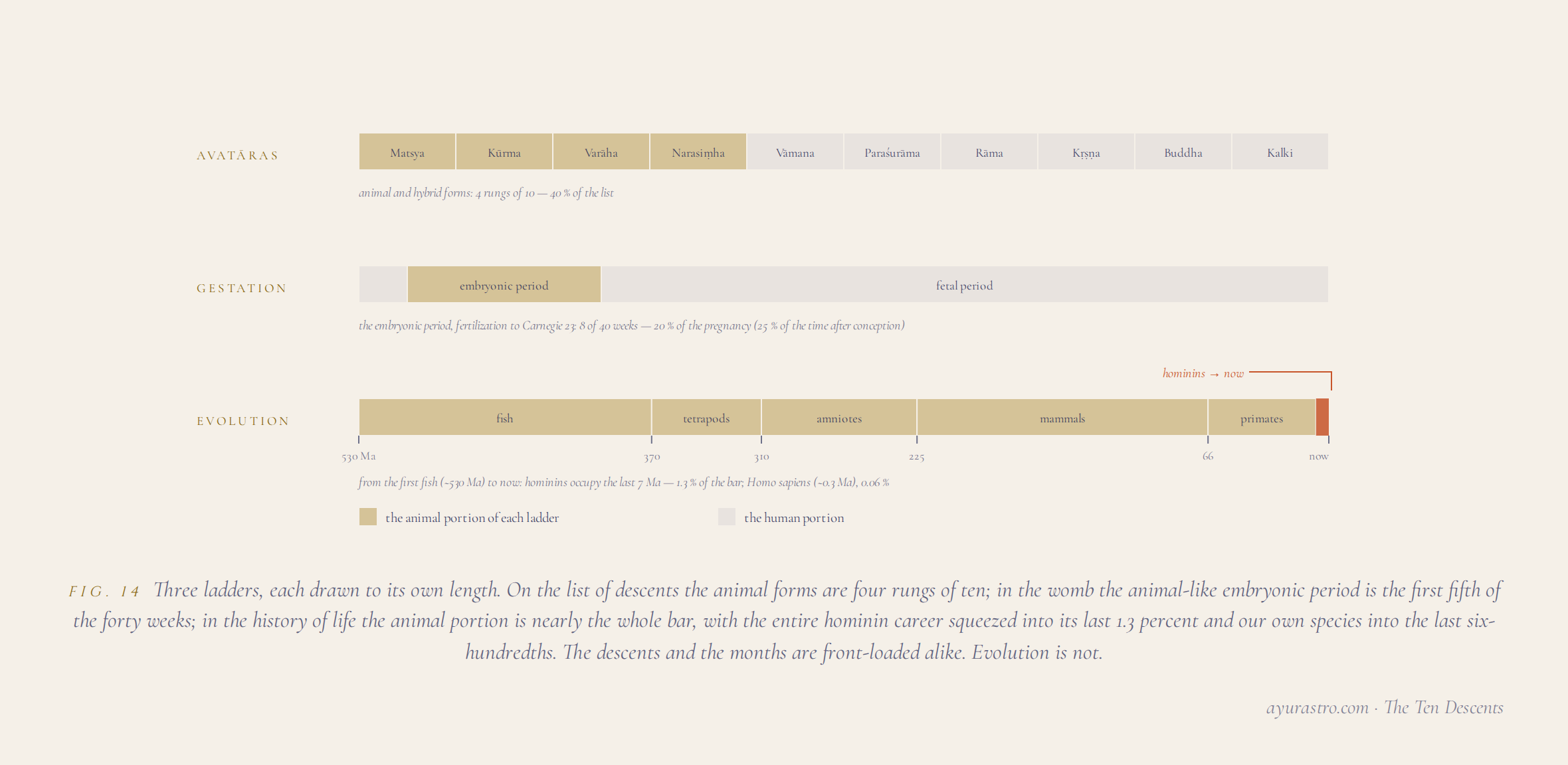
As biology, the grid fits only in its first four rungs, and only loosely. A fish, then a tortoise: but the tortoise is a reptile, and reptiles came after the amphibians, of which the list has none — which is why Aurobindo quietly makes Kūrma “the amphibious animal,” a description of its habits rather than its class. A boar, a mammal, comes after the reptile: good. A man-lion for the bridge between animal and human: a poetic stroke, since the actual bridge is a small African ape and not a large cat. And then the list stops being biology at all. Dwarf, axe-man, ideal king, cowherd-god, ascetic, apocalyptic rider — these are not species; they are ages and temperaments of one species, and Aurobindo, to his credit, reads them so, as “the rajasic, sattwic, nirguna” stages of the human. In evolutionary time the animal part of the story is very nearly the whole of it: fish by five hundred and thirty million years ago, land animals by three hundred and seventy, mammals by two hundred and twenty-five, and the whole hominin career — the seven million years since our line parted from the chimpanzees' — squeezed into the last 1.3 percent, with our own species in the last six-hundredths.[71] On the avatāra list the animal part is four rungs of ten. In the womb it is the embryonic period — the first eight weeks after fertilization, a quarter of the forty. Figure 14 draws the three ladders to their own scales, and the mismatch is the point: the ten descents and the ten months are both front-loaded. They spend a few rungs becoming an animal and the rest becoming a person. Evolution spent almost everything becoming an animal.
None of which makes the Victorian reading worthless. It made a generation of Indian readers hospitable to Darwin at a time when much of the West was not, and it is, as Keshub said, a crude representation of an ascending scale — the sages who arranged fish, tortoise, boar, man-beast and man did put the water-animal before the land-animal before the human, because that is the order in which anyone who looks at animals ranks them. What it is not is a prophecy. And it is not, in any case, the parallel this essay is about. The ten descents do not track evolution beyond the fourth rung. They track, rather better, the ten months.
What Actually Recapitulates
Set the three ladders down and count what held. The strong claim — that the avatāras encode evolution, or that the fetus climbs through its ancestors — held nowhere. The weak claim, that the ten descents and the ten months share a grammar, held in more places than I expected when I began, and I want to be exact about which.
First, the tradition's own sequence tracks the embryologist's in its order, and the tracking is not vague. Jelly, dense mass, sprouting buds, bone, skin, hair, completion, the perilous eighth, the restless ninth, birth: read against the chart, that is blastocyst, embryonic disc and organogenesis, limb buds and digits, ossification, vernix, eyebrows and scalp hair, the thalamocortical threshold, the month of fat and unsteady state, the settling of sleep and waking, term. I do not think this is mysterious. The Āyurvedic sequence is the order in which a fetus looks — the order of what is visible to a physician who has seen the products of miscarriage at every month — which any physician of any age has, whatever else they did or did not dissect. Suśruta records a debate among the sages over which part forms first — Śaunaka said the head, Kṛtavīrya the heart, Mārkaṇḍeya the hands and feet, Dhanvantari all at once — and remarks that the parts cannot be seen in their earliest stages “owing to their extremely attenuated size, like a mango fruit or the sprouts of bamboo.”[28] That is the sentence of people who were looking. Ontogeny, in the Āyurvedic texts, recapitulates observation; and observation, done carefully, agrees with itself across two thousand years.
Second, the four registers converge on the same two months, and the convergence is textual. The seventh month is complete and conscious in Caraka, Suśruta, Vāgbhaṭa, the Bhāgavata, the Garbha Upaniṣad and Varāhamihira, and it is the month in which modern neuroscience places the earliest wiring that could support experience.[27,28,29,30,31,34,50,51] The eighth month is perilous in three Āyurvedic authors and in the Hippocratic corpus; it is the month whose lord, in Jyotiṣa, is the native's own.[27,28,29,33,34] Two ancient medical traditions and one astrological one agreeing about the seventh and eighth months, for reasons that a modern developmental biologist can at least partly reconstruct, is more than a coincidence and less than a prophecy. It is what careful observation produces.
Third, the resemblance between the avatāras and the months is real, and it is structural rather than symbolic in exactly the places I have marked Order: the animal forms front-loaded in both; the hybrid at the threshold of the settled middle; the first felt movement at the measuring dwarf; viability at the immortal; completion at the complete man; the dangerous eighth at the hunted eighth child; the remembering ninth at the Buddha; the end of an age at birth. Where I have written Image — the hatching fish, the notochord as Mandara, the tusk and the gut, the lion's coat, the axe, the butter, the sword on the cord — the correspondence is mine and the reader is free to decline it. I have tried never to smuggle an image across the line into a claim.
Fourth and last, the Haeckelian residue is small and precisely located. The embryo resembles its vertebrate relatives, as an embryo, most closely in the second month — at the waist of the hourglass, under the tortoise — and single features from earlier chapters of the lineage (the arches, the tail, the transient kidneys, the fur) appear and are set aside one at a time. The tradition, with no theory of evolution, nonetheless put its most animal descents first and its most animal months first, because that is the direction in which a body grows: from the general to the particular, as von Baer said, from the shared to the individual. On this, and only on this, the three ladders are one ladder.
Varāhamihira's Lords
A word for the jyotiṣīs, because the verse that gave this essay its Jyotiṣa register deserves more than a column in a table. Bṛhat Jātaka 4.16 is one line: seven stage-names and ten lords, Venus to the Sun, and the remark that the good and ill of each month are “according to the lord of the month.” N. Chidambaram Iyer's translation carries the commentators' rule — miscarriage in the month whose lord is afflicted at conception; suffering in the month whose lord is merely dim — and I quote it as commentary, not as Varāhamihira's own words.[34]
What I had not noticed until I laid the verse beside the Āyurvedic months is how carefully its lords are chosen. Varāhamihira's second chapter gives each planet a tissue and a faculty of the Cosmic Man: the Sun is the soul and rules bone; the Moon is the mind and rules blood; Mars the marrow; Mercury speech and skin; Jupiter knowledge and fat; Venus desire and semen; Saturn sorrow and sinew.[35] Now read the months. The first month, the seed, has Venus, whose name and tissue are the seed. The fourth month, which the verse itself names asthi, has the Sun, who rules asthi. The fifth month, in which Suśruta wakes the manas, has the Moon, who is the manas. The sixth, which Vāgbhaṭa opens with sinews and hair, has Saturn, who rules sinew and is hard-haired. The seventh, cetanatā, has Mercury, who is intelligence and speech. The tenth, birth, has the Sun, the soul, the light. Only the second, third, eighth and ninth resist the pattern, and the eighth resists it beautifully: the month whose ojas the physicians could not trust is given to no planet at all but to the lord of the conception-ascendant — the self of the chart, standing in for a body not yet steady enough to have one.[28,29,34,35]
The practical use, for those who cast ādhāna charts, is the one the commentators drew: the month-lords are a calendar of vigilance. And for the vaidya-jyotiṣī the calendar has a second column in the Āyurvedic regimen — Vāgbhaṭa's ninth-month regimen of unctuous rice with meat juice, fat-rich gruel, the oil enema and an oiled cloth placed in the yoni; Suśruta's meat-offering in the eighth; Caraka's insistence that the two-hearted woman's cravings be met — so that the month whose lord is weak is also the month whose regimen is strict.[27,28,29] I leave the astrological weighing of afflictions to the reader's own school; my point is only that the verse is not arbitrary. Its author knew the physicians' months and set his planets against them with intent.
| Month | Stage (BJ 4.16) | Lord (BJ 4.16) | The lord's tissue or faculty (BJ 2.1, 2.11) against the Āyurvedic month |
|---|---|---|---|
| I | kalala — the jelly | Śukra (Venus) | Venus — semen (śukra): the seed-month |
| II | ghana — the dense mass | Kuja (Mars) | Mars — marrow; Suśruta's ghana is “cooked by heat” |
| III | aṅkura — the sprout | Guru (Jupiter) | Jupiter — increase: the sprouting month |
| IV | asthi — bone | Ravi (the Sun) | Sun — rules asthi, and the stage is asthi |
| V | carma — skin | Candra (the Moon) | Moon — is manas (2.1); Suśruta's manas awakens |
| VI | aṅgaja — hair | Śani (Saturn) | Saturn — rules sinew, is hard-haired; Vāgbhaṭa's snāyu, roma |
| VII | cetanatā — consciousness | Budha (Mercury) | Mercury — intelligence and speech; the stage is cetanatā |
| VIII | (commentary: it feeds through the cord) — hunger | the lord of the conception-lagna | the native's own lagna-lord for the month of unsteady ojas |
| IX | (commentary: filled with cares) — restlessness | Candra (the Moon) | Moon — for the month “filled with cares” |
| X | (commentary: it is born) — birth | Ravi (the Sun) | Sun — the soul of the Kālapuruṣa: into the light |
Kalki Has Not Come
I said at the beginning that I would not claim the sages foresaw the blastocyst, and I have not. What I have found instead is that a civilization which counted ten descents of its god and ten months of its children, and used one verb for both, was not being careless with its numbers. The ten months are a real sequence, observed, and the ten descents were arranged by people whose physicians knew that sequence — who knew that a body begins as water and jelly and a rod, that it passes through a stretch when it could be any animal, that it sprouts, hardens, furs, stirs, becomes able to live alone, becomes complete, passes through a month of danger and a month of restless remembering, and is then thrust out into the light by a wind and forgets. Whether they arranged the avatāras as that sequence I cannot prove and do not assert. That the two sequences rhyme, rung for rung, at the seventh and the eighth and the ninth, is simply the case.
And the tenth rung is empty on both ladders. Kalki has not come; the child at term has not yet been born. Every birth is a tenth descent — a being that has spent ten months becoming, arriving with its memory struck away by Viṣṇu's wind into an age that is, for it, entirely new. The Garbha Upaniṣad's fetus, in the ninth month, remembered its births and vowed to seek release; the newborn remembers nothing; and so the vow is made again in every womb and lost at every birth, which is perhaps why the tradition needed a descent that is always still to come. The Ṛgveda's prayer is the only sensible thing to say about it, and I will let it close the essay as it opened it: daśa māsāñ chaśayānaḥ kumāro adhi mātari, niraitu jīvo akṣato jīvo jīvantyā adhi — the child who has lain ten months in his mother, may he come forth alive, unharmed, living from the living one.[32]
References & Further Reading
The Ten Descents — Texts
- Padma Purāṇa, Uttarakhaṇḍa 71.26–27 — the compact formula of the ten: matsyaḥ kūrmo varāhaś ca nṛsiṃho vāmanas tathā | rāmo rāmaś ca kṛṣṇaś ca buddhaḥ kalkī tataḥ smṛtaḥ. Sanskrit at wisdomlib.org.
- Garuḍa Purāṇa 1.86.10–11 (tr. M. N. Dutt, 1908, ch. 86): fish, tortoise, boar, man-lion, dwarf, the two Rāmas, Kṛṣṇa, Buddha, Kalki. wisdomlib.org.
- Matsya Purāṇa 285.6–7 (the standard ten) and 54.15–19 (Balarāma in place of Kṛṣṇa, Buddha retained) — as collated in the Matsya Purāṇa critical study, “Incarnations of Viṣṇu.” wisdomlib.org.
- Agni Purāṇa 49 (tr. N. Gangadharan, Motilal Banarsidass, 1984–87): iconography of the ten, the Buddha “calm, having long ears, white complexion,” Kalki “a twice-born endowed with a bow and quiver.” wisdomlib.org.
- Bhāgavata Purāṇa 1.3.23–26 (tr. A. C. Bhaktivedanta Swami): Balarāma and Kṛṣṇa counted together at 1.3.23; the Buddha, “son of Añjanā, in Kīkaṭa,” at 1.3.24; Kalki at 1.3.25; and 1.3.26, “the incarnations of the Lord are innumerable, like rivulets flowing from inexhaustible sources of water.” Also 6.8.19 and 10.40.22, where the Buddha is named. vedabase.io.
- Jayadeva, Gītagovinda 1.5–16, the Daśāvatāra-stotra (c. 1170): tr. Barbara Stoler Miller, Love Song of the Dark Lord (Columbia University Press, 1977). Its ten run Fish, Tortoise, Boar, Man-lion, Dwarf, Paraśurāma, Rāma, Balarāma, Buddha, Kalki, with Kṛṣṇa as the addressee of every refrain; the Buddha “moved by deep compassion” condemns the Vedic slaughter of animals.
- Kṣemendra, Daśāvatāracarita (Kashmir, 1066 CE), which gives the Buddha seventy-four verses drawn from Aśvaghoṣa rather than the Purāṇic story of delusion. See the studies at wisdomlib.org.
- Vedānta Deśika, Daśāvatārastotra (13th–14th c.), the Śrī Vaiṣṇava list without the Buddha: Balarāma eighth, Kṛṣṇa ninth, Kalki tenth. celextel.org.
- Śatapatha Brāhmaṇa 1.8.1.1–6, tr. J. Eggeling (Sacred Books of the East 12, 1882): the fish that outgrows the jar, the pit, and must be carried to the sea; the ship's rope tied to its horn. sacred-texts.com.
- Bhāgavata Purāṇa 8.24.12–26: the fish in Satyavrata's cupped hands, the water-jug, the well, the lake, the ocean “full of dangerous sharks.” vedabase.io.
- Śatapatha Brāhmaṇa 7.5.1.5–6, tr. Eggeling (SBE 41): Prajāpati as the tortoise, “inasmuch as he made (kar), he is called kūrma”; “this tortoise is the same as yonder sun.” sacred-texts.com.
- Bhāgavata Purāṇa 8.7.8–10: Viṣṇu as the tortoise beneath Mount Mandara during the churning. vedabase.io.
- Taittirīya Saṃhitā 7.1.5.1, tr. A. B. Keith (1914): “becoming a boar he seized her … she extended, she became the earth”; and Śatapatha Brāhmaṇa 14.1.2.11 (SBE 44), the boar Emūṣa who raised her. sacred-texts.com.
- Bhāgavata Purāṇa 3.13.18–31: the boar from Brahmā's nostril; the earth lifted on his tusks. vedabase.io.
- Bhāgavata Purāṇa 7.3.35–38 (Hiraṇyakaśipu's boon: no created being, no residence or outside, no day or night, no ground or sky, no weapon) and 7.8.17–29 (the pillar, “neither that of a man nor that of a lion,” the doorway, the lap, the nails). The twilight hour belongs to the commentaries, not to these verses. vedabase.io.
- Ṛgveda 1.154.1–2, tr. R. T. H. Griffith: Viṣṇu “who measured out the earthly regions,” within whose three strides all creatures dwell. sacred-texts.com.
- Bhāgavata Purāṇa 8.18–21: the brahmacārī dwarf with staff, umbrella and water-pot (8.18.12–23); “three paces of land” (8.19.16, 27); the expansion (8.20.21) and the missing room for the third step (8.20.34; 8.21.29). vedabase.io.
- Bhāgavata Purāṇa 9.16.5–8 (the killing and restoration of Reṇukā), 9.16.18–19 (the earth cleared of kṣatriyas twenty-one times), 9.16.26 (“still lives … on Mount Mahendra”). vedabase.io.
- Bhāgavata Purāṇa 9.10.50–51: Rāma cared for the citizens like a father, and “the age was like Satya-yuga.” The epithet maryādā-puruṣottama is devotional usage, not a phrase of the primary texts. vedabase.io.
- Bhāgavata Purāṇa 10.1.34 (“the eighth child of the woman you are carrying will kill you”); 10.2.4–8 (six children killed; the seventh, Saṅkarṣaṇa, moved to Rohiṇī's womb); 10.3.7–8 (born at midnight); 10.3.49–50 (the Yamunā parts for Vasudeva); 10.8.29 (the butter-thief). vedabase.io.
- Viṣṇu Purāṇa 3.17–18, tr. H. H. Wilson (1840): Māyāmoha, the naked shaven mendicant on the Narmadā who turns the daityas from the Veda — the Purāṇic ambivalence about the Buddha. sacred-texts.com.
- Bhāgavata Purāṇa 12.2.16–20: at the close of Kali, in the house of Viṣṇuyaśas of Śambhala, Kalki on the horse Devadatta, sword in hand. (The horse's whiteness is later iconography.) On the Kalki Purāṇa as a Bengal work not later than the early 18th century: R. C. Hazra, Studies in the Upapurāṇas (1958). vedabase.io.
- Bhagavad Gītā 4.7–8 (yadā yadā hi dharmasya … sambhavāmi yuge yuge) — the classical rationale of descent, in a text that never uses the word avatāra; see P. Hacker, “Zur Entwicklung der Avatāralehre,” Wiener Zeitschrift für die Kunde Süd- und Ostasiens 4 (1960), and N. Sheth, “Hindu Avatāra and Christian Incarnation,” Philosophy East and West 52 (2002). vedabase.io.
- Majjhima Nikāya 36, Mahāsaccaka Sutta: “in the first watch of the night … I recollected my manifold past lives, one birth, two births … a hundred thousand births”; tr. Bhikkhu Ñāṇamoli and Bhikkhu Bodhi, The Middle Length Discourses of the Buddha (Wisdom, 1995). wordsofthebuddha.org.
- Monier-Williams, A Sanskrit–English Dictionary (1899), s.v. ava-√tṝ “to descend into … (as a deity) in becoming incarnate”; avatāra “descent (especially of a deity from heaven)”; avakramaṇa / avakrānti “descending (into a womb), conception.” wisdomlib.org · avakrānti.
- Padma Purāṇa, Uttarakhaṇḍa 31, “The Vow of Janmāṣṭamī” (tr. N. A. Deshpande, Motilal Banarsidass, 1988–92): the eighth of the dark half, with Rohiṇī, as the birth-anniversary of Kṛṣṇa. wisdomlib.org.
The Womb — Āyurveda and the Garbha Texts
- Caraka Saṃhitā, Śārīrasthāna 4.9–26 (Mahatī Garbhāvakrānti Śārīra), tr. Shree Gulabkunverba Ayurvedic Society (1949): the ten months from kheṭabhūta (4.9) to the eighth month's unsteady ojas (4.24) and the ninth-to-tenth-month time of delivery (4.25); the two-hearted state at 4.15. Sanskrit and translation at carakasamhitaonline.com and wisdomlib.org.
- Suśruta Saṃhitā, Śārīrasthāna 3.18 and 3.30 (Garbhāvakrānti Śārīra), tr. K. L. Bhishagratna (1911): kalala, ghana, the five buds, the heart and cetanā-dhātu of the fourth month and the dauhṛdinī; manas in the fifth, buddhi in the sixth, completion in the seventh, unsteady ojas in the eighth, birth in the ninth to twelfth. 3.32 gives the sages' dispute over which part forms first. wisdomlib.org.
- Vāgbhaṭa, Aṣṭāṅgahṛdaya, Śārīrasthāna 1 (Garbhāvakrānti): 1.37 (kalalī after one week), 1.49–50 (ghana, peśī, arbuda), 1.52–53 (the fetal heart born of the mother and connected to hers), 1.54–55 (the five parts and the knowledge of pleasure and pain), 1.57 (fourth to sixth months), 1.58 (seventh), 1.62–63 (ojas in the eighth), 1.66 (the time of delivery), 1.67–68 (the ninth-month regimen). All English renderings of Vāgbhaṭa in this essay are quoted from the author's own edition, Vāgbhaṭa's Aṣṭāṅgahṛdayam: A Full English Translation (Renay Oshop, 2026), Śārīra Sthāna, pp. 108–109. Sanskrit with Aruṇadatta's commentary at wisdomlib.org.
- Bhāgavata Purāṇa 3.31.1–24 (Kapila to Devahūti), tr. Bhaktivedanta: kalala in one night, budbuda in five, karkandhu in ten (3.31.2); head at one month, limbs at two, nails, hair, bone, skin, genitals and orifices at three (3.31.3); the seven dhātus at four, hunger and thirst at five, the amnion at six (3.31.4); consciousness from the seventh month (3.31.10); the fetus's prayer (3.31.11–21); the ten-month child, the birth-wind, and the forgetting (3.31.22–24). vedabase.io.
- Garbha Upaniṣad, tr. A. G. Krishna Warrier; also tr. Subhash Kak. The month list runs by nights and months to the ninth; the vow (“if I am freed from this womb I will practise Sāṅkhya and Yoga … I will take refuge in Maheśvara”); and the birth line, vaiṣṇavena vāyunā saṃspṛśyate, which both translators render “touched by the all-pervading wind.” Sanskrit at sanskritdocuments.org; Warrier at celextel.org.
- Ṛgveda 5.78.5–9, the Saptavadhri hymn to the Aśvins, tr. R. T. H. Griffith: “so may the ten-month babe descend” (7), “ten-month babe, descend together with the after-birth” (8), and “the child who hath for ten months' time been lying in his mother's side, may he come forth alive, unharmed, yea, living from the living dame” (9). sacred-texts.com.
- Reiss, R. E., & Ash, A. D. (1988). “The eighth-month fetus: classical sources for a modern superstition.” Obstetrics & Gynecology 71(2), 270–273 — the belief that an eighth-month child fares worse than a seventh-month one, traced to the Hippocratic On the Eighth-Month Child and carried through Greek, Talmudic and medieval medicine.
Jyotiṣa
- Varāhamihira, Bṛhat Jātaka 4.16: kalala-ghana-aṅkura-asthi-carma-aṅgaja-cetanatāḥ sita-kuja-jīva-sūrya-candra-ārki-budhāḥ parataḥ udayapa-candra-sūrya-nāthāḥ — seven named stages, and ten month-lords. Tr. N. Chidambaram Iyer (1885), with the commentarial gloss on months eight to ten and the affliction rule. wisdomlib.org.
- Bṛhat Jātaka 2.1 (the Kālapuruṣa: the Sun his soul, the Moon his mind, Mercury his speech, Jupiter knowledge and happiness, Venus desire, Saturn sorrow) and 2.11 (the Sun rules bone, the Moon blood, Mars marrow, Mercury skin, Jupiter fat, Venus semen, Saturn sinew). wisdomlib.org.
Embryology
- O'Rahilly, R., & Müller, F. (2010). “Developmental stages in human embryos: revised and new measurements.” Cells Tissues Organs 192(2), 73–84. doi:10.1159/000289817. The twenty-three Carnegie stages span the first eight weeks after fertilization; postmenstrual age runs about two weeks longer.
- Moore, K. L., Persaud, T. V. N., & Torchia, M. G. (2020). The Developing Human: Clinically Oriented Embryology, 11th ed. Elsevier — the standard week-by-week account drawn on throughout.
- StatPearls (NCBI Bookshelf), chapters consulted for the week-by-week data: Embryology, Week 1; Week 2–3; Neural Tube; Heart Tube; Branchial Arches; Hand; Kidney, Bladder and Ureter; Midgut; Teeth; Bone Ossification; Sexual Development; Lanugo; Vernix Caseosa; Fetal Movement; Pulmonary; Breech Presentation; Estimated Date of Delivery. ncbi.nlm.nih.gov.
- Hill, M. A. UNSW Embryology: the Carnegie stage pages (stages 10–23), the Timeline of Human Development, Fetal Development, Bone Development Timeline, and the Carnegie–Theiler stage comparison. embryology.med.unsw.edu.au.
- Santos, C., Marshall, A. R., Murray, A., et al. (2024). “Spinal neural tube formation and tail development in human embryos.” eLife 12:e88584; and Tojima, S., et al. (2018). “Tail reduction process during human embryonic development.” Journal of Anatomy 232(5), 806–811 — the tail longest at Carnegie 16 (days 37–39), a stump by stage 18.
- Ivanovs, A., et al. (2017). “Human haematopoietic stem cell development: from the embryo to the dish.” Development 144, 2323–2337; Charbord, P., et al. (1996). “Early ontogeny of the human marrow from long bones.” Blood 87, 4109–4119 — yolk sac, then liver, then marrow.
- Zuzarte-Luís, V., & Hurlé, J. M. (2002). “Programmed cell death in the developing limb.” International Journal of Developmental Biology 46, 871–876 — the interdigital death that separates the fingers.
- Amankona, E., et al. (2025). “Effectiveness of prenatal ultrasound in fetal sex identification: a systematic review and meta-analysis.” Journal of Ultrasound 28, 563–574 — 89 % at 12 weeks, 96 % at 13.
- Doubilet, P. M., et al. (2013). “Diagnostic criteria for nonviable pregnancy early in the first trimester.” New England Journal of Medicine 369, 1443–1451 — the sonographic heartbeat at about six weeks.
- de Vries, J. I. P., Visser, G. H. A., & Prechtl, H. F. R. (1982). “The emergence of fetal behaviour. I. Qualitative aspects.” Early Human Development 7, 301–322 — the first movements seen on ultrasound at about seven weeks.
- Hepper, P. G., & Shahidullah, B. S. (1994). “Development of fetal hearing.” Archives of Disease in Childhood 71, F81–F87 — a 500 Hz tone answered at 19 weeks; 250 and 100 Hz by 27; 1,000 by 33; 3,000 by 35. Cochlear function from about 24 weeks: Lahav, A., & Skoe, E. (2014). Frontiers in Neuroscience 8:381.
- Kisilevsky, B. S., et al. (2003). “Effects of experience on fetal voice recognition.” Psychological Science 14(3), 220–224 — at term the fetal heart quickens to the mother's voice and slows to a stranger's.
- Tawfik, H. A., et al. (2016). “Embryologic and fetal development of the human eyelid.” Ophthalmic Plastic & Reconstructive Surgery 32, 407–414; Robinson, J., & Fielder, A. R. (1990). “Pupillary diameter and reaction to light in preterm neonates.” Archives of Disease in Childhood 65, 35–38; Reid, V. M., et al. (2017). “The human fetus preferentially engages with face-like visual stimuli.” Current Biology 27, 1825–1828.
- Garel, C., et al. (2001). “Fetal cerebral cortex: normal gestational landmarks identified using prenatal MR imaging.” American Journal of Neuroradiology 22, 184–189; Chi, J. G., Dooling, E. C., & Gilles, F. H. (1977). “Gyral development of the human brain.” Annals of Neurology 1, 86–93.
- Kostović, I., & Judaš, M. (2010). “The development of the subplate and thalamocortical connections in the human foetal brain.” Acta Paediatrica 99, 1119–1127; Kostović, I., et al. (2021). Journal of Neuropathology & Experimental Neurology 80, 393–414 — thalamocortical axons entering the cortical plate at 24–27 weeks.
- Lagercrantz, H., & Changeux, J.-P. (2009). “The emergence of human consciousness: from fetal to neonatal life.” Pediatric Research 65, 255–260.
- Oppenheim, R. W. (1991). “Cell death during development of the nervous system.” Annual Review of Neuroscience 14, 453–501; Wong, F. K., & Marín, O. (2019). Annual Review of Cell and Developmental Biology 35, 523–542 — the brain keeps only a fraction of the neurons it makes.
- Nijhuis, J. G., et al. (1982). “Are there behavioural states in the human fetus?” Early Human Development 6, 177–195; Mirmiran, M., Maas, Y. G. H., & Ariagno, R. L. (2003). “Development of fetal and neonatal sleep and circadian rhythms.” Sleep Medicine Reviews 7, 321–334.
- Bell, E. F., et al. (2022). “Mortality, in-hospital morbidity, care practices, and 2-year outcomes for extremely preterm infants in the US, 2013–2018.” JAMA 327(3), 248–263 — survival 10.9 % at 22 weeks, 49.4 % at 23, 69.9 % at 24, 87.6 % at 26, 94.0 % at 28.
- Institute of Medicine (2009). Weight Gain During Pregnancy: Reexamining the Guidelines, ch. 3 — about 1 kg at 28 weeks, 2.5 kg more by term, 12–16 % body fat at birth; Ziegler, E. E., et al. (1976). “Body composition of the reference fetus.” Growth 40, 329–341.
- Malek, A., et al. (1996). “Evolution of maternofetal transport of immunoglobulins during human pregnancy.” American Journal of Reproductive Immunology 36, 248–255; Palmeira, P., et al. (2012). “IgG placental transfer in healthy and pathological pregnancies.” Clinical and Developmental Immunology 2012:985646.
- Hickok, D. E., et al. (1992). “The frequency of breech presentation by gestational age at birth.” American Journal of Obstetrics and Gynecology 166, 851–852; Weeks, A. R. L., & Flynn, M. J. (1975). “Engagement of the fetal head in primigravidae.” British Journal of Obstetrics and Gynaecology 82, 7–11 — which finds that most first-time mothers do not experience “lightening” at 36 weeks.
- ACOG Committee Opinion No. 579 (2013). “Definition of term pregnancy.” Obstetrics & Gynecology 122, 1139–1140 — early term 37–38, full term 39–40, late term 41, post-term 42 weeks. Naegele's rule and the 280-day count: StatPearls, “Estimated Date of Delivery.”
Haeckel, von Baer, and the Hourglass
- Haeckel, E. (1866). Generelle Morphologie der Organismen, Bd. 2, p. 300: “Die Ontogenesis ist die kurze und schnelle Recapitulation der Phylogenesis”; (1868) Natürliche Schöpfungsgeschichte, with the first comparative embryo plates; (1874) Anthropogenie. On the plates and the fraud charges: Hopwood, N. (2006). “Pictures of evolution and charges of fraud.” Isis 97, 260–301; Barnes, M. E. (2014). “Ernst Haeckel's Biogenetic Law (1866).” Embryo Project Encyclopedia.
- von Baer, K. E. (1828). Über Entwickelungsgeschichte der Thiere. Königsberg: Bornträger — the four laws, in T. H. Huxley's 1853 rendering: “the embryo of a higher form never resembles any other form, but only its embryo.” See Gilbert, S. F. (2000). Developmental Biology, 6th ed., ch. 1, “The four principles of Karl Ernst von Baer.” ncbi.nlm.nih.gov.
- Richardson, M. K., et al. (1997). “There is no highly conserved embryonic stage in the vertebrates.” Anatomy and Embryology 196, 91–106; Richardson, M. K., & Keuck, G. (2002). “Haeckel's ABC of evolution and development.” Biological Reviews 77, 495–528 — “the Biogenetic Law is supported … if applied to single characters only.”
- Hopwood, N. (2015). Haeckel's Embryos: Images, Evolution, and Fraud. University of Chicago Press — the drawings were idealized type-figures, “unconventional, reckless even, but there was no intent to deceive.”
- Gould, S. J. (1977). Ontogeny and Phylogeny. Harvard University Press; Garstang, W. (1922). “The theory of recapitulation: a critical re-statement of the biogenetic law.” Journal of the Linnean Society, Zoology 35, 81–101.
- Duboule, D. (1994). “Temporal colinearity and the phylotypic progression.” Development Suppl., 135–142; Raff, R. A. (1996). The Shape of Life. University of Chicago Press; Kalinka, A. T., et al. (2010). “Gene expression divergence recapitulates the developmental hourglass model.” Nature 468, 811–814; Domazet-Lošo, T., & Tautz, D. (2010). Nature 468, 815–818; Irie, N., & Kuratani, S. (2011). “Comparative transcriptome analysis reveals vertebrate phylotypic period during organogenesis.” Nature Communications 2:248; Hu, H., et al. (2017). Nature Ecology & Evolution 1, 1722–1730; Uesaka, M., Kuratani, S., & Irie, N. (2022). “The developmental hourglass model and recapitulation: an attempt to integrate the two models.” Journal of Experimental Zoology B 338, 76–86. The human placement of the phylotypic window (Carnegie 10–13) is this essay's inference from the mouse E9.5–10.5 result via the Theiler–Carnegie tables; no transcriptome study has staged it in humans directly.
The Avatars as Evolution — a History
- Blavatsky, H. P. (1877). Isis Unveiled, vol. II, pp. 274–276 — the first printed reading of the ten as a geological progression: the fish and tortoise for “the Palaeozoic and Mesozoic times,” the boar and man-lion for the Cenozoic. theosociety.org.
- Sen, Keshub Chunder (1882). “That Marvellous Mystery — The Trinity,” in Keshub Chunder Sen's Lectures in India (London: Cassell, 1904): “Lo! the Hindu Avatar rises from the lowest scale of life through the fish, the tortoise, and the hog up to the perfection of humanity. Indian Avatarism is, indeed, a crude representation of the ascending scale of Divine creation. Such precisely is the modern theory of evolution.” archive.org.
- Brown, C. Mackenzie (2007). “The Western Roots of Avataric Evolutionism in Colonial India.” Zygon 42(2), 423–448; and (2012). Hindu Perspectives on Evolution: Darwin, Dharma, and Design. Routledge — Keshub “apparently the first Indian to develop the notion of avataric evolutionism,” with its roots in Blavatsky.
- Sri Aurobindo, Letters on Yoga I (Complete Works 28), “The Ten Avatars as a Parable of Evolution”: “First the Fish Avatar, then the amphibious animal between land and water, then the land animal, then the Man-Lion Avatar, bridging man and animal, then man as dwarf … Krishna, Buddha and Kalki depict the last three stages.” sri-aurobindo.co.in.
- Nanda, M. (2010). “Madame Blavatsky's Children: Modern Hindu Encounters with Darwinism.” In J. R. Lewis & O. Hammer (eds.), Handbook of Religion and the Authority of Science. Brill, pp. 279–344.
- The remark attributed to J. B. S. Haldane, that the ten avatars are “a true sequential depiction of the great unfolding of evolution,” first appears in print in a posthumous profile — “Haldane: Life of a Prodigious Mind,” Science Reporter 29 (1992), p. 46 — and has not been traced to anything Haldane wrote. See the discussion in the author's Life Begins (below).
- Benton, M. J. (2015). Vertebrate Palaeontology, 4th ed. Wiley-Blackwell — for the rough geological dates on the third ladder: jawless fish by the Cambrian, tetrapods in the Devonian, amniotes in the Carboniferous, mammaliaforms in the Triassic, hominins within the last seven million years.
On This Site
- Oshop, R. Life Begins — Samudra Manthana and the Origin of Life (the churning read beside abiogenesis, and the Haldane attribution); The Nine Pantries (the graha correspondences, source by source); The Mind, the Hand, and the Heart (Caraka, Suśruta and Vāgbhaṭa as three temperaments).
An illustrated essay on the ten descents of Viṣṇu and the ten months of the womb, with an instrument for climbing both, prepared for readers of the Purāṇas, the Saṃhitās, the Bṛhat Jātaka, and the embryology textbooks alike.
Ten descents · Ten months · One verb
← Back to Writings