The Twenty-Seven Stations
Every night the Moon lodges in a different house of the sky, and there are twenty-seven of them. Begin at Punarvasu, a double star in the sign of the Couple; call that night conception; walk the houses in their order at ten days apiece, and the twenty-seventh ends where a pregnancy ends. This essay asks what the names, gods and stories of the nakṣatras say, taken in that order, about the making of a child — and hands you the wheel.
आ सिञ्चतु प्रजापतिर्धाता गर्भं दधातु ते ॥
ā siñcatu prajāpatir dhātā garbhaṃ dadhātu te ||
The Moon's Twenty-Seven Houses
A nakṣatra नक्षत्र is, before it is anything else, a place where the Moon spends the night. The word means a star, an asterism, and the sky is cut into twenty-seven of them because the Moon takes twenty-seven days and a third to come round to the same stars again, so that each night it lies in a new one. The Purāṇas made the twenty-seven the daughters of Dakṣa and the wives of Soma, the Moon, who visits each in turn and loved one, Rohiṇī, too much.[5] The Vedic ritualists gave each a god: Agni for the Pleiades, Prajāpati for Aldebaran, Rudra for the red star of Orion, and so down the list of the Taittirīya Saṃhitā.[1] The muhūrta manuals gave each a shape — a horse's head, a razor, a cart, a hand, a drum — and the astrologers of every later century gave each a temperament.[4,7] A nakṣatra, by the time the tradition was done with it, was a small world: a place, a god, a picture, a story, and a mood.
The idea of this essay is simple and, so far as I know, has not been tried. Take the twenty-seven in their sky-order and read them as a sequence — not the sequence of the Moon's month but the sequence of a human gestation, which lasts, from the night of conception, about thirty-eight weeks. Start not at Aśvinī, where the zodiac starts, but at Punarvasu, for reasons I will give; call the first pāda of Punarvasu the night the two cells met; give each nakṣatra ten days; and ask, at every one of the twenty-seven, what the embryologists say is happening in the womb in those ten days, and what the star's own name, god and figure say about it. Then set the two side by side and see what rhymes.
Why Punarvasu? Because it is where the premise sends us. Punarvasu is a dual star — Castor and Pollux, the twins, “the two Punarvasus” of the ritual — and it lies, for three of its four quarters, in Mithuna, the sign whose name means the Couple and whose image is a man and woman together. Its goddess is Aditi, whose name means the unbound, the boundless, and who is the mother of the gods.[5,10] A pair of stars, in the sign of the pair, under the great mother: if the sky has a place for the night two people make a third, this is it. And there is a second reason, which I did not see until I had drawn the wheel. Twenty-seven stations from the start of Punarvasu bring you round the whole zodiac and back into Mithuna, where Ārdrā, the last station, lies wholly within the Couple's sign. The road that begins with two becoming one ends, in the same sign, with one becoming two.
I will say plainly what this is not. It is not a claim that the Moon's position governs the embryo; the real Moon runs through all twenty-seven houses every month and circles about ten times in a pregnancy. It is a reading — of a sequence the tradition made, against a sequence the body makes — in the manner of the two essays it follows, Life Begins and The Ten Descents: resonance, not prediction.[23] As there, every correspondence carries a label saying what kind of thing it is. A Text means the star's own name, god or figure says it — Hasta means the hand, Śravaṇa means hearing, Ārdrā means wet. An Order means that the embryology lands in that station's ten days by the calendar alone, a structural fact that needs no metaphor. An Image means the correspondence is mine, offered as poetry. Some stations carry all three. A few carry only the first and the last, and I say so.
Twenty-Seven Tens
The clock works because of a coincidence I did not arrange. Twenty-seven stations of ten days are 270 days. The best modern measurement of how long a human pregnancy lasts — Jukic and colleagues, following 125 women whose ovulation was known to the day — found a median of 268 days from ovulation to birth, thirty-eight weeks and two days.[28] The obstetric convention puts the due date at 266 days after conception, which is forty weeks from the last period.[52] So the twenty-seventh station, Ārdrā, ends within two days of the measured median and four of the textbook due date; a real pregnancy, whose natural spread is about five weeks, will end somewhere in the last two or three stations, and the wheel is honest about that.[28]
Two more pieces of arithmetic fell out of the drawing. The first is that the Moon's own month — 27.32 days, the time it takes to return to the same nakṣatra — multiplied by ten is 273 days. The classical texts say a child is carried daśa māsa, ten months, and the Ṛgveda already knows the daśamāsya, the ten-month child; counted in months of the Moon's return to the stars, that is not a loose figure but a nearly exact one, 273 against 268.[23] The essay before this one turned those ten months into a clock; this one is the finer dial beneath it, twenty-seven stations against ten.
The second is that twenty-seven is three nines. The muhūrta tradition reads the nakṣatras from any starting star in cycles of nine — the navatāra, whose names are janma, birth; sampat, wealth; vipat, danger; kṣema, safety; pratyari, obstacle; sādhaka, accomplishment; vadha, death; mitra, friend; atimitra, the great friend — and the same nine names return three times round the wheel.[7,8] Counted from Punarvasu, the three cycles of nine are ninety days each, and ninety days is a trimester. The second cycle opens with Viśākhā, whose classical figure is an archway, in the same days that the second trimester opens; the third opens with Pūrva Bhādrapadā, whose god is “the Unborn who stands on one foot,” in the same days as the third. I will not pretend that all twenty-seven tārā-names fit their stations — several do not, and section VII says which — but the three janma stars falling on conception and the two trimester boundaries is arithmetic, not interpretation.
One convention, stated once. Embryologists count from fertilization; obstetricians count from the first day of the last period, which runs about two weeks ahead. The stations are in fertilization days — day 0 is conception — and when I say “week” without qualification I mean the obstetric week, because that is the number a reader who has been pregnant will recognize; the wheel shows both. Moore's table of the fetal period, which I lean on for sizes and for the eyelids, uses fertilization age, and I convert where it matters.[24]
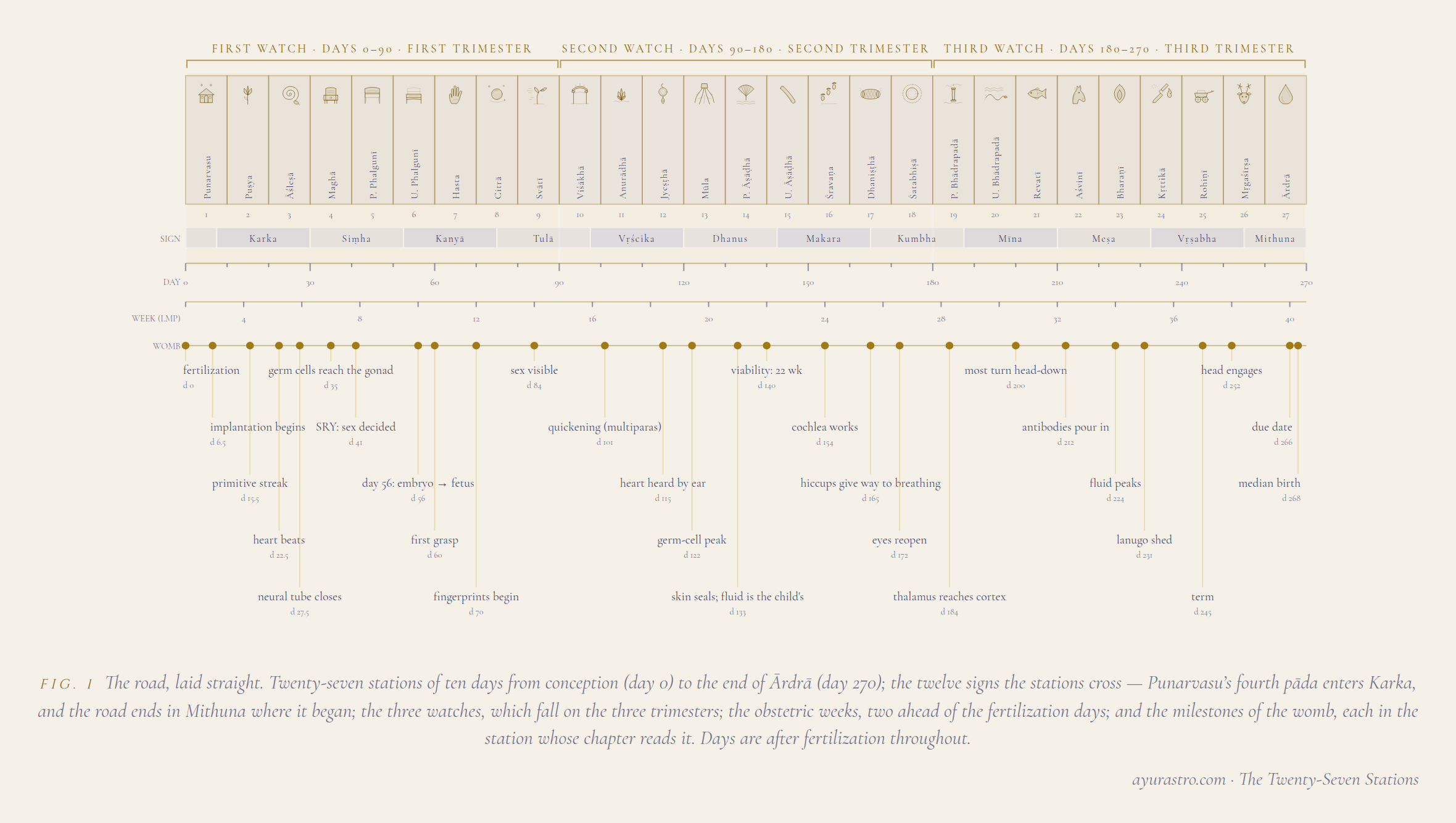
Figure 1 lays the road out straight: the twenty-seven stations, the twelve signs they cross, the three watches, and the milestones of the womb on one 270-day line. The instrument in the next section bends it into a wheel.
The Nakṣatra Wheel
The wheel below is the essay in one object. Its outer ring is the twelve signs; inside it, the twenty-seven stations with their emblems, Punarvasu at the top and the road running clockwise; the pointer is the day after conception, and the drawing at the centre is the child as the embryologists describe it at that day. The panel beside the wheel reads, for whatever station the pointer is in, the star's name and god and figure and the story that goes with it, what happens in the womb in those ten days (the dots on the inner track are the dated milestones, and they light as the pointer passes them), where the pointer stands in sign and pāda and tārā, and my reading of the station with its labels. Drag the pointer, press play for a thirty-six-second tour, click an emblem on the ring or a station in the grid below, or use the keyboard: arrows move a day, shift-arrows ten, Page Up and Page Down a station, the digits 1, 2 and 3 jump to the three watches.
Below the grid there is one more thing, for readers who are not reading this abstractly. Enter the first day of a last period, or a date of conception, or a due date, and the wheel will show where that pregnancy stands today, mark it in red on the ring, and list the dates on which each of the twenty-seven stations begins. The arithmetic is done in your browser; nothing you type is stored or sent anywhere.
- The star
- In the womb
- Sky & sign
The wheel as a table · all twenty-seven stations
| Station | Nakṣatra | Deity | Classical figure | Sign, pādas, tārā, star | In the womb (days after fertilization) | Reading |
|---|---|---|---|---|---|---|
| 1 days 0–10 wk 2–3.4 LMP | पुनर्वसु Punarvasu “wealth again” — the return of the light | Aditi the Boundless, mother of the Ādityas | a house (gṛha) popular: a bow and quiver | Mithuna pādas 1–3; Karka pāda 4 Janma-tārā · Castor and Pollux (α, β Geminorum) | Fertilization, cleavage, the free-swimming blastocyst; it hatches, and — as the fourth pāda crosses into Karka — it comes home. | TextOrderImage |
| 2 days 10–20 wk 3.4–4.9 LMP | पुष्य Puṣya “the nourisher”, from puṣ, to thrive, to bloom — older name Tiṣya | Bṛhaspati the priest of the gods | an arrow (pṛṣatka) popular: a cow's udder; a lotus | Karka pādas 1–4 Sampat-tārā · γ, δ and θ Cancri, about the Beehive cluster | The trophoblast — literally the nourishing bud — taps the mother's blood; the period that should have come does not; the disc draws its first line. | TextOrderImage |
| 3 days 20–30 wk 4.9–6.3 LMP | आश्लेषा Āśleṣā “the embrace, the entwining”, from ā-śliṣ, to cling | Sarpāḥ the Serpents | a wheel (cakra) popular: a coiled serpent | Karka pādas 1–4 Vipat-tārā · δ, ε, η, ρ and σ Hydrae — the Water-Snake's head | Neurulation: the plate rolls into the neural tube and closes; the heart begins to beat; the embryo curls into a C. | TextOrderImage |
| 4 days 30–40 wk 6.3–7.7 LMP | मघा Maghā “the mighty, the bountiful” — the seat of the ancestors | Pitaraḥ the Fathers, the ancestors | a house (bhavana) popular: a throne, a palanquin | Siṃha pādas 1–4 Kṣema-tārā · Regulus (α Leonis), the heart of the Lion | The lineage takes its seat: the primordial germ cells finish their migration into the gonadal ridge; the heart, in the Lion's sign, is being partitioned. | TextOrderImage |
| 5 days 40–50 wk 7.7–9.1 LMP | पूर्वा फल्गुनी Pūrvā Phalgunī “the former reddish one” — the front of the bed | Bhaga god of fortune and of the marriage-bed | the front legs of a bed (mañca) popular: a swinging hammock; a fig tree | Siṃha pādas 1–4 Pratyari-tārā · δ and θ Leonis | Under the god of the marriage-bed the sex of the child is decided: SRY switches on in the indifferent gonad. The eyes darken with pigment. | TextOrderImage |
| 6 days 50–60 wk 9.1–10.6 LMP | उत्तरा फल्गुनी Uttarā Phalgunī “the latter reddish one” — the foot of the bed | Aryaman god of contracts, hospitality and the marriage bond | the back legs of a bed popular: a bed | Siṃha pāda 1; Kanyā pādas 2–4 Sādhaka-tārā · Denebola (β Leonis) | The contract is completed: at day fifty-six every organ system is present and the embryo becomes a fetus. | TextOrderImage |
| 7 days 60–70 wk 10.6–12 LMP | हस्त Hasta “the hand” | Savitṛ the Impeller, the golden-handed | a hand (kara) popular: a hand | Kanyā pādas 1–4 Vadha-tārā · δ, γ, ε, α and β Corvi — the Crow | The hand: fingers close on a touched palm, nails begin, and the ridges that will be fingerprints start to rise. | TextOrderImage |
| 8 days 70–80 wk 12–13.4 LMP | चित्रा Citrā “the bright, the many-coloured, the picture” | Tvaṣṭṛ the divine craftsman who shapes the forms in the womb | a pearl (mauktika) popular: a bright jewel | Kanyā pādas 1–2; Tulā pādas 3–4 Mitra-tārā · Spica (α Virginis) | Tvaṣṭṛ shapes the forms: the face is finished, the fingerprints are being engraved, and the profile appears on the first scan. | TextOrderImage |
| 9 days 80–90 wk 13.4–14.9 LMP | स्वाती Svātī “the self-going, the independent one” — Arcturus | Vāyu the Wind, the breath | coral (vidruma) popular: a young sprout swaying in the wind; a sword | Tulā pādas 1–4 Atimitra-tārā · Arcturus (α Boötis) | The wind rehearses: breathing movements and hiccups work the diaphragm; the fetus, small in a large sea, moves freely. | TextImage |
| 10 days 90–100 wk 14.9–16.3 LMP | विशाखा Viśākhā “the forked, the branched” — the gateway | Indrāgnī Indra and Agni together | an archway (toraṇa) popular: a triumphal gateway; a potter's wheel | Tulā pādas 1–3; Vṛścika pāda 4 Janma-tārā · α, β, γ and ι Librae | The gateway: the first cycle of nine ends and the second begins as the first trimester closes; the branches — of airway and of sex — are set. | TextOrderImage |
| 11 days 100–110 wk 16.3–17.7 LMP | अनुराधा Anurādhā “following Rādhā” — devotion, success that follows | Mitra the Friend, god of the bond | a heap of offerings (bali) popular: a lotus; a triumphal arch | Vṛścika pādas 1–4 Sampat-tārā · β, δ and π Scorpii | The bond is felt: quickening — the mother's first perception of the child — arrives now for mothers who know what they are feeling. | TextOrderImage |
| 12 days 110–120 wk 17.7–19.1 LMP | ज्येष्ठा Jyeṣṭhā “the eldest, the chief” — Antares | Indra king of the gods, wielder of the thunderbolt | an earring (kuṇḍala) popular: an umbrella; a circular amulet | Vṛścika pādas 1–4 Vipat-tārā · Antares (α Scorpii) | Indra's thunder is heard: the heartbeat becomes audible to the unaided ear; first-time mothers feel the child; the scan surveys the whole kingdom. | TextOrderImage |
| 13 days 120–130 wk 19.1–20.6 LMP | मूल Mūla “the root” | Nirṛti goddess of dissolution, un-doing | a lion's tail (siṃhapuccha) popular: a bundle of roots | Dhanus pādas 1–4 Kṣema-tārā · λ, υ, κ, ι, θ, η, ζ, μ, ε Scorpii — the Scorpion's tail | The root of all future generations is counted and then thinned: a female fetus holds its lifetime peak of germ cells, and the culling begins. | TextOrderImage |
| 14 days 130–140 wk 20.6–22 LMP | पूर्वाषाढा Pūrvāṣāḍhā “the former unconquered” | Āpaḥ the Waters | an elephant's tusk (gajadanta) popular: a fan; a winnowing basket | Dhanus pādas 1–4 Pratyari-tārā · δ and ε Sagittarii | The Waters become the child's own: as the skin keratinizes, the amniotic fluid is thereafter mostly what the fetus itself has passed. | TextOrderImage |
| 15 days 140–150 wk 22–23.4 LMP | उत्तराषाढा Uttarāṣāḍhā “the latter unconquered” — the final victory | Viśvedevāḥ the All-Gods | an elephant's tusk; a cot (mañcaka) popular: an elephant's tusk | Dhanus pāda 1; Makara pādas 2–4 Sādhaka-tārā · ζ and σ Sagittarii | The threshold of viability: for the first time, a child born now might live. | TextOrderImage |
| 16 days 150–160 wk 23.4–24.9 LMP | श्रवण Śravaṇa “hearing; the ear” — older name Śroṇā | Viṣṇu the Pervader, who strode three steps | three footsteps (tricaraṇa) popular: an ear; three footprints | Makara pādas 1–4 Vadha-tārā · Altair (α Aquilae) | Hearing begins: the cochlea becomes functional and the fetus first flinches at a sound. | TextOrder |
| 17 days 160–170 wk 24.9–26.3 LMP | धनिष्ठा Dhaniṣṭhā “the most wealthy; the most famous” — older name Śraviṣṭhā | Vasavaḥ the eight Vasus, the Dwellers — earth, water, fire, wind, sky, sun, moon, stars | a drum (mṛdaṅga) popular: a drum; a flute | Makara pādas 1–2; Kumbha pādas 3–4 Mitra-tārā · α, β, γ and δ Delphini — the Dolphin | The drum: the diaphragm's hiccup-beat gives way to breathing; the lungs' air-sacs begin; the child keeps time with sound. | TextOrderImage |
| 18 days 170–180 wk 26.3–27.7 LMP | शतभिषज् Śatabhiṣaj “having a hundred physicians” | Varuṇa lord of the waters and of the binding oath, thousand-eyed | a circle (vṛtta) popular: an empty circle; a hundred flowers | Kumbha pādas 1–4 Atimitra-tārā · λ Aquarii, amid a hundred faint stars | The eyes reopen. Varuṇa, the thousand-eyed, keeps the station in which the fused lids part. | TextOrderImage |
| 19 days 180–190 wk 27.7–29.1 LMP | पूर्वभाद्रपदा Pūrva Bhādrapadā “the former auspicious feet” | Aja Ekapād the one-footed goat — or, reading aja otherwise, the Unborn who stands on one foot | the front legs of a cot (mañca) popular: a sword; a two-faced man | Kumbha pādas 1–3; Mīna pāda 4 Janma-tārā · Markab and Scheat (α and β Pegasi) | The third cycle opens with the third trimester; the thalamus reaches the cortex — the single pillar from the depths to the surface of the mind. | TextOrderImage |
| 20 days 190–200 wk 29.1–30.6 LMP | उत्तरभाद्रपदा Uttara Bhādrapadā “the latter auspicious feet” | Ahir Budhnya the Serpent of the Deep | a pair, twins (yamala) popular: the back legs of a funeral cot; a serpent in the deep | Mīna pādas 1–4 Sampat-tārā · γ Pegasi and α Andromedae | The serpent of the deep coils: the cortex folds into its secondary sulci; sleep divides into active and quiet. | TextImage |
| 21 days 200–210 wk 30.6–32 LMP | रेवती Revatī “the wealthy, the abundant” | Pūṣan the Nourisher, guide of roads and herds, who eats gruel because he has no teeth | a drum (mṛdala) popular: a fish; a drum | Mīna pādas 1–4 Vipat-tārā · ζ Piscium | Pūṣan the way-finder turns the traveller onto the road: most fetuses now turn head-down. | TextOrderImage |
| 22 days 210–220 wk 32–33.4 LMP | अश्विनी Aśvinī “of the horsemen” | Aśvinau the twin horsemen, physicians of the gods | a horse's head (turagāsya) popular: a horse's head | Meṣa pādas 1–4 Kṣema-tārā · β and γ Arietis | The physicians arrive: the mother's antibodies pour across the placenta; the lungs are nearly ready; the skin is made smooth. | TextOrderImage |
| 23 days 220–230 wk 33.4–34.9 LMP | भरणी Bharaṇī “she who bears”, from bhṛ, to carry | Yama the Restrainer, lord of the dead, the first to find the way; yama also means twin | the yoni popular: the yoni; an elephant | Meṣa pādas 1–4 Pratyari-tārā · 35, 39 and 41 Arietis | The bearer bears the most: the amniotic fluid reaches its peak and begins to recede; the space closes in; a child born now would almost certainly live. | TextOrderImage |
| 24 days 230–240 wk 34.9–36.3 LMP | कृत्तिका Kṛttikā “the cutters” — the Pleiades, the six nurses of Skanda | Agni Fire | a razor (kṣura) popular: a razor; a flame | Meṣa pāda 1; Vṛṣabha pādas 2–4 Sādhaka-tārā · the Pleiades (η Tauri and companions) | The razor shaves the fetus and the nurses make it ready: the lanugo is shed, brown fat gathers for the first cold, and sucking, swallowing and breathing learn to work together. | TextOrderImage |
| 25 days 240–250 wk 36.3–37.7 LMP | रोहिणी Rohiṇī “the red one, the growing one”, from ruh, to grow — Aldebaran, the Moon's favourite wife | Prajāpati Lord of Creatures, who in the conception hymn pours the seed | a cart (anas) popular: an ox-cart; a chariot | Vṛṣabha pādas 1–4 Vadha-tārā · Aldebaran (α Tauri) and the Hyades | Term. The growing one has grown: at thirty-seven weeks the child is a full load, and the last story of the ring begins — Prajāpati and his daughter. | TextOrderImage |
| 26 days 250–260 wk 37.7–39.1 LMP | मृगशीर्ष Mṛgaśīrṣa “the deer's head” — the stag Orion, from mṛg, to seek, to hunt | Soma the Moon, husband of the twenty-seven | a deer's head (eṇāsya) popular: a deer's head | Vṛṣabha pādas 1–2; Mithuna pādas 3–4 Mitra-tārā · λ, φ¹ and φ² Orionis — the head of Orion | The deer's head comes down: in the last two weeks before birth the head engages in the pelvis and the child seeks the way out. | TextOrderImage |
| 27 days 260–270 wk 39.1–40.6 LMP | आर्द्रा Ārdrā “the moist one” | Rudra the Howler, who was born weeping and named for it | a gem (maṇi) popular: a teardrop; a diamond | Mithuna pādas 1–4 Atimitra-tārā · Betelgeuse (α Orionis) | Birth: the waters break, the hunter's arrow finds the stag, and the child comes out wet and howling — Rudra, who was named for his cry. | TextOrderImage |
Punarvasu to Svātī · Days 0–90
The first cycle of nine is the first trimester: the nine stations in which a cell becomes a body. Everything that will ever be built is built here; the rest of the road is growth.
Two Become One, and Find a House
Days 0–10 after conception · obstetric weeks 2–3.4Figure a house (gṛha) (popularly a bow and quiver)Sign Mithuna pādas 1–3 · Karka pāda 4 · tārā Janma, birthStar Castor and Pollux (α, β Geminorum)
Punarvasu is two stars, Castor and Pollux, and the ritual texts name it in the dual: punarvasū, the two Punarvasus.[1] The name means “wealth again,” the return of what was lost — the light after the monsoon, the herd after the raid — and its classical figure is a house, gṛha.[4,5] Its goddess is Aditi, the boundless: “Aditi is the heaven, Aditi is mid-air, Aditi is the Mother and the Sire and Son; Aditi is all gods, Aditi five-classed men, Aditi all that hath been born and shall be born.”[10] Three of its four pādas lie in Mithuna, the Couple; the fourth crosses into Karka, the Crab, the Moon's own sign, the sign of the home.
The first ten days of a human life are the days of the couple. Two cells, each carrying half a set of chromosomes, meet in the fallopian tube and become one; about thirty hours later the one divides into two, then four, then eight, and by the third or fourth day it is a morula, a mulberry of sixteen to thirty-two cells, still inside the shell that has surrounded the egg since the ovary. On the fifth day it hollows into a blastocyst, a sphere with a knot of cells at one pole, and on the fifth or sixth it does the thing embryologists call hatching: it breaks its shell, the zona pellucida, and swims free. On the sixth or seventh day it touches the wall of the womb and begins to bury itself; by the eighth it has two layers; by the ninth the outer layer has opened little lakes, lacunae, and the first hormone of pregnancy is reaching the mother's blood.[24,26,27]
Text Order Image A dual star in the sign of the Couple opens the sequence at the one moment in a life when two are literally becoming one, and its goddess is the unbound one — a good goddess for a cell whose first independent act is to break out of its shell. That is text and image. The order is stricter. Divide the station's ten days into its four pādas of two and a half, and the first three, the ones in Mithuna, hold fertilization, cleavage, the blastocyst and the hatching — the whole free-swimming life of the embryo — while the fourth pāda, the only one in Karka, begins on day seven and a half, and implantation begins on day six or seven. The pāda that crosses into the Moon's sign, the sign of the home, is the pāda in which the embryo finds a house. Punar-vasu: a dwelling, again.
The Nourisher, and the Flower That Does Not Come
Days 10–20 after conception · obstetric weeks 3.4–4.9Figure an arrow (pṛṣatka) (popularly a cow's udder; a lotus)Sign Karka pādas 1–4 · tārā Sampat, wealthStar γ, δ and θ Cancri, about the Beehive cluster
Puṣya is “the nourisher.” The root is puṣ, to thrive, to be nourished, to bloom, and it gives Sanskrit its word for nourishment, puṣṭi, and its word for a flower, puṣpa. Its god is Bṛhaspati, the priest who speaks for the gods; its classical figure is an arrow, and the popular one a cow's udder.[1,4,5,7] The older name of the star was Tiṣya, the auspicious, and the Ṛgveda knows it by that name.[5] It lies entirely in Karka, wholly in the Moon's house.
In the second ten days the embryo, having landed, feeds. The cells of its outer layer bore into the mother's wall, open lakes in her tissue, and on the eleventh to thirteenth day maternal blood fills those lakes: the uteroplacental circulation, the first supply line, is open. By the twelfth day the lining has sealed over the embryo; by the thirteenth the outer layer has thrown out the first fingers of what will be the placenta. The layer that does all this was named in 1889 by the Dutch embryologist Hubrecht, who called it the trophoblast — from Greek trophē, nourishment, and blastos, a sprout, a bud.[24,29] And on about the fourteenth day after fertilization a period falls due and does not come, because the trophoblast's hormone, hCG, has told the ovary to keep making progesterone. Then, on the fifteenth or sixteenth day, a line appears on the disc of cells — the primitive streak — and the body has a head end and a tail end for the first time.[24,26]
Text Order Image I had planned this station around the flower, because the morula is a bud and the blastocyst is a bud opening, and puṣpa and blastos mean nearly the same thing. But the tradition had a sharper reading ready. In Suśruta and in the lexicons puṣpa is also the menstrual flow — a menstruating woman is puṣpavatī, one who has her flower — and the first sign of a pregnancy, for every woman who has ever had one, is a flower that does not come.[5,21] It fails to come in Puṣya's ten days, and it fails because the cells that the embryologists named the nourishing bud are, at that moment, nourishing. The station called the Nourisher receives the trophoblast, and withholds the flower.
The Serpent Closes
Days 20–30 after conception · obstetric weeks 4.9–6.3Figure a wheel (cakra) (popularly a coiled serpent)Sign Karka pādas 1–4 · tārā Vipat, dangerStar δ, ε, η, ρ and σ Hydrae — the Water-Snake's head
Āśleṣā is the embrace, the coiling-round; the verb is ā-śliṣ, to cling to, to entwine.[5] Its gods are the Sarpas, the serpents; its classical figure is a wheel, and every practitioner draws it as a coiled snake.[1,4,7] In the sky it is the head of Hydra, the water-serpent. It is, in the tradition's judgment, a hard station — a place of poison, of binding, of what clings and will not let go.
Neurulation is the one process in embryology that everyone has seen drawn as a serpent. A flat plate of cells along the embryo's back thickens, its edges rise into two folds, the folds arch toward each other and fuse — beginning in the middle, on the twenty-first or twenty-second day, and zipping in both directions — until the plate has become a tube. The head end of the tube closes about the twenty-fifth day, the tail end about the twenty-seventh or twenty-eighth; the tube is the brain and the spinal cord.[24,26] In the same ten days the segments of the back, the somites, appear along its length; the heart, a simple tube itself, begins to beat on the twenty-second or twenty-third day; the buds of the arms appear on the twenty-sixth; and the whole embryo, which had been a flat disc, folds head-to-tail and side-to-side into a C, a coil, with the tube running down its convex back.[26]
Text Order Image The tube that rolls up and closes along its length, the body that curls into a coil around it, the somites like the segments of a snake's back: the serpents' station is the station in which the embryo is most a serpent, and the calendar puts the closing of the tube — days twenty-two to twenty-eight — squarely inside days twenty to thirty. The tradition's wariness is not misplaced either. A tube that fails to close in these days is the commonest grave malformation of the human embryo; the folic acid that every pregnancy is now advised to begin before conception exists to see Āśleṣā safely through.
The Fathers Take Their Seat
Days 30–40 after conception · obstetric weeks 6.3–7.7Figure a house (bhavana) (popularly a throne, a palanquin)Sign Siṃha pādas 1–4 · tārā Kṣema, well-beingStar Regulus (α Leonis), the heart of the Lion
Maghā is Regulus, the royal star at the heart of the Lion; the name means mighty, bountiful, and its gods are the Pitṛs, the Fathers — the ancestral dead who are fed at the śrāddha and who stand behind every living person as the line that produced them.[1,5] Its classical figure is a house, a hall; the popular tradition makes it a throne or a palanquin, the seat of inherited power.[4,7] It is the first station in Siṃha, the Sun's sign.
What the Fathers pass on passes on through one cell-line. Very early — in the third week, before there is a heart or a tube — a few dozen cells are set aside in the wall of the yolk sac, outside the embryo proper, and told, in effect, to do nothing: to become neither skin nor gut nor nerve but to wait. These are the primordial germ cells, and every egg and every sperm the child will ever make descends from them. In the fifth and sixth weeks they migrate — actively, by crawling — up the mesentery of the gut and into the two ridges of tissue on the back wall of the belly where the gonads will form, and by about the sixth week they have arrived.[24,25] In the same days the heart, in the Lion's sign, is being divided into its chambers; the plates of the hands appear; the eye and the ear begin as pits in the surface; and the embryo's tail is at its longest.[26]
Text Order Image The station of the ancestors is the station in which the ancestry of the next generation is installed: the cells that carry the line arrive, in Maghā's ten days, at the seat they will occupy for the rest of a life, and the seat is what the tradition drew — a house, a throne. That the heart's partition into chambers falls in the Sun's sign, the sign the Kālapuruṣa assigns to the heart, is a second order-fact I will only point at. Regulus is a king's star, and a king is nothing but a line made visible.
The God of the Marriage-Bed Decides
Days 40–50 after conception · obstetric weeks 7.7–9.1Figure the front legs of a bed (mañca) (popularly a swinging hammock; a fig tree)Sign Siṃha pādas 1–4 · tārā Pratyari, obstacleStar δ and θ Leonis
The two Phalgunīs are one bed. The classical figure of this star is the front legs of a bed, mañca, and of the next the back legs; the popular emblem is a swinging hammock.[4,7] The Vedic lists give this star to Aryaman and the next to Bhaga; the jyotiṣa lists reverse them, and I follow the jyotiṣa order because it is the one the tradition of the wheel uses.[1,3] Bhaga is the god of fortune, of the share, of the marriage-bed — bhaga is also a word for the womb — and he is the god who was blinded: at the sacrifice of Dakṣa, when the offering was set before him, it burnt out his eyes.[5,12]
Sex is not decided at conception. The chromosomes are, but for six weeks the gonad is indifferent, a ridge of tissue that could become either thing, and the body that carries it looks the same whether it will be a boy or a girl. On about the forty-first day after fertilization, in an embryo with a Y chromosome, a single gene, SRY, switches on in that ridge, peaks about the forty-fourth day, and turns it toward testis; in an embryo without it nothing switches on, and the ridge becomes an ovary.[30] That switch is the fork of sex, and it falls in this station. In the same ten days the fingers appear as rays in the plate of the hand, the elbows bend, and — about the forty-first to forty-fourth day — pigment appears in the back of the eye, so that the embryo, which until now had no visible eyes, has two dark spots where its eyes will be.[24,26]
Text Order Image The god of the marriage-bed keeps the station in which the body decides what it will bring to a marriage-bed. That is the order-fact, and it is exact to the day. The image is stranger, and I offer it only as one: Bhaga is the god who lost his eyes, and his station is the one in which the embryo's eyes first darken and become visible. The blinded god watches the eyes appear.
The Contract Is Signed
Days 50–60 after conception · obstetric weeks 9.1–10.6Figure the back legs of a bedSign Siṃha pāda 1 · Kanyā pādas 2–4 · tārā Sādhaka, accomplishmentStar Denebola (β Leonis)
Aryaman is the Āditya of the bond between persons — of contracts, hospitality, alliances, and the marriage bond in particular; his name is the source of the word arya, the companion, the noble one who keeps faith.[3,5] His station is the foot of the bed that Bhaga's station began. It straddles the border of Siṃha and Kanyā: one pāda in the Lion, three in the Maiden.
The embryonic period has a legal end. Embryologists divide the first eight weeks after fertilization into twenty-three Carnegie stages, and the last of them, stage 23, is reached on about the fifty-sixth day; after it the noun changes, and what was an embryo is a fetus.[26] The reason for the change is that by day fifty-six every organ system that will ever exist is present in outline — heart, lungs, gut, kidneys, brain, gonads, limbs, eyes, ears — and what remains is growth and refinement, not construction.[24] In Aryaman's ten days the webs between the fingers and toes die away so that the digits separate (day fifty-two to fifty-six); the eyelids begin to form; the tail, which was at its longest in Maghā, is gone; the head is half the body; and on the ultrasound the first spontaneous movements can be seen.[26,33] The creature is thirty millimetres long, crown to rump.
Text Order Image The god of completed contracts keeps the station in which the contract of the body is signed and sealed — every party present, the document closed at stage 23 on day fifty-six, inside the station's days fifty to sixty. And the bed the two Phalgunīs make is finished at its foot on the same day the body is finished in outline. The image is the essay's; the order is the calendar's; the bed and the god are the texts'.
The Golden Hands
Days 60–70 after conception · obstetric weeks 10.6–12Figure a hand (kara)Sign Kanyā pādas 1–4 · tārā Vadha, deathStar δ, γ, ε, α and β Corvi — the Crow
Hasta means the hand, and that is its whole name: five stars of Corvus, the Crow, that the tradition saw as a palm and fingers. Its god is Savitṛ, the Sun as impeller, the power that sets things going, whom the Ṛgveda calls hiraṇyapāṇi, golden-handed, and hiraṇyahasta, gold-handed.[1,11] The Brāhmaṇas tell why: at Dakṣa's sacrifice the fore-portion of the offering, which had blinded Bhaga and knocked out Pūṣan's teeth, cut off Savitṛ's hands, and the gods gave him two of gold.[11,12]
In the seventh station the hand becomes a hand. Its fingers separated only last week; now, at about the sixtieth day — ten and a half weeks by the obstetric count — a touch on the palm makes them close. That grasp was the earliest reflex Davenport Hooker could elicit in his famous studies of the 1930s and 1940s, and it comes before almost anything else the fetus can do.[31] In the same ten days the nails begin at the fingertips, and on the pads of the fingers the first ridges rise that will, over the next six weeks, become fingerprints.[24,32] The eyelids, formed last station, fuse shut and will stay shut for four months; the gut, which has been herniated into the umbilical cord since the sixth week for want of room, returns to the abdomen; and the interim kidney, the mesonephros, which has filtered the embryo's blood since the fourth week, regresses as the permanent one takes over.[24,25]
Text Order Image The station named the Hand is the station in which the hand first grasps and first grows nails — text and order together, with no help from me. The god's story adds the image: Savitṛ's hands were cut off and remade in gold; the fetus's are being made for the first time, and what they will hold no one yet knows.
Tvaṣṭṛ Carves the Forms
Days 70–80 after conception · obstetric weeks 12–13.4Figure a pearl (mauktika) (popularly a bright jewel)Sign Kanyā pādas 1–2 · Tulā pādas 3–4 · tārā Mitra, friendStar Spica (α Virginis)
Citrā is Spica, the brightest star of the Maiden; the name means bright, many-coloured, a picture, a pattern.[5] Its classical figure is a pearl.[4] The Vedic lists give it to Indra, but from the Taittirīya Brāhmaṇa onward its god is Tvaṣṭṛ, the artificer of the gods, who made Indra's thunderbolt and the cup of Soma — and who, in the Ṛgveda's hymn for conception, is given one task above the others: tvaṣṭā rūpāṇi piṃśatu, “let Tvaṣṭar carve the forms.”[1,2,9] The verse is the epigraph of this essay because it names three of our stations' gods in one line — Viṣṇu, Tvaṣṭṛ, Prajāpati — and gives each a job in the womb.
Tvaṣṭṛ's job, in embryology, is done in the eighth station. The face closes into a face: the eyes, which began on the sides of the head like a fish's, have moved to the front; the ears have risen to their places; the nose and upper lip are joined; the profile, on a scan taken at eleven to fourteen weeks, is unmistakably a person's.[24] And on the fingertips the carving of a lifetime begins. The primary ridges of the fingerprints, which appeared at the end of Hasta, are laid down through these weeks in the whorls, loops and arches that are set by about the sixteenth week after fertilization and never change: the one part of the body's form that is finished in the womb and identifies its owner for life.[32] The kidneys, meanwhile, make their first urine and pass it into the fluid.[24]
Text Order Image The conception hymn asks Tvaṣṭṛ to carve the forms, and the station that carries his name is the station in which the forms are carved — the face into a face, the fingertips into a pattern. Citra means a pattern, a picture, and the fingerprint is the first picture the body makes of itself. The pearl is the essay's image for the head: round, bright, and finished on the surface long before it is finished within.
The Wind Rehearses
Days 80–90 after conception · obstetric weeks 13.4–14.9Figure coral (vidruma) (popularly a young sprout swaying in the wind; a sword)Sign Tulā pādas 1–4 · tārā Atimitra, great friendStar Arcturus (α Boötis)
Svātī is Arcturus, the brightest star of the northern sky, standing alone far from the ecliptic — which is why the tradition called it svātī, the self-going, the independent one.[5] Its god is Vāyu, the wind, the breath of the cosmos and of every body; its classical figure is a piece of coral, and its popular one a young plant bending in the wind.[1,4,7]
The fetus has been practising breath since Hasta, and in Svātī the practice becomes a habit. Fetal breathing movements — contractions of the diaphragm that draw amniotic fluid, not air, into the lungs and push it out — appear on ultrasound from about the tenth week and become frequent through the twelfth to fifteenth; and alongside them come hiccups, sharp rhythmic jerks of the same muscle, which are in fact the diaphragm's commonest movement for the whole first half of pregnancy.[33,45] In these ten days the sex is distinguishable from the outside, at twelve weeks after fertilization; the yolk sac, which fed the embryo before the placenta could, has shrunk to a vestige, and the placenta, which took over from the ovary's corpus luteum at about the eighth week, feeds the child alone;[35] and the fetus is, relative to the fluid around it, as small and as free as it will ever be — a swimmer in a sea it has not yet grown to fill.[24]
Text Image The god of wind keeps the station in which the fetus rehearses wind, and that is text; but the rehearsal begins a station earlier and continues for months, so I do not claim the order. The image is the plant bending: a fetus at thirteen weeks turns and stretches and somersaults in more room than it will have again, and the independence the star is named for is, for these ten days, a fact of hydraulics.
Viśākhā to Śatabhiṣaj · Days 90–180
The second cycle of nine is the second trimester: the mother feels the child, hears it, and the child, by the end, hears and sees. In its middle the child crosses the line past which it could live outside.
The Gateway
Days 90–100 after conception · obstetric weeks 14.9–16.3Figure an archway (toraṇa) (popularly a triumphal gateway; a potter's wheel)Sign Tulā pādas 1–3 · Vṛścika pāda 4 · tārā Janma, birthStar α, β, γ and ι Librae
Viśākhā means forked, two-branched — vi-śākhā, having branches apart.[5] Its gods are a pair, Indra and Agni; its classical figure is a toraṇa, the arched gateway that stands before a temple or a town, and the popular tradition keeps the gate and adds a potter's wheel.[1,4,7] It is the tenth station and the first of the second cycle of nine: from Punarvasu, its tārā is janma, birth, for the second time.
The first trimester ends, by the obstetric count, at the close of the thirteenth week; Viśākhā runs from the fifteenth to the sixteenth. In its ten days the fork of sex, decided in Bhaga's station fifty days ago, becomes plain to a scan — 98.7 per cent accurately at twelve weeks, 100 per cent at thirteen — and the fork of the airways is nearly complete: the bronchial tree, which has been branching since the fifth week, has almost all its conducting passages, and will have every one by the sixteenth week after fertilization, after which it grows only in the small.[24,34] The limbs move in coordination; bone has replaced cartilage across much of the skeleton; the ears, which sat low on the neck, stand out from the head.[24]
Text Order Image The arithmetic put a gate here before I did. Three cycles of nine make the wheel, and the second cycle opens with Viśākhā — the archway — within a week of the day obstetrics opens the second trimester. That is order. The text supplies the fork: the two-branched star keeps the station in which the body's two great forkings, of sex and of breath, are settled and visible. The image is the traveller passing under the toraṇa into the middle of the road.
The Friend Is Felt
Days 100–110 after conception · obstetric weeks 16.3–17.7Figure a heap of offerings (bali) (popularly a lotus; a triumphal arch)Sign Vṛścika pādas 1–4 · tārā Sampat, wealthStar β, δ and π Scorpii
Anurādhā is the star that follows Rādhā — Viśākhā's older name — and the tradition heard in it devotion, following, the success that comes of loyalty.[5] Its god is Mitra, the Friend, the Āditya of alliance and of the bond between persons, who is invoked with Varuṇa as the keeper of what is agreed.[1] Its classical figure is a bali, a heap of offerings; the popular one is a lotus.[4,7]
For sixteen weeks the mother has known the child by absence — a period that did not come, a nausea, a line on a test, a picture on a screen. In Anurādhā she begins to feel it. Quickening, the first perception of fetal movement from inside, comes at eighteen to twenty weeks for most first-time mothers, but about a week earlier for women who have carried before and know what they are feeling for, and the reported range begins at fourteen.[36] In the same ten days the lanugo, a fine fur, has covered the body; the gut has begun to store the meconium it will pass after birth; and the womb has risen above the navel, so that the pregnancy, felt from inside, is now also visible from outside.[24]
Text Order Image The god of the bond between persons keeps the station in which the bond is first felt from both sides — order, for the mothers who know what to feel for, and a station early for the rest, whom Jyeṣṭhā will catch. The heap of offerings is the essay's image for that first movement: the child's first gift, given before it can know it is giving.
Thunder, Heard
Days 110–120 after conception · obstetric weeks 17.7–19.1Figure an earring (kuṇḍala) (popularly an umbrella; a circular amulet)Sign Vṛścika pādas 1–4 · tārā Vipat, dangerStar Antares (α Scorpii)
Jyeṣṭhā is the eldest, the chief; it is Antares, the red heart of the Scorpion, and its god is Indra, king of the gods, whose weapon is the thunderbolt.[1,5] Its classical figure is a kuṇḍala, an earring; the popular one an umbrella, the royal parasol.[4,7]
The thunder is heard in Jyeṣṭhā. A fetoscope — a stethoscope shaped for a pregnant abdomen — picks up the fetal heart for the first time at seventeen weeks in some women, at a mean of nineteen and a half, and in nearly all by twenty-one; Doppler had found it electronically since the tenth, but this is the first time a heartbeat can be heard, unamplified, by a human ear.[37] In the same ten days the first-time mothers, whom Anurādhā did not reach, feel their children move;[36] the anatomy scan of the eighteenth to twenty-second week surveys the whole body, limb by limb and chamber by chamber; the vernix, a waxy coat, begins to form on the skin; and the inner ear, which will be the subject of the next cycle's stations, is reaching its adult size and shape.[24]
Text Order Image The thunder-god's station is the one in which the child is first heard. That the sound is a heartbeat rather than thunder is the difference between a god and a fetus; that it arrives at seventeen to twenty-one weeks, inside Jyeṣṭhā's eighteenth and nineteenth, is the calendar. The earring is the essay's image for an inner ear coming to its final size; the parasol, for the vernix that begins, in these days, to shelter the skin.
The Root, Counted and Cut
Days 120–130 after conception · obstetric weeks 19.1–20.6Figure a lion's tail (siṃhapuccha) (popularly a bundle of roots)Sign Dhanus pādas 1–4 · tārā Kṣema, well-beingStar λ, υ, κ, ι, θ, η, ζ, μ, ε Scorpii — the Scorpion's tail
Mūla is the root. It is the tail of the Scorpion, a curl of stars that points at the centre of the galaxy; its goddess is Nirṛti, dissolution, the un-doing of order, whom the Nakṣatreṣṭi sends away “with averted face”; its classical figure is a lion's tail and its popular one a bundle of roots.[2,4,5,7] The Vedic Saṃhitā had given the star to the Fathers; the Brāhmaṇa gave it to Nirṛti, and the astrologers kept her.[1,2]
The roots of every later generation are counted in Mūla, and then thinned. A girl's ovaries hold, around the twentieth week, more germ cells than they will ever hold again — Baker counted some 600,000 at two months, a peak of 6.8 million in the fifth month, and about two million at birth — and from that peak the culling never stops: most are dissolved before she is born, and of the two million that remain a few hundred will ever be ovulated.[38] The brain is doing the same thing on its own scale. Neurons are made in enormous excess and then removed; in the one direct count of the human cortex the number peaks near the twenty-eighth week and falls thereafter, and across the nervous system generally something like half the cells born are culled.[39] Brown fat, which will burn to warm the newborn, first appears about now; beneath the milk teeth the buds of the permanent ones are forming.[24,51]
Text Order Image The station of the root and of un-doing is the station in which the body's excess is counted and cut. The germ cells are the root in the plainest sense — every grandchild descends from a cell that is present, and being counted, in these ten days — and Nirṛti's dissolution is the atresia that begins at the peak. The order holds for the peak of the germ line, which the textbooks put at twenty weeks; the neuronal pruning is a longer story that I let the goddess stand for.
The Child Makes Its Own Sea
Days 130–140 after conception · obstetric weeks 20.6–22Figure an elephant's tusk (gajadanta) (popularly a fan; a winnowing basket)Sign Dhanus pādas 1–4 · tārā Pratyari, obstacleStar δ and ε Sagittarii
The two Āṣāḍhās are the unconquered, a-ṣāḍha, what cannot be overcome. This one's deities are the Āpaḥ, the Waters, the divine mothers of the Ṛgveda — āpo asmān mātaraḥ śundhayantu, “may the Waters, the mothers, cleanse us.”[1,20] Its classical figure is an elephant's tusk; the popular one is a fan.[4,7]
Until Pūrvāṣāḍhā the sea the child floats in is mostly the mother's. Water crosses the fetal skin freely, and the fluid is in exchange with her tissues; the fetus has been passing urine into it since the eighth to eleventh week, but as a contribution, not a source.[40] Between the twenty-second and twenty-fifth week the skin keratinizes — grows the horny outer layer that adult skin has — and stops letting water through, and from then on the amniotic fluid is chiefly what the fetus itself has passed: urine, and the fluid its lungs secrete, swallowed by the hundreds of millilitres a day and passed again.[40] The volume stands at about half a litre now and will rise toward a litre. Eyebrows and eyelashes appear at about the twentieth week after fertilization.[24]
Text Order Image The Waters' station is the station in which the waters change hands: the skin seals in the twenty-second week, at the station's close, and the sea becomes the child's own — made by it, swallowed by it, made again. The hymn calls the Waters mothers; here the child becomes the mother of its waters, which is the essay's image and, I think, the tradition's own kind of inversion.
Unconquered
Days 140–150 after conception · obstetric weeks 22–23.4Figure an elephant's tusk; a cot (mañcaka)Sign Dhanus pāda 1 · Makara pādas 2–4 · tārā Sādhaka, accomplishmentStar ζ and σ Sagittarii
Uttarāṣāḍhā completes the unconquered. Its gods are the Viśvedevas, the All-Gods, invoked together when no single power will do; its figure is the elephant's tusk again, or a cot.[1,4] Counted from Punarvasu it is the sādhaka of the second cycle — the star of accomplishment, of the thing achieved.[8]
Before Uttarāṣāḍhā no child born could live. After it, some can. In the largest recent American series, of children born at twenty-two completed weeks about one in ten survived to go home; at twenty-three, one in two; at twenty-four, about seven in ten.[41] The station runs from the twenty-second week to the twenty-third and a half, and it is the threshold of viability by any definition anyone uses: the lungs' terminal sacs are beginning, the first surfactant is not far off, and the brain has enough wiring to sustain breathing when it is helped.[24,41] Nothing in the whole of pregnancy changes so much, in so few days, as the answer to the question could it live?
Text Order Image “Unconquered” is the right word for what happens in these ten days: a threshold crossed inside a single station, from no chance to an even one. It takes every organ system at once — heart, lungs, gut, kidneys, brain, skin, each just barely enough — and every organ system at once is what the Viśvedevas are for. That the tārā of this station is sādhaka, accomplishment, is arithmetic, and the one place in the second cycle where the tārā-name and the biology agree without any help from me.
Hearing
Days 150–160 after conception · obstetric weeks 23.4–24.9Figure three footsteps (tricaraṇa) (popularly an ear; three footprints)Sign Makara pādas 1–4 · tārā Vadha, deathStar Altair (α Aquilae)
Śravaṇa means hearing, and the ear; it is Altair, the bright eye of the Eagle, and its older name was Śroṇā.[5] Its god is Viṣṇu, who in the Ṛgveda strides three steps across the worlds and in the conception hymn is asked to “form and mould the womb”; its classical figure is three footprints.[1,4,9] The Mahābhārata tells of Aṣṭāvakra, who heard his father Kahoḍa reciting the Veda from inside his mother's womb, told him that the recitation “is not correct,” and was cursed for it to be born crooked in eight places.[15]
Hearing begins in Śravaṇa. The cochlea, the spiral of the inner ear, is structurally complete by about the twentieth week, but it does not work until about the twenty-fourth, when the hair cells that turn vibration into nerve impulse mature and connect.[43] Birnholz and Benacerraf, in 1983, pressed a vibrating sound source to the mothers' abdomens and watched the fetuses on ultrasound: the first blink-startle responses came at twenty-four to twenty-five weeks, and were consistent after twenty-eight.[42] Hepper and Shahidullah, a decade later, found that the fetus hears low tones first — 500 Hz drew responses from the nineteenth week in a few, and by the twenty-seventh 96 per cent responded to 250 and 500 Hz and none to 1,000 or 3,000 — so that what the child first hears is the low rumble of its mother: her heart, her gut, the deepest part of her voice.[43]
Text Order The station named Hearing is the station in which hearing begins: the cochlea comes on line at twenty-four weeks, in the middle of Śravaṇa's ten days, and the first startle at a sound is recorded at twenty-four to twenty-five. That is the plainest text-and-order pairing on the wheel, and I add no image to it. Aṣṭāvakra's protest from the womb is the tradition's own guess that the unborn listen — a guess it made a good two thousand years before the ultrasound, and which embryology now dates.
The Drum
Days 160–170 after conception · obstetric weeks 24.9–26.3Figure a drum (mṛdaṅga)Sign Makara pādas 1–2 · Kumbha pādas 3–4 · tārā Mitra, friendStar α, β, γ and δ Delphini — the Dolphin
Dhaniṣṭhā is the wealthiest — its older name, Śraviṣṭhā, means the most famous — and it is the little constellation of the Dolphin.[5] Its gods are the eight Vasus, the Dwellers, who are the elements themselves: earth, water, fire, wind, sky, sun, moon and stars.[1] Its classical figure is the mṛdaṅga, the two-headed drum of clay whose name means “made of earth.”[4]
The fetus has a drum: a skin stretched over a hollow, struck in time. It is the diaphragm, and in Dhaniṣṭhā its rhythm changes. Pillai and James, watching fetuses for hours at a time, found that before the twenty-sixth week the diaphragm's commonest movement is the hiccup — sharp, regular, a drumbeat — and that hiccups fall away sharply between the twenty-fourth and twenty-sixth weeks while breathing movements, slower and deeper, rise from the twenty-sixth to the thirty-second.[45] In the same ten days the hollows the drum will one day fill begin to form: the terminal sacs of the lungs, at twenty-six to twenty-eight weeks, and with them the first surfactant.[24] And the child begins to keep time from outside as well as inside — its heart rate changes and it moves when a sound is made at the abdomen, a response that is consistent from the twenty-eighth week.[42]
Text Order Image The drum is the essay's image for the diaphragm, and it is a better fit than I expected: a membrane over a cavity, beaten in a rhythm, whose rhythm changes in these very days from the hiccup's tap to the breath's slow stroke. The Dwellers who are the elements move into a body that is now, for the first time, answering the world with movement. The order is Pillai and James's twenty-fourth to twenty-sixth week; the text is the drum.
The Thousand-Eyed Opens an Eye
Days 170–180 after conception · obstetric weeks 26.3–27.7Figure a circle (vṛtta) (popularly an empty circle; a hundred flowers)Sign Kumbha pādas 1–4 · tārā Atimitra, great friendStar λ Aquarii, amid a hundred faint stars
Śatabhiṣaj, “having a hundred physicians,” is a hundred faint stars round λ Aquarii in the Water-Bearer. The Vedic Saṃhitā gave it to Indra; the Brāhmaṇa and everyone after gave it to Varuṇa, keeper of the cosmic waters and of the binding oath, whom the Ṛgveda calls sahasracakṣas, thousand-eyed — “Varuṇa, Mighty, with a thousand eyes, beholds the paths wherein these rivers run.”[1,2,17] Its classical figure is a bare circle.[4]
The eyelids fused in Hasta, at the ninth or tenth week, and have been shut since. In Śatabhiṣaj they part. The atlases put the reopening at twenty-four to twenty-six weeks after fertilization; Moore's table has the eyes “partially open, eyelashes present” at twenty-six and “open” at twenty-eight, which is the twenty-eighth to thirtieth week by the obstetric count, at the station's close.[24] There is little to see — the womb is dark, and what light reaches it is red — but the eye can now tell dark from less dark, and in a few weeks its pupil will begin to react. In the same ten days the amniotic fluid, Varuṇa's element, stands at the plateau of about 800 millilitres it will hold until term, and 96 per cent of fetuses answer a low tone.[40,43]
Text Order Image The classical emblem of this star is an empty circle, and its god is the one with a thousand eyes; in its ten days the fetus's eyes open. That the circle is an eye is my reading, and I mark it as such; that the lids part in the window is the calendar, with a caveat about which atlas one follows. The hundred physicians I leave for Aśvinī, where the medicine arrives.
Pūrva Bhādrapadā to Ārdrā · Days 180–270
The third cycle of nine is the third trimester: the brain wires and folds, the child turns and grows heavy, is shaved and armed and made ready to feed, and — in the last three stations, which tell one story — comes down and comes out.
The Unborn Stands on One Foot
Days 180–190 after conception · obstetric weeks 27.7–29.1Figure the front legs of a cot (mañca) (popularly a sword; a two-faced man)Sign Kumbha pādas 1–3 · Mīna pāda 4 · tārā Janma, birthStar Markab and Scheat (α and β Pegasi)
Aja Ekapād is one of the strangest gods of the Veda. The name means the One-Footed Goat, and he is a pillar — of lightning, or of the sky itself — standing between the waters and the heavens; but aja also means the Unborn, and the epithet has always carried both senses at once: the Unborn One-Footed.[1,5] His station's classical figure is the front legs of a cot; the popular ones are a sword and a man with two faces.[4,7] It is the nineteenth station and the first of the third cycle: the janma star for the third time.
The third trimester begins at twenty-eight weeks, and so does Pūrva Bhādrapadā. At twenty-eight weeks 94 per cent of children born will live; the question of viability, so raw in Uttarāṣāḍhā, is settled.[41] What happens now happens in the brain. Since the middle of pregnancy the axons rising from the thalamus — the relay through which every sensation except smell must pass on its way to consciousness — have been waiting in a layer beneath the cortex called the subplate; between the twenty-fourth and twenty-eighth week after fertilization they leave it and enter the cortical plate, and for the first time the deep brain and the surface of the brain are connected.[46] This is the anatomical floor of sensation — the earliest wiring on which anything like feeling could stand. The startle to sound becomes consistent; by Moore's table the eyes are open and there is a good head of hair.[24,42]
Text Order Image The Unborn who stands on one foot is the fetus of the third trimester: complete, viable, still inside. The single foot is the essay's image for the pillar of axons rising from the depths to the surface of the mind in these weeks — the one connection on which every later sensation stands; the two-faced man is the two hemispheres. That the third cycle of nine opens with the third trimester is the wheel's arithmetic, and the name the tradition gave this god is the best single epithet for an eight-month fetus I know.
The Serpent of the Deep Coils
Days 190–200 after conception · obstetric weeks 29.1–30.6Figure a pair, twins (yamala) (popularly the back legs of a funeral cot; a serpent in the deep)Sign Mīna pādas 1–4 · tārā Sampat, wealthStar γ Pegasi and α Andromedae
Ahir Budhnya is the Serpent of the Deep — budhna is the bottom, the ground, the base — a Vedic power of the waters under the earth, invoked with Aja Ekapād and later counted among the Rudras; the Ṛgveda prays, “Ne'er may the Dragon of the Deep harm us.”[1,5,17] The classical figure of the star is yamala, a pair, twins; the popular tradition draws the back legs of a funeral cot, or a serpent in the deep.[4,7]
The deepest thing in a human being is the folded surface of the brain, and it folds now. At mid-pregnancy the cortex is nearly smooth; the primary sulci — the great fissures — appear between the fourteenth and twenty-sixth weeks, and the secondary sulci, which give the brain the coiled look of every anatomy plate, between the twenty-sixth and the thirty-second.[47] Uttara Bhādrapadā runs from the twenty-ninth week to the thirty-first. In the same ten days the number of neurons in the cortex, having peaked near twenty-eight weeks by the one direct count we have, begins its long fall; sleep divides for the first time into two recognizable kinds, quiet and active — the second with the rapid eye movements that in adults accompany dreaming; and the mother's antibodies, crossing the placenta, reach half her own level in the child.[24,39,49]
Text Image The serpent in the depths is the essay's image for a cortex coiling itself, and for the first sleep with dreams in it; the pair the classical texts drew is my image for the two hemispheres. I claim the text and the image and not the order, because the folding is a process of months that this station only sits inside. It sits well inside it.
The Way-Finder Turns the Traveller
Days 200–210 after conception · obstetric weeks 30.6–32Figure a drum (mṛdala) (popularly a fish; a drum)Sign Mīna pādas 1–4 · tārā Vipat, dangerStar ζ Piscium
Revatī, the abundant, the wealthy, is the last nakṣatra of the zodiac, in the Fishes.[5] Its god is Pūṣan, the herdsman of the Ṛgveda, who knows every road, guards travellers, finds what is lost, and eats karambha, curd mixed with meal, because — the Brāhmaṇas say — the sacrificial portion knocked out his teeth.[1,12,18] Its classical figure is a drum; the popular one is a fish.[4,7]
The traveller finds the road in Revatī. At twenty-eight weeks about a quarter of fetuses lie breech, bottom down; by thirty-two weeks fewer than one in ten do, and by term fewer than one in twenty-five: in the four weeks that Revatī sits in the middle of, most children that were lying the wrong way turn, in the water, to lie head-down, the only way out.[48] In the same ten days fat is laid under the skin, so that the wrinkled red skin of the sixth month fills and smooths; the toenails appear; and the fetus, at about 1.7 kilograms, has half its birth weight still to gain.[24] Revatī is also the last house of the sky: with it the pointer has visited every nakṣatra once, though the road has nine stations to go before it comes round to Mithuna.
Text Order Image The god of roads and of the lost keeps the station in which the traveller turns onto the road — text and order both, since the turning is concentrated in the twenty-eighth to thirty-second weeks and Revatī is the thirty-first and thirty-second. The toothless god who lives on gruel presides over a child that will be born toothless and live on milk; that is the essay's image, and so is the fish that turns in the water in the sign of the Fishes.
The Physicians Arrive
Days 210–220 after conception · obstetric weeks 32–33.4Figure a horse's head (turagāsya)Sign Meṣa pādas 1–4 · tārā Kṣema, well-beingStar β and γ Arietis
Aśvinī is the first nakṣatra of the zodiac, and its gods are the Aśvins, the twin horsemen who ride before the dawn and are the physicians of the gods: in the Ṛgveda they give Viśpalā a leg of iron, restore sight to the blind, and “from the old Cyavāna … stripped, as 'twere mail, the skin upon his body” and made him young again.[1,19] The classical figure is a horse's head.[4]
The medicine arrives in Aśvinī. Since mid-pregnancy the mother's immunoglobulin G — the antibodies of every infection she has ever fought and every vaccine she has ever had — has been crossing the placenta into the child, slowly: five to ten per cent of her level at seventeen to twenty-two weeks, half at twenty-eight to thirty-two. From here the transfer accelerates, and by term the child's blood carries as much antibody as its mother's or more, a borrowed immune system for the first months of life outside.[49] In the same ten days the lungs' surfactant becomes sufficient to hold the air-sacs open, so that a child born now will usually breathe unaided; the pupils begin to react to light; and the skin, red and wrinkled since the twenty-second week, is filling and smoothing — “pink and smooth,” in Moore's table, by thirty-two weeks after fertilization — as the fingernails reach the fingertips.[24]
Text Order Image The divine physicians keep the station in which medicine, in the plainest sense, is given: the mother's antibodies, half-delivered by Aśvinī's first day and pouring in thereafter. The Aśvins' most famous cure was to remake an old man's skin and make him young; in their station the fetus's skin fills and smooths, which is the essay's image and Moore's fact. The horse's head is the head that now, in most children, lies downward and leads.
She Who Bears
Days 220–230 after conception · obstetric weeks 33.4–34.9Figure the yoniSign Meṣa pādas 1–4 · tārā Pratyari, obstacleStar 35, 39 and 41 Arietis
Bharaṇī is she who bears, from bhṛ, to carry — three faint stars in the Ram.[5] Its god is Yama, the Restrainer, the first mortal to die and find the road the dead take, whose name also means twin; the classical figure of the star is the yoni, and Monier-Williams, who did not care for the word, wrote “figured by the pudendum muliebre.”[1,4,5]
The bearer's station is the one in which the mother bears the most. The amniotic fluid, which the child has been making since Pūrvāṣāḍhā, reaches its greatest volume at about the thirty-fourth week — Brace and Wolf's pooled curve peaks near 930 millilitres — and declines from there to term, so that the fetus, still growing fast, meets the walls of its room for the first time and its great rolling movements give way to smaller ones.[40] At about 2.1 to 2.4 kilograms, a child born in these days is “late preterm,” and nearly all born now breathe unaided and go home.[24,52]
Text Order Image The bearer's station is the peak of the burden, and the peak of the waters falls at thirty-four weeks, inside Bharaṇī's thirty-third-and-a-half to thirty-fifth: text and order. Yama the Restrainer is the essay's reading of the room closing in; the yoni, which the classical texts made the star's own shape, is the door the child now faces, and the last thing it will pass.
The Razor and the Six Nurses
Days 230–240 after conception · obstetric weeks 34.9–36.3Figure a razor (kṣura)Sign Meṣa pāda 1 · Vṛṣabha pādas 2–4 · tārā Sādhaka, accomplishmentStar the Pleiades (η Tauri and companions)
Kṛttikā is the Pleiades — the cutters — with which the Vedic year and the Vedic list of nakṣatras begin; its god is Agni, fire, and its figure a razor, kṣura.[1,4,5] The six Kṛttikās nursed the war-god Skanda: in the Anuśāsana Parva “the six Krittikas … began to rear him with the sustenance of their breasts,” and he took the name Kārttikeya from them; the story-tellers added that he grew six faces to drink from all six at once.[16] Kṛttikā was set in the heavens for it, and “that star presided over by Agni shines as if with seven heads.”[16]
Everything in this station is about the razor and the breast. The lanugo, the fine fur that has covered the fetus since the fourth month, is shed between the thirty-third and thirty-sixth weeks; by Moore's table the body is “plump, lanugo almost absent.”[24] And the child is made ready to nurse. Sucking, swallowing and breathing are three reflexes that must interleave without a fault — a swallow at the wrong instant is a breath of milk — and their coordination matures across the thirty-third to fortieth week; clinically, a child born from about thirty-four to thirty-six weeks can usually feed at the breast, and one born earlier usually cannot.[50] Agni is the fire the Āyurvedic texts call jāṭharāgni, the digestive fire, and the brown fat that will burn to keep the newborn warm in its first hours — a tissue whose whole function is to make heat — accumulates now.[22,51] Hearing, meanwhile, reaches the high tones: 1,000 Hz at thirty-three weeks, 3,000 at thirty-five.[43]
Text Order Image The razor shaves the fetus — the lanugo goes in Kṛttikā's weeks — and the six nurses make it ready to be nursed: the suck-swallow-breathe coordination that decides whether a newborn can feed matures in the same days. Both are order. Fire is the text: Agni, whose station this is, is the digestive fire and the heat-making fat. The seven heads of the Pleiades are the image I leave the reader.
The Red Doe
Days 240–250 after conception · obstetric weeks 36.3–37.7Figure a cart (anas) (popularly an ox-cart; a chariot)Sign Vṛṣabha pādas 1–4 · tārā Vadha, deathStar Aldebaran (α Tauri) and the Hyades
Rohiṇī is Aldebaran, the red eye of the Bull, and the name means both the red one and the growing one, from ruh, to grow, to rise; Monier-Williams glosses it first as “a red cow.”[5] Her god is Prajāpati, Lord of Creatures, whom the conception hymn asks to “infuse the stream”; her classical figure is a cart, anas.[1,4,9] She is the Moon's favourite among his twenty-seven wives, and she is the heroine of the oldest story the Brāhmaṇas tell about the sky, which begins here and ends two stations on.
The growing one has grown. Rohiṇī runs from the thirty-sixth week to the thirty-eighth, and at thirty-seven weeks the child is at term — “early term,” in the current definition, with “full term” beginning at thirty-nine.[52] It gains about 200 grams a week, and the mother's antibodies, half-delivered in Aśvinī, now rise steeply toward and past her own level.[24,49] There is nothing left to build. The cart is loaded.
Text Order Image The star named the growing one keeps the station in which growing is finished and term begins — text and order — and her god is the creator of the conception hymn, who has completed his creature. But the Aitareya Brāhmaṇa tells one more story about Rohiṇī: Prajāpati desired his own daughter, “the Sky, say some; Uṣas, say others,” and pursued her as a stag pursues a red doe, rohit; the gods made from their most dreadful parts a hunter to stop him; and when the hunter's arrow struck, the stag became the constellation Mṛga, the hunter Mṛgavyādha, the doe Rohiṇī, and the arrow the three-jointed arrow that is Orion's belt.[12,13] The last three stations of the wheel are that story's three stars, and section VI reads them together.
The Deer's Head Comes Down
Days 250–260 after conception · obstetric weeks 37.7–39.1Figure a deer's head (eṇāsya)Sign Vṛṣabha pādas 1–2 · Mithuna pādas 3–4 · tārā Mitra, friendStar λ, φ¹ and φ² Orionis — the head of Orion
Mṛgaśīrṣa is the deer's head: the three small stars at the head of Orion, who is the stag of the Brāhmaṇa story, Prajāpati transformed, the arrow already in him.[6,13] Its god is Soma, the Moon, husband of all twenty-seven; its figure is a deer's face; and the root of its name, mṛg, means to seek, to track, to hunt — the deer is the seeker.[1,4,5] One pāda lies in Vṛṣabha; three in Mithuna, where the ring began.
The deer's head is the fetal head, the largest part of the child and the part that leads, and in Mṛgaśīrṣa it does what the whole pregnancy has been arranged for: it comes down. The folk wisdom of “lightening” says the head settles into the pelvis at thirty-six weeks; the one careful study of first pregnancies found otherwise. Weekes and Flynn followed 462 women and found the head engaged by the end of the thirty-seventh week in only 23 per cent; engagement peaked at thirty-nine and forty weeks, a median of seven days before delivery, and the authors concluded that the head does not, as commonly believed, engage at thirty-six to thirty-eight weeks in most primigravidae.[53] Mṛgaśīrṣa is the thirty-eighth and thirty-ninth week. In the same days the child's heart rate rises when its mother speaks and falls when a stranger does; the plates of its skull, still unfused, are ready to mould to the passage; and at thirty-nine weeks it is at full term.[44,52]
Text Order Image The deer's head descends in the deer's head's station, and it descends late — in the thirty-ninth and fortieth weeks for most first-time mothers, not the thirty-sixth — which puts it in Mṛgaśīrṣa and not before. Text and order. The seeker seeks the way out; the stag with the arrow in him runs for the gap in the trees; the Moon, whose star this is, has come round to the Couple's sign again.
The Howler
Days 260–270 after conception · obstetric weeks 39.1–40.6Figure a gem (maṇi) (popularly a teardrop; a diamond)Sign Mithuna pādas 1–4 · tārā Atimitra, great friendStar Betelgeuse (α Orionis)
Ārdrā means the moist one, the wet; it is Betelgeuse, the red star on Orion's shoulder, and its god is Rudra.[1,5,6] Its classical figure is a gem, maṇi; the popular tradition sees a teardrop.[4,7] The Viṣṇu Purāṇa tells how Rudra got his name: a youth sprang from Brahmā “crying with a low cry, and running about”; asked why he wept, he asked for a name; “Rudra be thy name,” said Brahmā, from rud, to weep — “desist from tears.”[14] In the Brāhmaṇa story he is the hunter, Mṛgavyādha, the Deer-Slayer, whose arrow finds the stag; in the sky the hunter is Sirius, at Orion's heels.[5,13]
The last station is wet. The obstetric due date, 266 days after conception, falls on Ārdrā's seventh day; the measured median of human pregnancy, 268 days from ovulation, falls on its ninth; and the twenty-seventh station ends on day 270, thirty-eight and a half weeks after conception, which is the fortieth week and a half by the count on every mother's chart.[28,52] Somewhere in these days, for most women, the membranes rupture and the waters that the child has been making since Pūrvāṣāḍhā come out first; the head that engaged in Mṛgaśīrṣa is driven down and turned; and the child comes out slick, streaked, wet to the hair, and does the thing Rudra was named for. It howls. The cord is cut; the lungs, dry for the first time, fill; the first breath is a cry. The median child weighs about three and a third kilograms and is half a metre long.[54]
Text Order Image The station named the Wet One, whose god was named for weeping, is the station in which the child is born wet and crying: text and order together, with the median birth landing two days short of the station's end. The hunter's arrow is the essay's image for the cut cord and for the shock of the first breath, and the gem for what is held afterward. And the ring closes where it opened. Punarvasu began in Mithuna with two cells becoming one; Ārdrā ends in Mithuna, the sign of the Couple, with one body becoming two — a mother and a child, the new pair, in the place the sky keeps for pairs.
The Stag, the Doe and the Hunter
When I had drawn the wheel I noticed that its last three stations were not three stories but one. Rohiṇī, Mṛgaśīrṣa and Ārdrā are the doe, the stag and the hunter of the oldest star-myth the Brāhmaṇas preserve, and the Brāhmaṇa that tells it best turns out to involve three more of our gods besides.
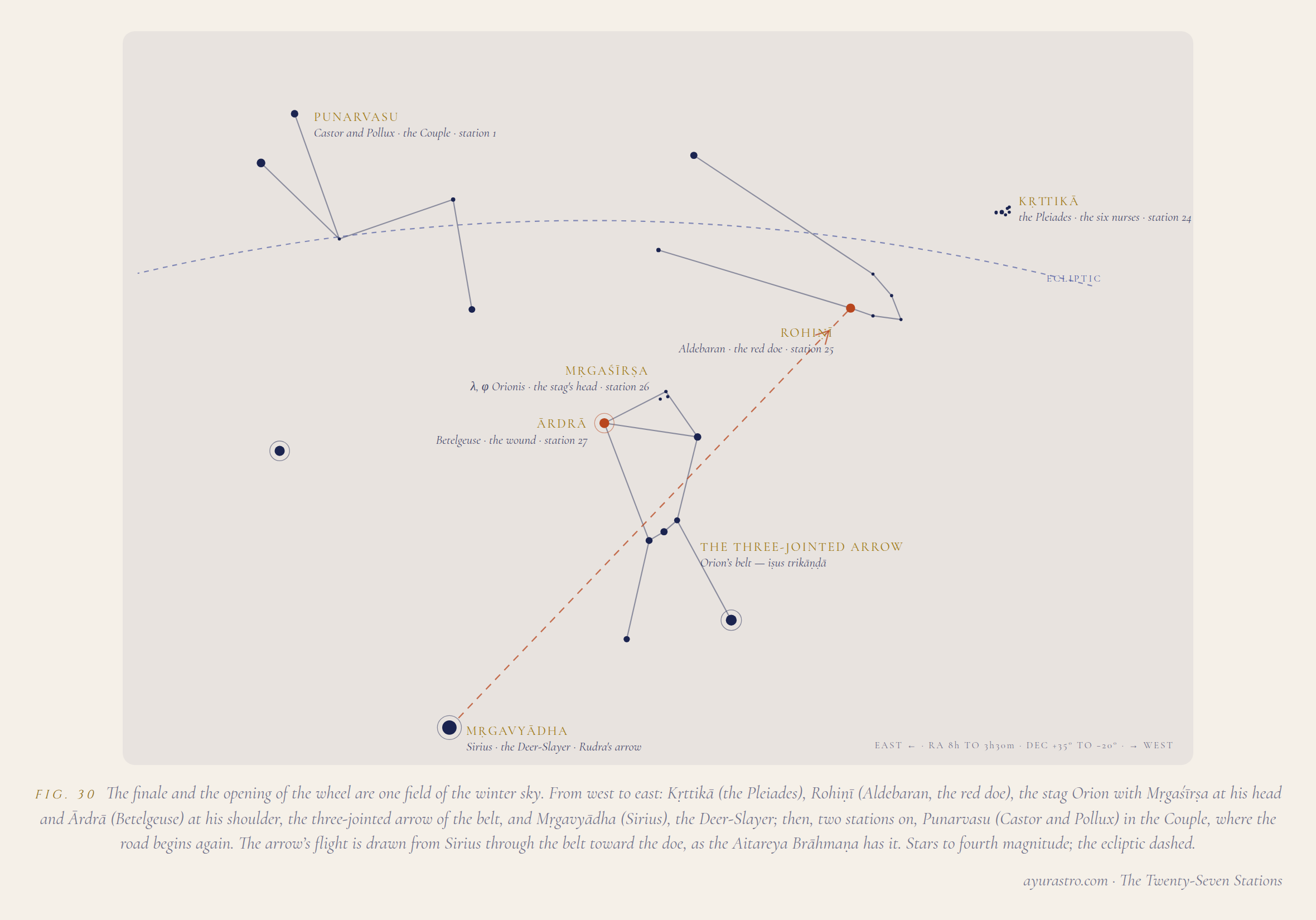
The Aitareya Brāhmaṇa tells it thus. Prajāpati, the Lord of Creatures, desired his own daughter — “the Sky, say some; Uṣas, the Dawn, say others.” He became a stag, ṛśya, and she a red doe, rohit, and he approached her. The gods, seeing it, said, “Prajāpati is doing what is not done,” and looked for one who would punish him; finding none among themselves, they gathered their most dreadful forms into one being, who was therefore called Bhūtavat, the one made of beings — Rudra — and who asked as his price the lordship of cattle. He drew his bow and pierced Prajāpati, who leapt upward and became the constellation called Mṛga, the Deer; the piercer became Mṛgavyādha, the Deer-Slayer; the doe became Rohiṇī; and the arrow became iṣus trikāṇḍā, the three-jointed arrow.[13] Anyone who has stood outside on a winter night knows the picture. The three-jointed arrow is the belt of Orion; the Deer is Orion himself, whose head is Mṛgaśīrṣa; the Deer-Slayer is Sirius, the brightest star in the sky, at his heels; the red doe is Aldebaran, the eye of the Bull, at whom the arrow points — with the Pleiades, Kṛttikā, just beyond her, and Ārdrā, the red star on the stag's shoulder, where the arrow went in. Betelgeuse is the wound.
The Śatapatha Brāhmaṇa tells the same story without the sky and then, in the same breath, tells the rest. After the god who rules the beasts has pierced Prajāpati, the gods take the fore-portion of the sacrifice, the prāśitra, and offer it to Bhaga — and it burns out his eyes. They offer it to Pūṣan, and it knocks out his teeth: “therefore Pūṣan is toothless, and eats gruel.” They offer it to Savitṛ, who alone receives it unharmed — though the Kauṣītaki Brāhmaṇa says it cut off his hands too, and the gods gave him two of gold.[11,12] Four gods maimed at one sacrifice — the blinded, the toothless, the handless, and the pierced — and all four are gods of stations on this wheel: Bhaga of Pūrvā Phalgunī, where the fetus's eyes first darken; Pūṣan of Revatī, where the child that will be born toothless turns to be born; Savitṛ of Hasta, where the hands are made; Prajāpati of Rohiṇī, the doe he pursued. With Rudra of Ārdrā, and the stag of Mṛgaśīrṣa, that is six stations of the twenty-seven bound into one episode.
I do not think the ritualists who assigned gods to stars in the Taittirīya Saṃhitā were thinking of the womb. But they were thinking of this story, because it is the story the sky tells in that quarter, and when the stations are read as a gestation the story reads as a birth: a creator who has finished his creature and grown too fond of it; a red doe, grown, in the Bull's sign, at term; a stag's head that comes down; a hunter made of everyone's most dreadful part — which is not a bad description of labour — whose arrow severs what was joined; and a wound on the shoulder that is a red star called Wet, whose god was named for his cry. The last four stations of the wheel are that finale, and Punarvasu, two stars further east, is where the sky begins the story again.
What the Wheel Is, and Is Not
What it is. A schematic clock. Twenty-seven equal stations of ten days, laid from conception, against the embryology of those days as the standard texts give it.[24,26] The real Moon has nothing to do with it: in a pregnancy the Moon runs through all twenty-seven houses about ten times, and no one's Moon sat in Puṣya for ten days while they implanted. The wheel is a reading of one sequence against another, and its claim is only that the two sequences, so laid, rhyme more often than chance would lead one to expect — and its evidence for that is the labels.
The labels. Every station carries up to three. Text means the correspondence is in the star's own name, god or classical figure, as the Taittirīya lists, the shapes verse and Monier-Williams give them.[1,2,4,5] Order means the embryological event falls inside the station's ten days by the published dates — I did not move a window or a milestone to make one fit, and where a source's age convention matters (Moore counts from fertilization, the obstetric papers from the last period) I have said which is which. Image means the correspondence is mine. Twenty-five of the twenty-seven stations carry an Order label; Svātī and Uttara Bhādrapadā do not, because the events I paired with them — breathing movements, the folding of the cortex — are processes of months that those stations merely sit inside. The reader should assume a friendly hand on the scales even so: I chose, for each station, the events in its window that spoke to the star, not the events that did not, and a station with ten days in it always has something happening. What I can say is that the strongest pairings — Puṣya and the trophoblast, Āśleṣā and the neural tube, Bhaga and the switch of sex, Aryaman and day fifty-six, Hasta and the grasp, Tvaṣṭṛ and the forms, Viśākhā and the trimester gate, Mitra and quickening, Indra and the audible heart, Mūla and the germ-cell peak, the Waters and the sealed skin, Uttarāṣāḍhā and viability, Śravaṇa and the cochlea, Dhaniṣṭhā and the hiccups, Varuṇa and the eyes, Aja Ekapād and the thalamus, Pūṣan and the turning, the Aśvins and the antibodies, Bharaṇī and the peak of the waters, Kṛttikā and the lanugo, Rohiṇī and term, Mṛgaśīrṣa and engagement, Ārdrā and the median birth — are dated to the week by their sources, and the dates are in the bibliography for anyone who wants to move the pointer and check.
The nine-fold count. The three janma stars falling on conception and the two trimester boundaries is real arithmetic. The rest of the navatāra is mixed, and I would rather say so than hide it in the panel. The sādhaka stars — Uttarā Phalgunī, Uttarāṣāḍhā, Kṛttikā — fit well: the completed embryo, viability, and readiness to feed are accomplishments. Two of the three sampat stars fit — Puṣya's nourishment and Anurādhā's first felt movement. Āśleṣā as vipat, danger, fits the neural tube; Bharaṇī as pratyari, the obstacle, fits Yama and the closing room; Aśvinī as kṣema, safety, fits the physicians. But Mūla as kṣema is a flat contradiction — the goddess of dissolution in the station of safety — and the vadha stars, Hasta, Śravaṇa and Rohiṇī, have nothing deathly about them unless one counts the degenerating mesonephros in Hasta or the pierced doe in Rohiṇī, which I do not. Roughly ten of the twenty-seven tārā-names read well against their stations; the trimester boundaries are the finding, and the rest is noted for completeness.[7,8]
Two textual cautions. The deities are the jyotiṣa deities, which differ from the oldest Vedic list at four places: the Taittirīya Saṃhitā gives Citrā and Śatabhiṣaj to Indra and Mūla to the Fathers, and has Aryaman before Bhaga in the two Phalgunīs; Tvaṣṭṛ, Varuṇa and Nirṛti are already in the Taittirīya Brāhmaṇa's Nakṣatreṣṭi, and the Phalgunī reversal is Purāṇic.[1,2,3] Had I used the Vedic list, Citrā would lose Tvaṣṭṛ and the conception hymn, Śatabhiṣaj would lose the thousand-eyed god, and the two beds would swap gods but not events; the reader may weigh those three stations accordingly. And the emblems: the shapes I call classical are from a Sanskrit verse-pair that the muhūrta tradition attributes to the Muhūrtacintāmaṇi of 1600, and that I have not been able to check against an edition of that text; the shapes I call popular — the udder, the lotus, the umbrella, the fan, the fish, the teardrop, the coiled serpent — are modern, from the handbooks practitioners actually use, and I have drawn several of them on the wheel because they are the images the stations now carry.[4,7] Where the two disagree the panel gives both.
What it is not. It is not medicine and it is not a due-date calculator. The date tool below the wheel does arithmetic on the number you give it — conception, or the last period plus fourteen days, or the due date less 266 — and a real pregnancy varies by five weeks around any of those; the wheel will tell you which station a pregnancy is in on its own reckoning and nothing more. Nor is it a claim about the Moon, or about what the makers of the nakṣatra lists knew. It is a way of reading twenty-seven very old names in an order they were not, so far as I know, ever read in before, and finding that the order tells a story the body also tells. The finding is the rhyme; the rest is the pleasure of turning the wheel.
The Ring Closes in Mithuna
The Moon visits every one of its twenty-seven houses every month, and lodges a night in each. A child visits each once, and lodges ten days. Read in the Moon's order from the house of the Couple, the names of the houses make a sequence I did not expect the tradition to have left lying there: a house, a nourisher, a serpent, the fathers' seat, the two ends of a bed, a hand, a pattern, a wind, a gate, a friend, a thunderclap, a root, the waters, the unconquered, hearing, a drum, an eye, a pillar, the deep, a road, the physicians, the bearer, a razor, growth, a deer's head, a cry. I do not think the twenty-seven were ever composed as a poem about how a person is made. But they can be read as one, and the body, which keeps its own order and has kept it since long before anyone named a star, does not object to the reading.
What the reading gave me that I did not have before is the ring. The zodiac has no beginning; the ritualists began the list at the Pleiades and the astrologers at Aśvinī, and both were choices. Beginning at Punarvasu is a choice too, made for the sake of a couple and a boundless mother; but once made it closes itself. Two hundred and seventy days from the first pāda of the two stars in the Couple's sign, the pointer comes round into the last pāda of the wet star in the Couple's sign, and what went in as two-becoming-one comes out as one-becoming-two. Every nakṣatra between is a night the Moon has slept in a thousand thousand times, and a station a child passes once. The wheel is turned; set it, if you like, to a date you know, and watch where it stands.
References & Further Reading
The Nakṣatras in the Texts
- Taittirīya Saṃhitā 4.4.10, the earliest full list of the twenty-seven nakṣatras with their deities (Kṛttikā–Agni, Rohiṇī–Prajāpati, Punarvasū–Aditi, Tiṣya–Bṛhaspati, Āśreṣā–Sarpāḥ, Maghā–Pitaraḥ, Phalgunī–Aryaman and Bhaga, Hasta–Savitṛ, Citrā–Indra, Svātī–Vāyu, Viśākhe–Indrāgnī, Anurādhā–Mitra, Jyeṣṭhā–Indra, Vicṛtau–Pitaraḥ, Āṣāḍhā–Āpaḥ and Viśve Devāḥ, Śroṇā–Viṣṇu, Śraviṣṭhā–Vasavaḥ, Śatabhiṣaj–Indra, Proṣṭhapadā–Aja Ekapād and Ahi Budhnya, Revatī–Pūṣan, Aśvayujau–Aśvinau, Apabharaṇī–Yama). Tr. A. B. Keith, The Veda of the Black Yajus School (1914). sacred-texts.com.
- Taittirīya Brāhmaṇa 3.1.1–2, the Nakṣatreṣṭi mantras, already giving Citrā to Tvaṣṭṛ (tvaṣṭā nakṣatram abhyeti citrām), Śatabhiṣaj to Varuṇa (kṣatrasya rājā varuṇo 'dhirājaḥ) and Mūla to Nirṛti (parācy etu nirṛtiḥ parācā); the prose sūtras of TB 1.5 keep Indra for Citrā and Śatabhiṣaj. Text at amritanilayam.org.
- Nārada Purāṇa 1.56.168–170 — the jyotiṣa deity list (nakṣatreśāḥ kramād dasra-yama-vahni-pitāmahāḥ …) that gives Bhaga to Pūrvā Phalgunī and Aryaman to Uttarā, reversing the Vedic order, and Tvaṣṭṛ, Nirṛti and Varuṇa to Citrā, Mūla and Śatabhiṣaj. Sanskrit at wisdomlib.org.
- The classical shapes (ākṛti) of the nakṣatras — aśvādirūpaṃ turagāsya-yonī kṣuro 'na eṇāsya-maṇir gṛhaṃ ca | pṛṣatka-cakre bhavanaṃ ca mañcaḥ śayyā karo mauktika-vidrumaṃ ca || toraṇaṃ bali-nibhaṃ ca kuṇḍalaṃ siṃhapuccha-gajadanta-mañcakāḥ | tryasri ca tricaraṇābham ardalau vṛtta-mañca-yamalābham ardalāḥ — horse's face, yoni, razor, cart, deer's face, gem, house, arrow, wheel, house, cot, bed, hand, pearl, coral, archway, heap of offerings, earring, lion's tail, elephant's tusk, cot, (triangle for Abhijit), three feet, drum, circle, cot, pair, drum. K. S. Shukla attributes the verses to Rāma Daivajña's Muhūrtacintāmaṇi (1600 CE) 2.59–60; the English list descends from Colebrooke (1807) through Burgess's notes to Sūrya Siddhānta ch. 8 and Monier-Williams's “figured by” glosses. Shukla's table at wisdomlib.org. The popular emblems used beside them here (udder, lotus, umbrella, fan, fish, teardrop, coiled serpent) are modern and are labelled as such.
- Monier-Williams, M. (1899). A Sanskrit-English Dictionary, s.vv. aditi (“not tied, free, boundless”), punarvasu (“restoring goods”), tiṣya, puṣya, puṣpa (“the menstrual flux, Suśr.”), āśleṣā, maghā, hasta, citra, svātī, viśākhā, mūla, śravaṇa, dhaniṣṭhā/śraviṣṭhā, śatabhiṣaj, ajaikapād, ahirbudhnya, revatī, bharaṇī (“figured by the pudendum muliebre”), rohiṇī (“a red cow; figured by a wheeled vehicle”), mṛgaśiras, mṛgavyādha (“the star Sirius”), ārdrā. Searchable at wisdomlib.org.
- Burgess, E. (1860). Translation of the Sūrya-Siddhānta, notes to ch. 8 — the identification of the yogatārās (Punarvasu β Gem, Puṣya δ Cnc, Āśleṣā ε Hya, Maghā Regulus, Citrā Spica, Svātī Arcturus, Jyeṣṭhā Antares, Śravaṇa Altair, Śatabhiṣaj λ Aqr, Revatī ζ Psc, Rohiṇī Aldebaran, Mṛgaśīrṣa λ Ori, Ārdrā Betelgeuse). Reprinted by the American Oriental Society; tables reproduced in K. S. Shukla's introduction cited above.
- Harness, D. M. (1999). The Nakshatras: The Lunar Mansions of Vedic Astrology. Lotus Press; de Fouw, H., & Svoboda, R. (1996). Light on Life: An Introduction to the Astrology of India. Penguin — the popular emblems (udder, lotus, umbrella, fan, fish, teardrop, coiled serpent, sword, two-faced man) and the navatāra reckoning as practitioners use them.
- Oshop, R. Navatāra Chakra (ayurastro.com) — the nine-fold tārābala reckoning (janma, sampat, vipat, kṣema, pratyari, sādhaka, vadha, mitra, atimitra) from any starting nakṣatra, with the Sarvatobhadra and the classical rules; and The Visual Guṇas of the Nakṣatras, the twelve classical layers on one wheel.
The Stories
- Ṛgveda 10.184.1: viṣṇur yoniṃ kalpayatu tvaṣṭā rūpāṇi piṃśatu | ā siñcatu prajāpatir dhātā garbhaṃ dadhātu te — “May Viṣṇu form and mould the womb, may Tvaṣṭar duly shape the forms, Prajāpati infuse the stream, and Dhātar lay the germ for thee” (Griffith). The verse is prescribed in the conception rite at Bṛhadāraṇyaka Upaniṣad 6.4.21. sacred-texts.com.
- Ṛgveda 1.89.10: aditir dyaur aditir antarikṣam aditir mātā sa pitā sa putraḥ — “Aditi is the heaven, Aditi is mid-air, Aditi is the Mother and the Sire and Son” (Griffith). sacred-texts.com.
- Ṛgveda 1.35.9 (hiraṇyapāṇiḥ savitā, “golden-handed Savitar”), 1.35.10 (hiraṇyahastaḥ) and 1.22.5. sacred-texts.com. For the hands: Kauṣītaki Brāhmaṇa 6.13 — the sacrificial portion cut off Savitṛ's hands and the gods gave him two of gold — cited by Eggeling in his note to ŚB 1.7.4.6.
- Śatapatha Brāhmaṇa 1.7.4.1–8, tr. J. Eggeling (1882): Prajāpati desires his daughter, “either the Sky or the Dawn”; the gods bid the god who rules the beasts pierce him; the prāśitra portion burns out Bhaga's eyes and knocks out Pūṣan's teeth, and Savitṛ alone receives it unharmed. wisdomlib.org.
- Aitareya Brāhmaṇa 3.33 (Keith, Rigveda Brahmanas, HOS 25, 1920): Prajāpati approaches his daughter — “the Sky, say some; Uṣas, say others” — as a stag (ṛśya) to a red doe (rohit); the gods make Bhūtavat from their most dreadful forms; he pierces Prajāpati, who becomes the constellation Mṛga; the piercer is Mṛgavyādha, the doe Rohiṇī, the arrow iṣus trikāṇḍā, the three-jointed arrow. Sanskrit at TITUS; Eggeling's summary in his note to ŚB 2.1.2.8.
- Viṣṇu Purāṇa 1.8, tr. H. H. Wilson (1840): a youth “crying with a low cry, and running about” springs from Brahmā; asked why he weeps, he asks for a name; “Rudra be thy name … desist from tears.” Wilson's note gives the Paurāṇic etymology from rud, to weep. sacred-texts.com.
- Mahābhārata, Vana Parva §§ 132–134 (Ganguli): the unborn Aṣṭāvakra tells his father Kahoḍa that his recitation “is not correct,” is cursed to be crooked in eight places, and later defeats Vandin at Janaka's court. sacred-texts.com.
- Mahābhārata, Vana Parva §§ 223–229 (Skanda's birth with six faces; Kṛttikā set in the heavens) and Anuśāsana Parva § 86 (“the six Krittikas … began to rear him with the sustenance of their breasts … he came to be known as Kartikeya”), tr. Ganguli; the six mouths at six breasts in the Kathāsaritsāgara, taraṅga 20 (Tawney). sacred-texts.com.
- Ṛgveda 7.34.10, “Varuṇa, Mighty, with a thousand eyes, beholds the paths wherein these rivers run,” and 7.34.17, “Ne'er may the Dragon of the Deep [Ahi Budhnya] harm us” (Griffith). sacred-texts.com.
- Ṛgveda 6.56.1, Pūṣan the eater of karambha, “mingled curd and meal” (Griffith); the teeth at ŚB 1.7.4.6. sacred-texts.com.
- Ṛgveda 1.116.10, the Aśvins “stripped, as 'twere mail, the skin” from old Cyavāna and made him young; 1.116.15, the iron leg of Viśpalā (Griffith). sacred-texts.com.
- Ṛgveda 10.17.10, āpo asmān mātaraḥ śundhayantu, “May the Waters, the mothers, cleanse us” — the Waters as mothers. sacred-texts.com.
Āyurveda and the Earlier Essays
- Suśruta Saṃhitā, Śārīrasthāna 2–3, tr. K. K. Bhishagratna (1907–16) — ārtava and its synonyms, the month-by-month garbha; the lexicographers' puṣpa for the menses follows this usage.
- Vāgbhaṭa, Aṣṭāṅgahṛdayam, Śārīrasthāna 1, tr. R. Oshop (2026), Vāgbhaṭa's Aṣṭāṅgahṛdayam: A Full English Translation — the months of the womb and the eighth-month ojas; the digestive fire (jāṭharāgni) at Sūtrasthāna 12.
- Oshop, R. The Ten Descents — Daśāvatāra and the Ten Months of the Womb (2026): the coarse clock of ten months, with the Āyurvedic, Purāṇic and Bṛhat Jātaka month-lists this essay does not repeat; and Life Begins, for the method — resonance, not prediction.
Embryology and Obstetrics
- Moore, K. L., Persaud, T. V. N., & Torchia, M. G. (2020). The Developing Human: Clinically Oriented Embryology, 11th ed. Elsevier — the standard account; its fetal-period table (Table 6-1) counts from fertilization: eyelids fused at 9–10 weeks, vernix from 16–20, eyes partly open at 26, open at 28, pupillary reflex at 30, skin pink and smooth at 32, lanugo almost gone at 36; crown–rump lengths and weights used for the wheel's size line.
- Sadler, T. W. (2019). Langman's Medical Embryology, 14th ed. Wolters Kluwer — primordial germ cells in the yolk-sac wall by weeks 3–4, migrating to the gonadal ridges in weeks 5–6; the mesonephros and metanephros.
- O'Rahilly, R., & Müller, F. (2010). “Developmental stages in human embryos: revised and new measurements.” Cells Tissues Organs 192(2), 73–84. doi:10.1159/000289817; and Hill, M. A., UNSW Embryology, Carnegie stage tables (embryology.med.unsw.edu.au) — stage 10 (heart beats, neural folds fuse) at days 22–23, stage 12–13 (limb buds) at days 26–32, stage 23 at day 56.
- Wilcox, A. J., Baird, D. D., & Weinberg, C. R. (1999). “Time of implantation of the conceptus and loss of pregnancy.” New England Journal of Medicine 340(23), 1796–1799. doi:10.1056/NEJM199906103402304 — hCG first detectable 6–12 days after ovulation, most often on days 8–10.
- Jukic, A. M., Baird, D. D., Weinberg, C. R., McConnaughey, D. R., & Wilcox, A. J. (2013). “Length of human pregnancy and contributors to its natural variation.” Human Reproduction 28(10), 2848–2855. doi:10.1093/humrep/det297 — median 268 days from ovulation to birth in 125 naturally conceived pregnancies, with a 37-day spread even after excluding preterm births.
- Pijnenborg, R., & Vercruysse, L. (2013). “A. A. W. Hubrecht and the naming of the trophoblast.” Placenta 34(4), 314–319. doi:10.1016/j.placenta.2013.01.002 — Hubrecht coined trophoblast (Greek trophē, nourishment, + blastos, sprout) in 1889.
- Hanley, N. A., Hagan, D. M., Clement-Jones, M., et al. (2000). “SRY, SOX9, and DAX1 expression patterns during human sex determination and gonadal development.” Mechanisms of Development 91(1–2), 403–407 — SRY expression from about day 41, peaking at day 44 after ovulation.
- Hooker, D. (1952). The Prenatal Origin of Behavior. University of Kansas Press; Humphrey, T. (1964). “Some correlations between the appearance of human fetal reflexes and the development of the nervous system.” Progress in Brain Research 4, 93–135 — finger closure on stimulation of the palm at 10½ menstrual weeks (about 8½ weeks after fertilization).
- Babler, W. J. (1991). “Embryologic development of epidermal ridges and their configurations.” Birth Defects Original Article Series 27(2), 95–112 — primary ridges from about week 10–10½ after fertilization, the pattern fixed by about weeks 16–17.
- de Vries, J. I. P., Visser, G. H. A., & Prechtl, H. F. R. (1982). “The emergence of fetal behaviour. I. Qualitative aspects.” Early Human Development 7(4), 301–322 — first general movements at 7–8, breathing movements and hiccups from about 9–10 postmenstrual weeks.
- Efrat, Z., Akinfenwa, O. O., & Nicolaides, K. H. (1999). “First-trimester determination of fetal gender by ultrasound.” Ultrasound in Obstetrics & Gynecology 13(5), 305–307 — 98.7 % accurate at 12 weeks and 100 % at 13 (menstrual age).
- Csapo, A. I., Pulkkinen, M. O., & Wiest, W. G. (1973). “Effects of luteectomy and progesterone replacement therapy in early pregnant patients.” American Journal of Obstetrics and Gynecology 115(6), 759–765 — the luteal–placental shift at about 7–9 menstrual weeks.
- Tsakiridis, I., et al. (2022). “Fetal movement counting…” Journal of Perinatal Medicine 50(9), 1174–1179, and the StatPearls summary “Fetal Movement” (NCBI Bookshelf NBK470566) — most first-time mothers perceive movement at 18–20 menstrual weeks, mothers of earlier children about a week sooner, the range 14–22.
- Herbert, W. N. P., Bruninghaus, H. M., Barefoot, A. B., & Bright, T. G. (1987). “Clinical aspects of fetal heart auscultation.” Obstetrics & Gynecology 69(4), 574–577 — fetal heart sounds first heard with a fetoscope at a mean of 19.4 menstrual weeks (range 17–22), in 81 % by 20 and virtually all by 21.
- Baker, T. G. (1963). “A quantitative and cytological study of germ cells in human ovaries.” Proceedings of the Royal Society B 158, 417–433. doi:10.1098/rspb.1963.0055 — about 600,000 germ cells at two months, a peak of 6.8 million in the fifth month (the textbooks' “about 20 weeks”), some two million at birth.
- Oppenheim, R. W. (1991). “Cell death during development of the nervous system.” Annual Review of Neuroscience 14, 453–501; Rabinowicz, T., et al. (1996). “Human cortex development: estimates of neuronal numbers indicate major loss late during gestation.” Journal of Neuropathology & Experimental Neurology 55(3), 320–328 — neurons are overproduced and culled; in the small human series the cortical count peaks near 28 weeks.
- Brace, R. A., & Wolf, E. J. (1989). “Normal amniotic fluid volume changes throughout pregnancy.” American Journal of Obstetrics and Gynecology 161(2), 382–388 — a plateau near 780 mL from 22 to 39 weeks, the fitted peak about 930 mL at 34 weeks, declining after 40; Underwood, M. A., Gilbert, W. M., & Sherman, M. P. (2005). “Amniotic fluid: not just fetal urine anymore.” Journal of Perinatology 25(5), 341–348 — fetal urine in the sac from 8–11 weeks, skin keratinized by 22–25, thereafter urine and lung fluid the main sources.
- Bell, E. F., Hintz, S. R., Hansen, N. I., et al. (2022). “Mortality, in-hospital morbidity, care practices, and 2-year outcomes for extremely preterm infants in the US, 2013–2018.” JAMA 327(3), 248–263. doi:10.1001/jama.2021.23580 — survival to discharge among all live births: 10.9 % at 22 weeks, 49.4 % at 23, about 70 % at 24, 94 % at 28.
- Birnholz, J. C., & Benacerraf, B. R. (1983). “The development of human fetal hearing.” Science 222(4623), 516–518 — blink-startle responses to vibroacoustic stimulation first at 24–25 weeks, consistent after 28.
- Hepper, P. G., & Shahidullah, B. S. (1994). “Development of fetal hearing.” Archives of Disease in Childhood 71(2), F81–F87 — first response to 500 Hz at 19 weeks; at 27 weeks 96 % respond to 250 and 500 Hz and none to 1,000 or 3,000; 1,000 Hz in all by 33 weeks, 3,000 Hz by 35.
- Kisilevsky, B. S., Hains, S. M. J., Lee, K., et al. (2003). “Effects of experience on fetal voice recognition.” Psychological Science 14(3), 220–224 — at 38 weeks the heart rate rises to the mother's voice and falls to a stranger's; DeCasper, A. J., & Fifer, W. P. (1980). “Of human bonding: newborns prefer their mothers' voices.” Science 208, 1174–1176.
- Pillai, M., & James, D. (1990). “Hiccups and breathing in human fetuses.” Archives of Disease in Childhood 65, 1072–1075 — hiccups are the predominant diaphragmatic movement before 26 weeks and fall away sharply between 24 and 26, while breathing movements rise from 26 to 32.
- Kostović, I., & Judaš, M. (2010). “The development of the subplate and thalamocortical connections in the human foetal brain.” Acta Paediatrica 99(8), 1119–1127 — thalamocortical afferents, after waiting in the subplate, enter the cortical plate at 24–28 postconceptional weeks.
- Chi, J. G., Dooling, E. C., & Gilles, F. H. (1977). “Gyral development of the human brain.” Annals of Neurology 1(1), 86–93 — 507 brains: primary sulci from 14 to 26 weeks, secondary about 26–32, tertiary from about 36 (menstrual age).
- Hill, L. M. (1990). “Prevalence of breech presentation by gestational age.” American Journal of Perinatology 7(1), 92–93 — 24.4 % breech at 28 weeks, 3.7 % at 37 (n = 4,024, ultrasound); Hickok, D. E., et al. (1992). “The frequency of breech presentation by gestational age at birth.” American Journal of Obstetrics and Gynecology 166(3), 851–852.
- Malek, A., Sager, R., Kuhn, P., Nicolaides, K. H., & Schneider, H. (1996). “Evolution of maternofetal transport of immunoglobulins during human pregnancy.” American Journal of Reproductive Immunology 36(5), 248–255 — fetal IgG 5–10 % of maternal at 17–22 weeks, about 50 % at 28–32; Palmeira, P., et al. (2012). “IgG placental transfer in healthy and pathological pregnancies.” Clinical and Developmental Immunology 2012, 985646 — a sharp rise after 36 weeks; cord IgG typically equals or exceeds the mother's at term.
- Bu'Lock, F., Woolridge, M. W., & Baum, J. D. (1990). “Development of co-ordination of sucking, swallowing and breathing.” Developmental Medicine & Child Neurology 32(8), 669–678; Lau, C. (2015). “Development of suck and swallow mechanisms in infants.” Annals of Nutrition and Metabolism 66(suppl. 5), 7–14 — coordination matures with gestational age across 33–40 weeks; clinically, oral feeding from about 34–36.
- Symonds, M. E., Pope, M., & Budge, H. (2015). “The ontogeny of brown adipose tissue.” Annual Review of Nutrition 35, 295–320 — brown fat first appears around mid-gestation and accumulates in late gestation; Lidell, M. E. (2019). “Brown adipose tissue in human infants.” Handbook of Experimental Pharmacology 251, 107–123 — about 5 % of body mass at birth.
- American College of Obstetricians and Gynecologists (2013). Committee Opinion No. 579, “Definition of term pregnancy.” Obstetrics & Gynecology 122(5), 1139–1140 — early term 37 0/7–38 6/7 weeks, full term 39 0/7–40 6/7, late term 41, post-term 42 and beyond.
- Weekes, A. R., & Flynn, M. J. (1975). “Engagement of the fetal head in primigravidae and its relationship to duration of gestation and time of onset of labour.” British Journal of Obstetrics and Gynaecology 82(1), 7–11 — in 462 first pregnancies the head was engaged by the end of week 37 in only 23 %; engagement peaked at 39–40 weeks, a median of seven days before delivery; the authors conclude that the head does not, as commonly believed, engage at 36–38 weeks in most primigravidae.
- WHO Multicentre Growth Reference Study Group (2006). WHO Child Growth Standards. Acta Paediatrica 95, suppl. 450 — median birth weight 3.35 kg (boys) and 3.23 kg (girls), length about 49–50 cm.
An interactive illustrated essay on the twenty-seven nakṣatras read as the stations of a human gestation, from Punarvasu to Ārdrā, with an instrument for turning them, prepared for readers of the Saṃhitās and Brāhmaṇas, the muhūrta manuals, and the embryology textbooks alike.
Twenty-seven stations · Two hundred and seventy days · One ring
← Back to Writings